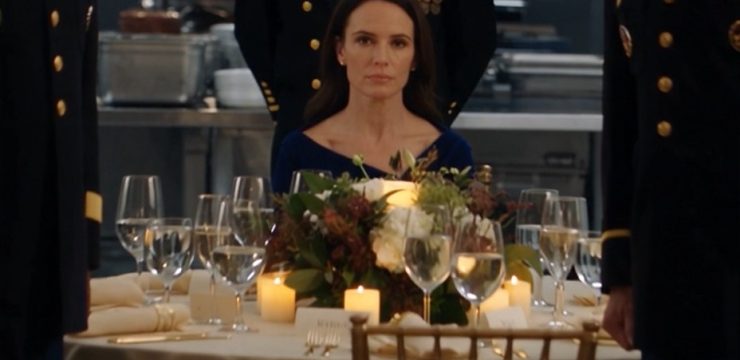
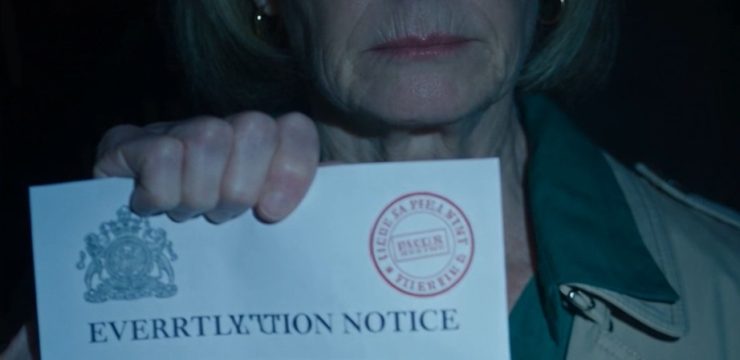
For one long second, nobody moved.
The doorway between the grand ballroom and the kitchen had become the most significant threshold in that entire estate. On one side, crystal chandeliers caught the light of a hundred candles. On the other, running water, stainless steel, and a simple apron still hanging from a young woman’s fingers.

And somehow, the kitchen said everything the ballroom never could.
The older man standing in that doorway looked at the young woman by the sink — and his expression wasn’t shock. It was grief. The deep, quiet grief of someone who had carried a painful truth for years, searching for the right moment, the right proof, the right words to finally say what needed to be said.
Because he had known. Not everything. But enough. For a long, long time.
What unfolded in that moment had its roots planted more than two decades earlier, buried in the kind of family secret that wealthy households keep wrapped in silence and sealed with shame. The Valmonte family’s youngest daughter had given birth quietly, away from public eyes. The child’s father came from the wrong branch of the family’s vast empire — not noble enough by the old matriarch’s standards, not politically useful, not someone whose bloodline would be welcomed at the formal dining table. The decision came swiftly and without mercy. The baby was declared stillborn to the young mother, quietly removed from every official document, stripped of her rightful place in the line of succession, and handed to household staff to be raised within the estate walls.
Close enough to watch over.
Far enough away to erase completely.
And so the true heir grew up polishing the family’s silver. She carried their breakfast trays. She learned which hallways she was permitted to walk down and which grand doors were meant for other people. She lowered her eyes when guests arrived. She wore the uniform. She answered when called and disappeared when dismissed.
She served the house that had stolen everything from her.
The woman standing across the kitchen in a gold sequined gown was not simply shocked at what was unfolding. She was terrified. For years, she had positioned herself and her son as the centerpiece of the Valmonte future. She had dressed herself in borrowed power, sat at the head of tables that were never truly hers, and conducted herself as though the inheritance was already settled. Now, watching an old man place documents on a steel counter, she felt the ground dissolving beneath her expensive shoes.
He reached into his tuxedo pocket and drew out a folded document sealed with the Valmonte family crest. Beside it, he laid down an old infant bracelet, worn thin with age, and a photograph — a newborn wrapped in monogrammed linen, bearing a small but unmistakable birthmark. The same birthmark now visible at the young woman’s collarbone, just above the neckline of her uniform.
A quiet ripple moved through the guests who had followed the tension from the ballroom.
The woman in gold stepped forward, her voice sharp with desperation.
“She’s just a servant.”
It was the worst possible thing she could have said.
Because something shifted in the young woman at that sink. She lifted her head — fully, completely, without apology. No more shrinking. No more making herself small to fit the space she had been assigned. She simply stood there and let them all see her face in the light.
And the room saw it.
The resemblance that had always been there, quietly hiding beneath uniform caps and downcast eyes. The unmistakable features of the Valmonte bloodline, right there in her jaw, her cheekbones, the particular way she held herself when she finally stopped pretending she belonged anywhere less than where she was standing.
The older man kept his hand gently on her shoulder and spoke in a voice that carried the full weight of what had been done.
“She served this house,” he said quietly, “because this house stole her place in it.”
That single sentence broke whatever was left of the illusion.
The crowd was no longer looking at a maid.
They were looking at a daughter. A hidden daughter. A woman who had spent her entire life carrying champagne flutes for people who were living off what should have been her legacy. She had cleaned their floors, pressed their clothes, and smiled graciously while being invisible in her own home.
And she had done it with more dignity than any of them deserved.
The woman in gold, glittering in her sequins and barely holding herself together, understood in that moment what the rest of the room was only just beginning to grasp. All the years of positioning, all the carefully constructed image of entitlement and belonging — none of it had ever been real. It had all been built on top of something that was taken from a child who had no say in the matter.
The girl at the sink had never been beneath them.
She had been above them all along.
And the most devastating part of the whole truth wasn’t the documents or the photograph or even the family crest pressed into old wax. It was the quiet realization settling over every person in that room — that they had all been looking at royalty for years and calling her by the wrong name.
Some things, once seen, cannot be unseen. Some truths, once spoken aloud in a kitchen light, are far more powerful than anything a chandelier could ever illuminate. The Valmonte name would carry a new meaning now. And the woman who had earned it the hardest way imaginable was finally, at long last, standing exactly where she was always meant to be.