The child wasn’t crying.
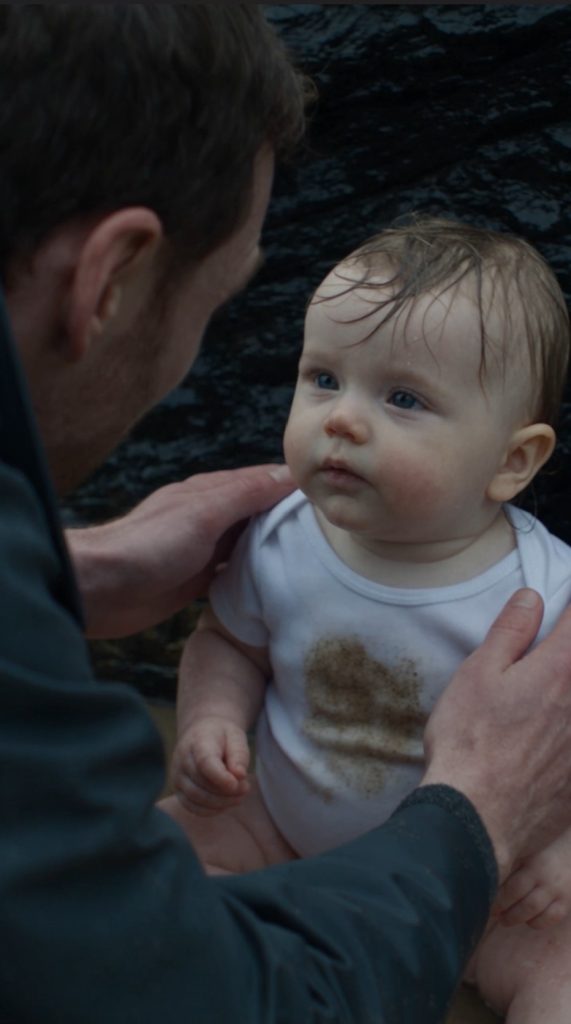
That was what frightened me most.
He sat half-submerged beside a black shoreline rock, soaked to the skin, staring past me at the ocean as though he was waiting for something to come back.
I had been walking toward my fishing boat just after sunrise when I first noticed the small shape near the water. From a distance, I thought someone had abandoned a bundle of clothes.
Then it moved.
I stopped cold.
The boy couldn’t have been more than two years old. Wet hair clung to his forehead, his clothes were heavy with seawater, and the morning wind was cold enough to make my hands ache.
Yet he didn’t shiver.
He didn’t call for anyone.
He simply sat there with wide, exhausted eyes.
My name is Daniel Carter. I’m forty-three, and I’d worked along that stretch of coast for nearly twenty years. I knew the fishermen, the currents, the families who sometimes came down before breakfast.
That morning, there was nobody.
No parents.
No stroller. No bags. No clear footprints leading away across the wet sand.
“Oh my God…”
I hurried toward him, then slowed as I got close, afraid of frightening him.
“Hey, buddy,” I said softly, crouching several feet away. “Where’s your mom?”
Nothing.
His eyes met mine, but his face barely changed.
A chill moved through me that had nothing to do with the wind.
This wasn’t a child who had wandered too far while his parents looked away. There was a strange emptiness in his expression, the kind you see after someone has been terrified for so long that even fear has burned itself out.
I held out my hands.
“It’s okay. I’m going to get you somewhere warm.”
I had just leaned forward to pick him up when his attention suddenly shifted.
His eyes moved over my shoulder.
Toward the sea.
Then I heard it.
A heavy splash.
Something scraped through the shallow water behind me.
I spun around.
A black shape was rolling between the waves.
For half a second, I thought it was fishing equipment. Then another wave shoved it closer, and my stomach tightened.
It was a waterproof bag.
Large.
Long.
Heavy enough to move sluggishly with the surf.
Almost the size of a person.
I looked back at the boy.
He was staring directly at it.
The next wave rolled the bag farther onto the sand. One end had been tightly secured, and near the zipper was a white identification label.
I didn’t touch it.
I called emergency services.
Within fifteen minutes, the beach was crowded with police and coastal rescue officers. A paramedic wrapped the little boy in a thick blanket, but he still wouldn’t speak.
Every time a wave struck the rocks, his eyes drifted back toward the water.
One rescue officer dragged the black bag fully onto the sand.
That was when someone noticed the writing on the label.
It carried the name of a small private boat.
Another officer carefully checked the inside of the boy’s soaked jacket.
A identification tag had been sewn into the lining.
The same boat name was printed there.
Nobody spoke.
For several seconds, all I could hear was the surf.
Then a police radio crackled.
An officer listened, his expression tightening.
A damaged boat with that exact name had just been discovered several miles down the coast.
Empty.
The officer looked at the child.
Then at the bag.
My mind went somewhere I desperately didn’t want it to go.
One of the rescue workers knelt beside the waterproof bag and slowly pulled the zipper open.
I watched his face.
Whatever he saw inside changed him instantly.
He looked for barely a second before closing the bag again.
Then he stood.
His eyes found mine.
“Daniel,” he said quietly, “take the child farther up the beach.”
My stomach dropped.
I looked down at the little boy beside me.
He wasn’t watching the officers.
He wasn’t looking at me.
He was staring at the black bag.
And for the first time, I wondered if his silence wasn’t confusion at all.
Maybe he already knew exactly what had washed ashore.
Nobody on that beach was prepared for what came next. 👇
The boy’s fingers tightened around the edge of the blanket.
Then, so softly I almost thought the wind had made the sound, he whispered one word.
“Mama.”
Every person near us seemed to stop moving.
The rescue worker who had opened the bag lowered his eyes. A police officer stepped between us and the shoreline while another gently guided me farther up the beach with the child pressed against my chest. I could feel his small body trembling now, the first real tremor I had seen in him.
He had known.
Inside the waterproof bag was a woman.
Her identification named her Mara Bennett, thirty-one years old. The boat was registered to her husband, Evan Bennett, and the little boy in my arms was their two-year-old son, Eli.
The name of the boat was North Star.
At the hospital, Eli refused to let go of my jacket.
A nurse tried to coax him toward a bed, but his fist stayed closed around the fabric at my chest. So I sat beside him beneath the fluorescent lights while detectives moved quietly through the corridor.
Almost two hours later, a man came running through the emergency entrance.
He was soaked from the waist down, barefoot, and bleeding from one temple.
“My son,” he gasped. “Where is my son?”
Eli heard the voice before he saw the man.
His entire body went rigid.
The cup in his hands slipped onto the floor.
The man stopped when he saw him. Relief crossed his face so quickly it almost looked convincing.
“Eli.”
He stepped forward.
The child made a sound I will never forget.
Not a cry.
A warning.
He crawled backward across the hospital bed until his shoulders hit the wall, then reached blindly for me.
“Daddy no.”
The corridor went silent.
Evan Bennett stared at his son.
A detective named Ruiz moved between them. “Mr. Bennett, we need to speak with you.”
Evan’s expression changed by a fraction. His mouth remained open, but the panic in his eyes sharpened into calculation.
He told police there had been an accident.
He said Mara had taken the boat during an argument and he had followed in a small tender. He claimed the sea turned rough, the North Star struck something, and he was thrown into the water.
Then Detective Ruiz placed a clear evidence bag on the table.
Inside was a phone.
Mara’s phone.
It had been found sealed inside the inner pocket of her life vest.
Evan stared at it.
Ruiz didn’t raise his voice.
“Your wife recorded the last eleven minutes aboard that boat.”
For the first time, Evan stopped pretending to shiver.
The recording was not played near Eli. I heard only pieces later, when police asked for my formal statement.
Mara’s voice was frightened but steady. She told Evan she was leaving him. She said her sister already knew about the bruises, the threats, the money he had hidden, and the custody papers she planned to file that morning.
Then his voice came through.
Low. Furious.
He told her she would never take his son away.
There was a struggle.
A scream.
And then Mara saying something that broke every person who heard it.
“Eli, baby, close your eyes.”
The recording ended with water, shouting, and the sound of the zipper on the black bag.
Evan tried to leave the interview room.
He never reached the door.
By sunset, investigators had more than the recording. Marina cameras showed him boarding the North Star after Mara and Eli. GPS data placed the boat near the same stretch of coast where Eli had been found. Blood inside the cabin matched Mara’s, and fibers from the waterproof bag were caught beneath Evan’s fingernails.
His story collapsed piece by piece.
But the final piece came from Eli.
Not that night.
Three days later.
A child specialist sat with him on the floor of a quiet room while I waited outside with Mara’s older sister, Claire. Through the glass, I watched Eli stack wooden blocks and knock them down without speaking.
Then he picked up a black toy box.
His hands froze.
He pushed it away.
“Daddy put Mama in black.”
Claire folded forward as though someone had struck her.
I caught her before she hit the floor.
Evan Bennett was charged with Mara’s murder, child abandonment, evidence tampering, and multiple offenses tied to the abuse investigators uncovered afterward.
Months later, he stood in court in a dark suit that no longer made him look powerful.
When the guilty verdict was read, he turned toward Claire.
Maybe he expected hatred.
She gave him nothing.
She simply reached down and took Eli’s hand.
That was the moment his power finally disappeared.
There was no screaming in the courtroom.
No applause.
Only a long, stunned silence, and the small sound of Eli rubbing his thumb across his aunt’s knuckles.
Evan was sentenced to life in prison.
Outside the courthouse, Claire found me standing near the steps.
“You can go home now, Daniel,” she said.
I looked at Eli.
He was holding a little wooden boat I had made for him during the trial.
He looked back at me and frowned.
“Daniel coming.”
Claire laughed, but then covered her mouth because the laugh turned into something else.
So I kept coming.
At first it was Sunday breakfast.
Then trips to the harbor, birthday parties, preschool concerts, and afternoons when Eli sat on an overturned bucket beside my fishing boat asking questions faster than I could answer them.
He never forgot his mother.
Claire made sure of that.
Her photographs stayed where he could reach them. Her name was spoken without fear. And when he asked difficult questions, nobody told him stories meant to make adults more comfortable.
We told him the truth gently.
His mother loved him.
She tried to protect him.
What happened to her was not his fault.
Nearly a year after the morning I found him, Detective Ruiz called me.
There was one piece of evidence the family had finally been cleared to receive from Mara’s phone.
A voice memo.
It had been recorded forty minutes before the final recording.
Claire and I listened together at her kitchen table while Eli slept upstairs.
Mara’s voice filled the room.
She sounded breathless.
“I got him off the boat for a minute,” she whispered. “Evan thinks I’m checking the engine.”
There was wind behind her.
Waves.
Then she said something that made me stop breathing.
“I put Eli by the black rocks near the fishermen’s launch. Someone always comes down there at sunrise. I’ve seen them every morning this week.”
Claire looked at me.
On the recording, Mara began to cry quietly.
“If I can’t get back to him, somebody will find him.”
My hands started shaking.
That little boy had not simply washed into my life.
His mother had chosen that place.
She had studied the shoreline. Watched the boats. Learned the rhythm of strangers who woke before dawn and went to sea.
And when she had only seconds to decide where her child might survive, she had trusted that someone would come.
Someone did.
Claire reached across the table and covered my hand with hers.
“She saved him,” she whispered.
I nodded, but it took a long time before I could speak.
“No,” I finally said. “She gave him a chance.”
The following morning, we took Eli back to the beach.
The sky was clear, the tide gentle.
For a while he stood several yards from the water holding my hand on one side and Claire’s on the other.
Then he let go.
He walked toward the black rocks.
Claire tensed, but I touched her shoulder.
Eli crouched near the place where I had first seen him and set the little wooden boat on the wet sand.
On its side, I had painted one name.
Mara.
A small wave came in, lifted it, and carried it a few feet before setting it gently back down.
Eli smiled.
Not because he had forgotten.
Because he was no longer afraid to remember.
He ran back toward us, sand flying behind his shoes, and Claire dropped to her knees to catch him.
I stood beside them while the morning sun spread across the water.
Then Eli reached one arm toward me.
I bent down, and he pulled me into the hug.
For nearly twenty years, I had thought of that coast as a place where I worked.
After that morning, it became something else.
A place where a mother had made one impossible choice.
A place where a child had survived it.
A place where three people who had lost something found one another anyway.
Behind us, the black rocks were still dark against the sea.
But Eli was laughing now.
And for the first time since the morning I found him there, the sound of the waves was only the sound of water.