The four-star general stopped inches from me, stared at the sealed envelope in my hand, and went pale.
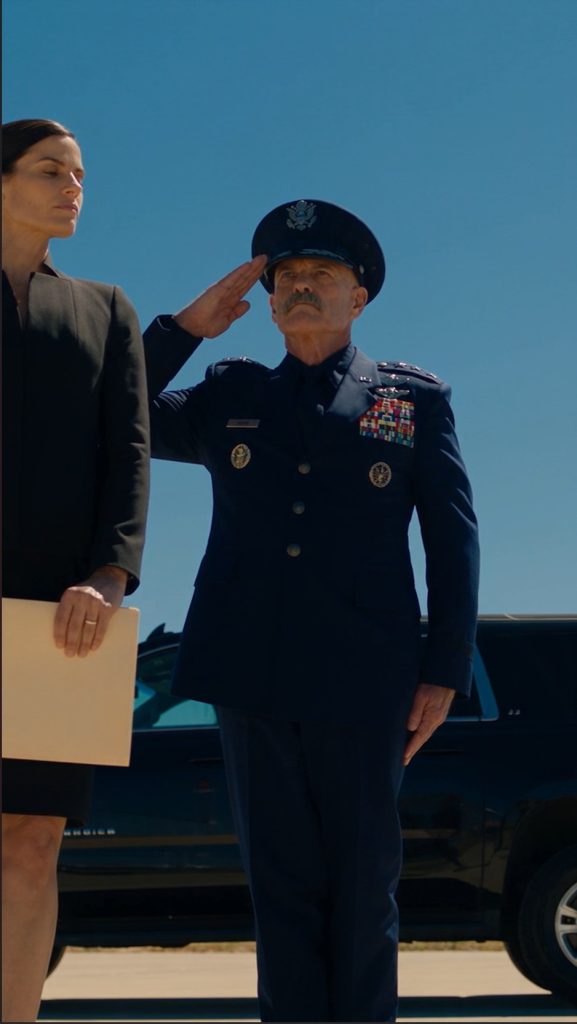
Then, in front of hundreds of soldiers and families, he raised his hand in a formal combat salute.
My father-in-law’s face lost every trace of color.
Only minutes earlier, military police had been ordered to remove me from the base.
The final notes of the national anthem were still drifting across the parade field when the MPs started toward me. July heat rippled above the asphalt, and somewhere behind the rows of folding chairs, a child’s tiny American flag snapped sharply in the dry Texas wind.
Hundreds of people were watching.
Most were pretending they weren’t.
At the center of it all stood Brigadier General Richard Calloway, my father-in-law, one rigid finger pointed directly at me.
“Escort this woman off my base. Now.”
At Fort Lincoln, an order delivered with that rank did not need repeating.
I stood in a simple navy-blue dress, holding a sealed envelope between my fingers.
Twenty feet away, my husband, Captain Ethan Calloway, remained perfectly still in his dress uniform.
His jaw tightened.
He did not come toward me.
His mother lowered her eyes to the ceremony program in her lap. Ethan’s younger sister took a slow sip of champagne, barely hiding a smile.
Richard made sure the officers near the reviewing stand heard every word.
“She has no clearance. She is not welcome on this base. And she is no longer part of this family.”
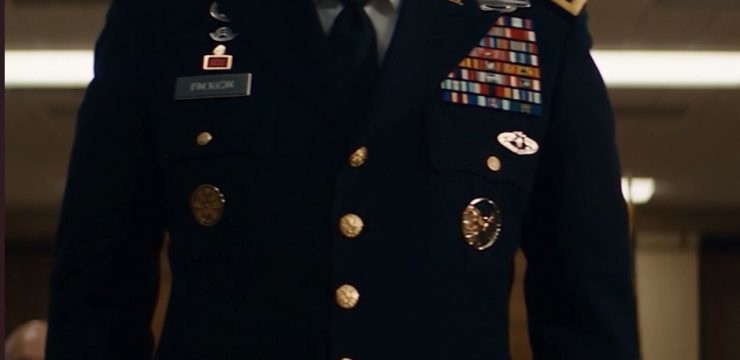
The first MP approaching me looked barely twenty-five. PARKER was stitched above his chest pocket.
Uncertainty flickered across his face.
I knew that look.
It was the moment a soldier realized an order felt wrong—but also knew the man giving it had enough rank to destroy a career.
So I spared him the decision.
“Sergeant,” I said quietly, “I’ll leave if you ask me to. But I would not put your hands on me today.”
His expression changed.
Not fear.
Recognition.
There are voices people in uniform remember.
Not loud voices.
Controlled ones.
The kind shaped in places where panic costs lives and hesitation can get someone killed.
Richard heard it too.
He simply chose not to understand it.
He turned toward the crowd with a dismissive laugh.
“Listen to her. Six years of this foolishness. She marries my son, and suddenly she thinks she belongs in military matters.”
People shifted in their seats.
Nobody laughed.
“She was working as a waitress before Ethan saved her,” Richard continued. “Now she walks around pretending she matters.”
I said nothing.
My silence had always infuriated him more than any argument.
For six years, he had never asked where I disappeared to during those long overseas consulting assignments.
He never wondered why officials in Washington returned my calls.
He never noticed why I always chose the seat facing an entrance.
Or why some nights I woke with my hands reaching instinctively for a weapon that was no longer there.
To Richard Calloway, I was only Claire Bennett Calloway.
The unwanted wife.
The mistake his son should have corrected years ago.
The envelope in my hand was dated 07/04.
Command stamp.
Blue-ink signature.
And the name at the bottom belonged to a man Richard had spent his entire career trying to impress.
I had never intended to open it publicly.
I had not come to humiliate anyone.
But some families mistake silence for weakness.
They never realize restraint may be the final kindness someone gives them before the truth arrives.
Then black SUVs appeared beside the reviewing stand.
Four small flags fluttered from the hood of the lead vehicle.
Four stars.
My heartbeat slowed.
The band faltered.
A single brass note hung awkwardly in the scorching air before dying away.
Officers straightened almost instinctively.
Richard turned toward the convoy, annoyance crossing his face for half a second before the polished smile returned.
The rear passenger door opened.
General Thomas Shepard stepped out.
Four-star command authority.
Richard immediately moved forward to greet him.
Shepard barely seemed to notice.
His eyes swept across the field.
Past the officers.
Past Ethan, now visibly pale.
Then they found me.
He stopped.
The change in his face was so sudden that even the crowd seemed to sense it.
His hand lowered slowly.
For one impossible second, nobody moved.
Then General Shepard walked straight past Richard.
The MPs stepped aside.
Ethan’s lips parted.
Richard’s smile began to fracture.
Shepard stopped inches from me and looked down at the sealed envelope.
Then back into my eyes.
“No,” he whispered.
But he wasn’t speaking to me.
He was speaking as though he had just seen a ghost.
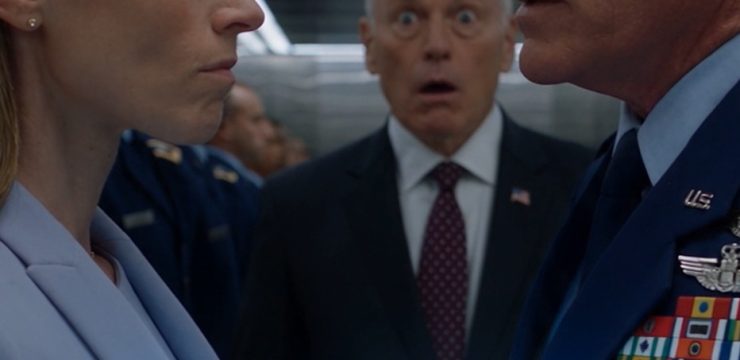
And then, before hundreds of witnesses, the four-star general snapped into a formal combat salute.
Richard went white.
The entire parade field fell silent as Shepard drew a breath and began to speak.
Nobody there was prepared for the words that came next. 👇
“Reaper Two,” General Shepard said.
The words were quiet, but they traveled farther than a shout.
Richard stared at him. “Sir?”
Shepard never looked away from me. “Former Major Claire Bennett. Joint recovery element, special access program. Call sign Reaper Two. Her service record is sealed at national-command level for a reason.”
A sound moved through the crowd—not conversation, not yet. Just hundreds of people breathing again all at once.
Richard gave a short, disbelieving laugh. “That’s impossible. She was a waitress.”
“I was a waitress,” I said. “I was also a soldier.”
He looked at me as if I had struck him.
Ethan finally moved. One step. Then another.
Richard pointed at the envelope. “Whatever this is, she lied to this family for six years.”
“No,” Shepard said. “She honored a security oath for six years. There is a difference.”
Richard’s wife covered her mouth. His daughter lowered her champagne glass.
I held out the envelope. “I came to give you this privately.”
Richard did not take it.
So I placed it in Shepard’s hand.
He broke the seal.
“Three months ago,” Shepard said after reading the first page, “Brigadier General Calloway used command security channels to place an adverse access notation against Claire Bennett Calloway. He did so without an investigation and after being informed that her restricted file was protected by higher authority.”
Richard’s mouth opened.
“The system logs every search, every alteration, every signature.”
The heat seemed to vanish from the parade field.
Richard looked toward Ethan.
My husband reached inside his dress coat and removed a folded document.
“I submitted the audit request,” he said.
For the first time that day, Richard looked frightened.
“You did what?”
“I found the notation on Claire’s visitor record. I knew she hadn’t done anything to earn it.”
“I am your father.”
Ethan swallowed. “That stopped being an answer a long time ago.”
The flag rope struck the pole behind the reviewing stand with a hollow metallic tap.
Richard turned back to Shepard. “Sir, this is a family dispute being inflated into—”
“No. The moment you used command authority to punish a member of your family, it stopped being a family dispute.”
Two senior officers stepped forward from the second SUV.
Richard saw them.
And understood.
Shepard folded the document. “Brigadier General Richard Calloway, effective immediately, you are relieved of command pending final action on the Inspector General findings. Surrender your command credentials and accompany these officers.”
No one moved.
Then Sergeant Parker quietly stepped aside and opened a path.
Richard looked at his wife. She could not meet his eyes.
He looked at his daughter. Her smile was gone.
Finally, he looked at Ethan.
“Son.”
One word.
Not an apology. A command disguised as blood.
Ethan came to stand beside me.
“No,” he said.
That was the moment Richard’s power ended.
He removed his credentials with stiff fingers and placed them into an officer’s hand. No one clapped. No one cheered.
That silence was worse.
When the SUV door closed behind him, the entire parade field seemed to exhale.
Only then did I notice my hand shaking.
Shepard saw it. “You never had to prove anything to these people, Claire.”
“I know.”
My voice broke anyway.
Ethan turned toward me, then stopped before reaching for my hand.
“I’m sorry.”
“There are a lot of things you could mean by that.”
“For every dinner where I let him talk over you. Every joke I pretended not to hear. Every time I called silence ‘keeping the peace.’” His throat tightened. “And for standing twenty feet away today.”
I held his gaze. “You reported him.”
“Yes.”
“You still stood there.”
“Yes.”
No defense.
That mattered.
“General Shepard’s office told me not to interfere if Dad made another public use of command authority. They needed witnesses. Parker had been briefed not to touch you unless there was an actual threat.”
I turned toward Parker.
He gave the smallest nod.
Suddenly I understood the recognition in his eyes.
Ethan had made sure I would not be hurt.
But he had still let me stand alone.
“I should have crossed the field anyway,” he said. “Evidence or no evidence. Career or no career. I should have been your husband first.”
My eyes burned.
“Yes,” I whispered. “You should have.”
He nodded and did not ask me to forgive him.
That evening, after the reviewing stands emptied and the heat began lifting from the concrete, Ethan’s mother found me beneath the grandstand.
She held the ceremony program folded into a narrow strip.
“I looked down because I was ashamed of Richard,” she said. Her fingers tightened around the paper. “But I was also afraid of him. I let that fear become your loneliness.”
I took a slow breath.
“I can understand why you were afraid without pretending it didn’t hurt me.”
Tears gathered in her eyes. “That’s fair.”
His sister came later.
No champagne glass. No smile.
“I thought if I laughed with him, he’d never turn it on me.”
“Did it work?”
Her mouth trembled.
“No.”
Months passed before the investigations ended.
Richard was permanently removed from command and retired under an adverse finding for abuse of authority and misuse of protected security systems. The family name he had worn like armor no longer opened doors the way it once had.
Ethan stayed in uniform, but requested reassignment out of his father’s old chain and began counseling before I asked him to.
Some nights we talked until two in the morning.
Some nights I could not bear to talk at all.
He learned the difference.
Then, one cold December morning, he placed a small black box on our kitchen table.
I stared at it. “We’re already married.”
“I know.”
Inside was not a ring.
It was a folded copy of the email he had sent to the Inspector General eleven days before the ceremony.
Attached to it was his transfer request.
The date made me sit down.
He had filed both before I ever told him I planned to attend.
“I thought you reported him because of what happened that day.”
“No,” Ethan said. “I reported him because I finally understood what had been happening for years.”
He sat across from me.
“I knew I might lose my promotion. I knew he might never speak to me again.” His voice dropped. “I just didn’t know whether I would lose you before you learned I had finally chosen.”
For months, I had remembered him standing twenty feet away as the clearest image of our marriage.
Now there was another image behind it.
Ethan alone at a desk eleven days earlier, choosing a truth that could cost him his father and his career.
It did not erase what happened.
But it changed what the silence meant.
I reached across the table.
Not for the paper.
For his hand.
The following July, I returned to the same parade field.
Not in a navy dress.
Not carrying a sealed envelope.
I wore a civilian suit and an identification badge bearing my own name.
Claire Bennett Calloway.
General Shepard had asked me to direct a new recovery and resilience program for service members returning from classified assignments—the kind of people who came home carrying stories they were not allowed to tell.
For years, silence had isolated me.
Now I would help others survive it.
Parker stood near the reviewing stand, newly promoted, and gave me a grin as I passed.
Ethan’s mother sat in the front row.
His sister sat beside her.
Neither looked down.
Ethan waited at the edge of the field in ordinary duty uniform. He did not step forward to claim the moment.
He simply waited.
When the ceremony ended, I walked to him.
The evening sun had turned the administration windows gold. Behind us, chairs scraped softly against concrete while families gathered children and folded flags.
Ethan held out his hand.
I looked at it for a moment.
Then I slipped my fingers through his.
No salutes.
No ranks.
No sealed records.
Just his hand around mine, warm and steady, as we walked away from the parade field together.
For the first time in years, I did not check the nearest exit.
I was already home.