The sound of tearing paper cut through the house like something breaking that could never be repaired.
From the hallway came a scream—raw, terrified, desperate.
“Stop! That’s my scholarship!”
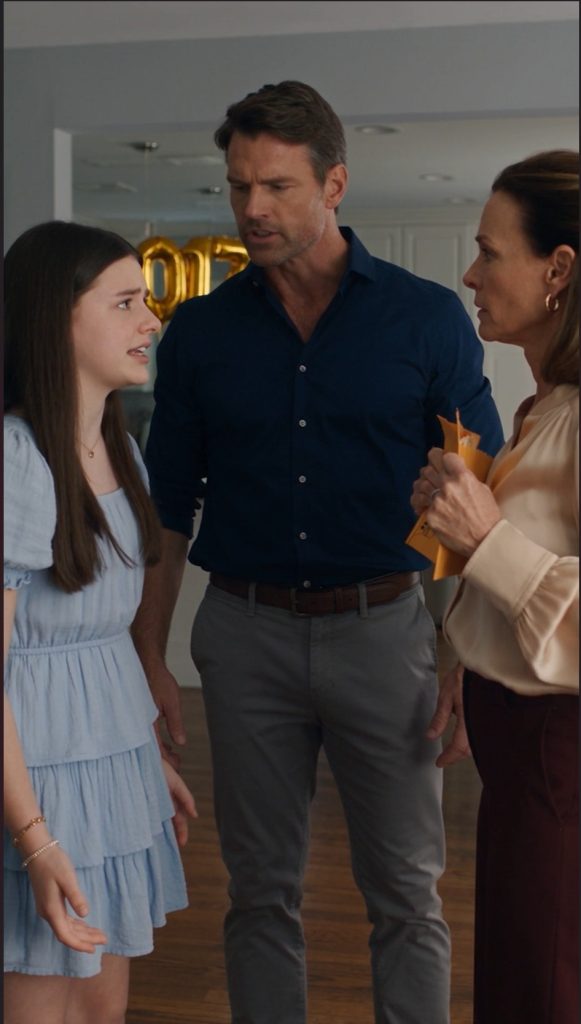
A young girl in a blue dress burst into the living room so fast she nearly slipped on the polished floor. Her face had gone pale, her eyes fixed on the thick envelope trembling between her mother’s hands.
One corner had already been ripped open.
She lunged forward.
“Mom, please!”
Her mother pulled the envelope away before she could reach it. There was no panic in her expression. No guilt. Just a strange, unsettling calm.
“They’re only copies,” she said.
The girl froze.
For half a second, the room went completely silent.
Then footsteps thundered from the other side of the house.
Her father appeared in the doorway, his expression tightening as he took in the scene—the torn envelope, his daughter shaking, his wife standing beside the table with pieces of paper in her hands.
“What is going on?”
His daughter turned toward him as if he were the only person left who could save her.
“She’s destroying my college papers.”
Her voice cracked.
“My scholarship papers.”
The father’s eyes immediately moved to his wife.
“Why would you tear those up?”
The mother placed the damaged envelope on the table with deliberate care.
“I told you. They’re copies.”
“That doesn’t answer the question.”
A flicker passed across her face, but her voice remained controlled.
“There’s nothing important in there anymore. The college already has her decision.”
The girl stared at her.
“What decision?”
Her mother hesitated just long enough for everyone to notice.
Then she said, “They recorded your formal declination.”
The words landed heavily.
Her daughter stopped breathing for a moment.
Her father looked from one of them to the other.
“You declined the scholarship?”
“No.”
The answer came instantly.
Then louder.
“No!”
Tears filled the girl’s eyes as she shook her head violently.
“I never declined anything. Why would I do that? It was a full scholarship.”
Her hands were trembling now.
She had worked for years for that letter. Late nights at the kitchen table. Weekends sacrificed to studying. Every grade, every application, every anxious day waiting for an answer had led to that envelope.
And now her mother was telling her she had willingly thrown it away.
“I never signed anything,” she whispered.
Her father’s face changed.
“What do you mean?”
“I mean I didn’t refuse it.”
She wiped at her cheeks, but more tears followed.
“I would never give that up.”
Her mother’s jaw tightened.
The girl looked directly at her.
And something in her expression shifted from confusion to fear.
“If the school has a signed form…”
Her voice faltered.
“…then somebody else signed it.”
The silence that followed felt different.
Heavier.
Her father slowly turned toward his wife.
She didn’t move.
Didn’t defend herself.
Didn’t ask what their daughter was talking about.
Then a violent knock struck the front door.
Once.
Twice.
Three times.
Everyone looked toward the hallway.
The father walked to the door while his daughter remained frozen beside the table, staring at the torn scholarship envelope like it contained the remains of the future she had been promised.
He opened the door.
A school administrator stood on the porch.
There was a folder tucked beneath one arm and a single document in his hand.
“I’m sorry to come without calling,” the administrator said quietly. “But there appears to be a serious issue concerning your daughter’s scholarship.”
The father’s stomach tightened.
“What issue?”
The administrator held out the paper.
“This is the refusal form we received.”
The father took it.
His eyes moved down the page.
His daughter stepped closer.
“That’s not my signature.”
Nobody spoke.
The father stared at the name written across the bottom of the document, then slowly raised his eyes toward his wife.
Something cold entered his expression.
Something had finally made sense.
His wife stood perfectly still.
He walked back into the living room, the signed refusal form clenched in his hand.
Then he stopped directly in front of her.
His voice was barely above a whisper.
“Did you do this?”
And nobody in that room was prepared for what came next. 👇
The mother’s fingers loosened around the torn envelope.
A strip of paper slipped from her hand and floated to the floor.
She looked at her daughter first, then at her husband, but when her eyes reached the administrator standing in the doorway, something in her face finally gave way.
“I was trying to protect her.”
The girl recoiled as though the words had struck her.
“Protect me from what?”
Her mother pressed her lips together.
Her father unfolded the refusal form completely and laid it on the table between them.
“Answer the question.”
The mother’s breathing became shallow.
“You don’t understand what happens when a child leaves,” she said. “She goes away, she builds another life, and suddenly this place is somewhere she visits twice a year.”
Her daughter stared at her.
“That’s why?”
“No.”
The mother’s answer came too quickly.
Then her eyes dropped.
“No. That’s not all of it.”
The administrator stepped inside and quietly closed the front door behind him. Rain had begun tapping against the porch roof, soft at first, then steadier, filling the silence between every breath in the room.
He opened the folder beneath his arm.
“We contacted the house because the refusal raised concerns.”
The mother’s head snapped toward him.
“What concerns?”
“The signature.”
He placed another sheet beside the first.
“The admissions office compared it with the signatures on her original application and scholarship agreement. They didn’t match.”
The girl leaned over the table.
Her own handwriting appeared on one page. The refusal signature sat beside it on the other.
The difference was unmistakable.
Her father looked at his wife again.
This time there was no confusion left in his face.
“Tell her.”
The mother closed her eyes.
“I signed it.”
Her daughter made a tiny sound, almost too quiet to hear.
Her knees seemed to weaken, and she reached for the back of a chair.
“You forged my name?”
“I thought—”
“You signed my name?”
The mother’s voice cracked.
“Yes.”
The girl stared at her as tears gathered again, but this time she didn’t wipe them away.
“All those nights I was studying…”
Her mother flinched.
“All those applications you watched me fill out. You helped me choose what I was going to wear if I got an interview.”
“I know.”
“You hugged me when the scholarship letter came.”
“I know.”
“Then you waited until I trusted you enough to stop checking.”
Her mother looked away.
That movement hurt more than any answer could have.
The father placed both palms against the table, steadying himself.
“How long were you planning this?”
The mother’s shoulders sank.
“Since she got accepted.”
His voice dropped.
“You let us celebrate.”
“I couldn’t lose her.”
The girl’s face hardened through the tears.
“So you decided I should lose everything instead?”
Her mother shook her head desperately.
“No. I thought she could attend somewhere nearby. We could pay what we could. She could stay here.”
“We can’t afford another college,” the father said.
“I would have figured something out.”
“No,” he said. “She figured something out. She earned this.”
The room went still.
For the first time, the mother looked small—not powerless, but exposed. The calm she had worn like armor had disappeared.
The administrator cleared his throat gently.
“There’s something else you need to know.”
Everyone turned.
He slid a printed email from the folder.
“The refusal form wasn’t the only communication we received. Someone contacted our office twice from an email address identifying herself as the student’s mother. The messages asked us not to contact the student directly because she was supposedly struggling emotionally with the decision.”
The father read the first page.
His jaw tightened.
The mother didn’t deny it.
The girl sank slowly into the chair.
“You made them think I couldn’t even speak for myself.”
Her mother stepped toward her.
“I was scared.”
“Don’t.”
The girl lifted one hand.
It was trembling violently.
“Please don’t come closer.”
Her mother stopped.
The distance between them was less than six feet, but it suddenly seemed enormous.
“I gave up everything when I was your age,” the mother whispered. “I had an opportunity too. I didn’t take it. My mother got sick. Then life happened. And every time you talked about leaving, every time you said how far away the campus was, I kept thinking…”
She swallowed.
“I kept thinking you would get the life I never had, and I would be left here wondering why I wasn’t enough to make you stay.”
The girl’s expression changed.
Not into forgiveness.
Into disbelief.
“So this wasn’t about protecting me.”
Her mother said nothing.
“It was about punishing me for getting to leave.”
The words hung in the room.
Her mother covered her mouth.
Her father straightened slowly.
“That’s enough.”
She looked at him.
“What?”
“You forged our daughter’s signature. You lied to the school. You destroyed her documents. And you stood here while she thought she had somehow lost the future she earned.”
His voice never rose.
That frightened her more than shouting would have.
“I need you to pack a bag.”
Her face went white.
“You’re throwing me out?”
“I’m getting her somewhere safe from the person who just proved she’ll destroy her own child’s future to keep control of her.”
“I am her mother.”
“And tonight you used that trust against her.”
The mother’s eyes filled.
She looked toward her daughter, searching for something—permission, mercy, perhaps even rescue.
The girl lowered her gaze.
“I love you,” she whispered. “But I don’t feel safe trusting you.”
The mother’s face crumpled.
No one moved to soften the sentence.
The administrator waited until the silence settled before speaking.
“The university will formally invalidate the refusal. We’re documenting the forged signature and the emails, and the matter will be referred through the appropriate process.”
The mother gripped the edge of the table.
“Will she lose the scholarship?”
The administrator looked at the girl.
“No.”
She blinked.
“What?”
“That’s actually why I came in person.”
He reached back into the folder.
For one terrible second, the girl seemed afraid to look.
Then he placed a fresh envelope on the table.
Unopened.
Untorn.
“Your refusal was never finalized.”
Nobody breathed.
“One of our admissions officers noticed the signature discrepancy before the scholarship was released to the next student. She flagged the file and stopped the process.”
The girl stared at him.
“So…”
“Your full scholarship is still yours.”
Her hand flew to her mouth.
Her father sat down as though his legs had simply stopped working.
The girl looked at the new envelope.
Then at the torn pieces scattered beside it.
For several seconds, she did nothing.
Finally she reached forward and touched the edge of the envelope with one fingertip.
“You saved it?”
The administrator smiled faintly.
“No. You did.”
She looked confused.
“The admissions officer remembered something from your application essay,” he said. “You wrote that earning an education meant having the freedom to choose your own future. She said it made no sense that someone who had fought that hard would surrender a full scholarship through a form and refuse every follow-up call.”
The girl’s eyes filled again.
But these tears came differently.
Slowly.
Quietly.
Her father reached for her hand.
She let him take it.
Across the room, her mother began to cry.
Not loudly. Not theatrically.
She simply stood beside the fragments of the letter she had tried to destroy and watched her daughter hold the future she had nearly stolen.
There was nothing left for her to control.
That was the moment her power broke.
She packed a small suitcase before midnight.
The father did not argue when she paused at the front door.
The daughter stood halfway down the hallway in the same blue dress, her arms wrapped around herself.
Her mother looked at her for a long time.
“I don’t expect you to forgive me.”
The girl swallowed.
“I don’t know if I can.”
Her mother nodded once.
“That’s fair.”
Then she stepped into the rain.
The door closed softly behind her.
No one celebrated.
That surprised the girl most.
She had imagined justice might feel like triumph. Instead, the house felt exhausted, as though every room had been holding its breath and had only just remembered how to exhale.
Her father found her later at the kitchen table.
The scholarship envelope lay unopened in front of her.
“You haven’t looked?”
“I’m afraid.”
“Of what?”
She traced the corner with her thumb.
“That if I open it, something else will happen.”
Her father pulled out the chair beside her.
He did not tell her everything was fine.
He did not promise nothing bad would ever happen again.
He simply sat there.
After a while, he said, “Then we open it together.”
She nodded.
His hand rested beside hers, not touching until she moved her fingers across the small space between them.
Then they opened it.
The scholarship was real.
Tuition.
Housing.
Books.
The details blurred when she started crying.
Her father read the letter aloud because she could no longer see through her tears.
Weeks passed.
The investigation confirmed what had happened, and the university permanently corrected the record. The forged refusal remained documented, impossible to hide or explain away.
Her mother moved out.
The marriage did not survive what she had done.
There were apologies later—some in letters, some through conversations that ended in long silences. The girl did not offer instant forgiveness, and nobody asked her to.
She learned that love and access were not the same thing.
She could love her mother and still require distance.
She could remember good years without pretending the terrible night had never happened.
And her mother, finally unable to blame anyone else, began living with the consequences of the choice she had made.
Near the end of summer, the administrator called again.
The girl nearly dropped her phone when she saw the university number.
Her father noticed immediately.
“What is it?”
She answered on speaker.
The administrator’s voice came through warmly.
“There’s one last detail about your scholarship we thought you should know before orientation.”
Her father’s eyebrows lifted.
The girl gripped the phone.
“What detail?”
“The admissions officer who stopped your refusal from being processed asked to remain anonymous at first.”
The girl waited.
“She changed her mind.”
A name followed.
The girl went completely still.
She recognized it.
Months earlier, during her scholarship interview, a quiet woman on the panel had stayed behind after everyone else left. The girl had been nervous, embarrassed by how badly her hands shook.
The woman had walked her to the elevator.
Just before the doors closed, she had said, “Never let anyone make you feel guilty for becoming who you worked to become.”
The girl had almost forgotten.
Almost.
That woman had been the admissions officer who recognized that the refusal made no sense.
The girl sat down slowly.
“She remembered me?”
“She remembered you.”
Her father looked away and wiped at his eyes.
The girl laughed through her tears.
All this time, she had believed her future survived because someone happened to notice a mismatched signature.
It hadn’t been luck alone.
Someone had listened to her before she even knew she would need to be heard.
On move-in morning, sunlight spilled across the campus lawns.
Her father carried two boxes at once despite her telling him not to.
“You’re going to throw your back out.”
“I’m your father. Embarrassing physical overconfidence is part of the job.”
She laughed.
It came easily now.
Inside the dorm room, they made the bed badly, rearranged the desk three times, and argued over where to put the lamp.
Then there was nothing left to unpack.
Her father stood by the door.
Neither of them seemed ready for that part.
“You okay?” he asked.
She looked around the little room.
At the books.
At the new sheets.
At the scholarship letter she had framed and placed quietly on the desk.
Then she looked at him.
“I think I am.”
He nodded, but his eyes shone.
She crossed the room and hugged him.
Not because she was afraid to let go.
Because now she knew she could.
When they separated, he kissed the top of her head.
“Call me when you want to.”
“I will.”
“And when you don’t want to.”
She smiled.
“I know.”
He reached the hallway before she called after him.
“Dad?”
He turned.
“Thank you for believing me.”
His face tightened.
“I’m sorry there was ever a second when you had to wonder if I would.”
Then he left.
The girl stood in the doorway watching until he disappeared around the corner.
A warm breeze moved through the open window behind her, lifting the edge of the scholarship letter inside its frame.
She walked back to the desk and placed one hand gently over the glass.
Months earlier, someone had tried to decide her future for her.
Now the room was quiet.
The door was open.
And for the first time in her life, every step beyond it belonged completely to her.