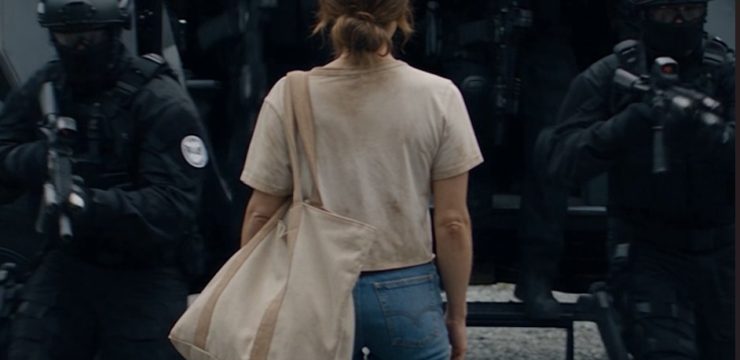
The words caught in Helen’s throat. She looked at Tasha’s face—the hard jaw, the guarded eyes—and saw, for one impossible instant, the little girl who used to hide beneath a kitchen table when the shouting began.
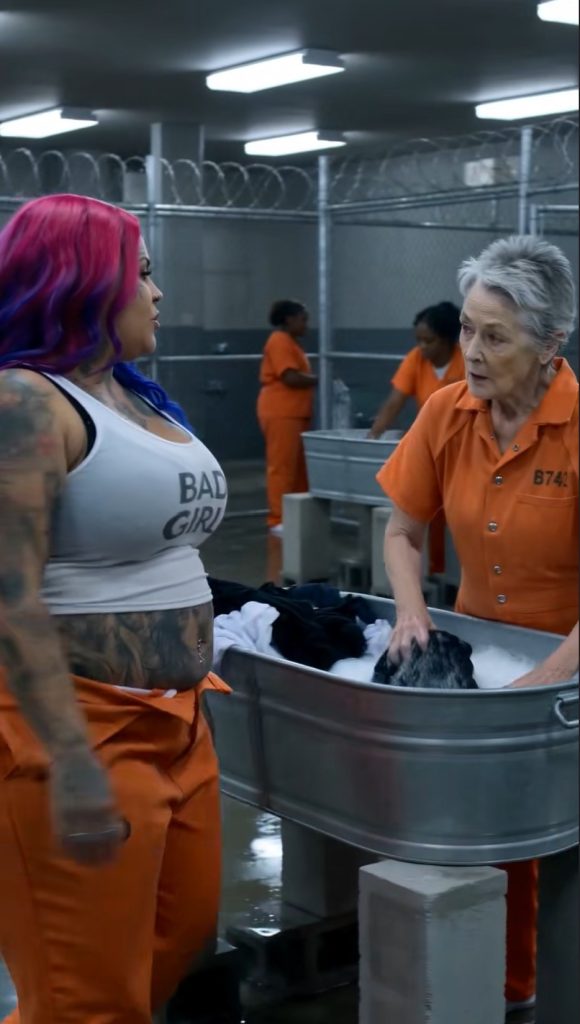
“Your mother was June Carter,” Helen said. “She was my daughter.”
Tasha’s expression didn’t change at first. Then her fingers curled into fists.
“No.” Her voice came out low. “My mother’s dead. And you’re not her.”
“I know she’s dead.”
“You don’t get to say her name.”
Around them, the women kept their distance. The basin rocked gently on its edge, a thin trail of suds creeping across the concrete. Tasha stared at Helen as if the old woman had reached across the yard and touched a wound no one else could see.
“You left her,” Tasha said. “You left me.”
Helen’s eyes shone, but she didn’t look away. “I never stopped looking for you.”
A sharp laugh escaped Tasha. “You expect me to believe that?”
“No,” Helen said. “I expect you to hear me.”
The guard at the far end of the yard had started toward them. Before she reached the basin, an inmate named Rosa stepped out from the others.
“She grabbed her,” Rosa said. Her voice trembled, but she held Tasha’s gaze. “We all saw it.”
A second woman moved beside her. Then another. None came close enough to touch Tasha. They simply stood where they were, refusing to turn away this time.
Tasha looked from face to face. For once, nobody lowered their eyes.
The guard separated them and led Tasha toward the building. Helen stayed beside the tipped basin, one hand pressed to her scalp. The yard began to stir again, but quietly, as if everyone understood that something larger than a fight had just broken open.
By evening, the story had reached the prison staff. Helen gave her account. Rosa did too. One by one, women who had spent months or years staying silent described the same pattern: food taken, threats whispered, work forced from them, and punishment for refusing.
The yard camera had recorded the assault. It showed Tasha’s hand in Helen’s hair, the basin tipping, and the ring of women watching. It also showed what happened after: Rosa stepping forward, then the others, standing witness.
The footage could not explain why Helen had recognized Tasha. It could not make anyone’s fear disappear. But it made the assault impossible to deny.
Two mornings later, Helen sat in a small interview room beneath a humming fluorescent light. A folded letter lay on the table between her and Tasha. The paper was yellowed at the edges, the writing faint in places where the ink had thinned.
Tasha didn’t touch it.
Helen kept her hands in her lap. “June wrote it before she died. I kept it because I thought one day you might ask what she wanted you to know.”
“You had years to find me.”
“I did.” Helen swallowed. “Your father moved. The letters came back. After June died, he told the court I was unfit to raise you. I fought it. I lost.”
Tasha stared at the letter. “He said you didn’t want me.”
“I know.”
“He said you chose to leave.”
Helen’s mouth tightened. “I’m sorry I couldn’t make him tell you the truth.”
For a long moment, Tasha didn’t move. Then she pulled the letter toward herself, careful not to let her fingers brush Helen’s.
June’s handwriting leaned across the page, familiar in a way Tasha couldn’t explain. It began with her childhood nickname. Halfway down, the ink blurred where a tear had fallen.
Tasha stopped reading. Her shoulders rose, then slowly dropped.
“She knew?” she whispered.
“She knew you were loved.”
Tasha folded the letter along its old creases. “That doesn’t fix what happened.”
“No,” Helen said. “It doesn’t.”
For the first time, Tasha looked at her without anger hiding every other feeling. There was hurt there, and disbelief, and something small and frightened that had survived all those years.
“I’m not asking you to forgive me,” Helen said. “And I’m not asking you to excuse what I did today.”
Tasha glanced at the door. “They’re going to move me.”
“There will be consequences.”
“I know.”
“Rosa and the others were afraid to speak because of you.”
Tasha’s eyes fell to the table. “I know that too.”
The review came quickly. The camera footage confirmed the assault, and the women’s statements established that it was not an isolated act. Tasha lost her yard privileges and was transferred to another facility after the disciplinary hearing. Her record followed her. The women she had intimidated were offered a confidential way to report what they had endured, and staff began investigating those complaints.
When the decision was read, Tasha’s face stayed still. Only her thumb moved, rubbing the edge of June’s letter through the clear property envelope.
The yard did not cheer. No one celebrated. The women simply stood in the thin winter light and watched the van carry away the person they had once been afraid to look at.
Rosa let out a breath she seemed to have been holding for years. Helen reached for her hand. Rosa hesitated, then took it.
“I should’ve spoken sooner,” Rosa murmured.
“You spoke when you could,” Helen told her.
In the weeks that followed, the yard changed in small, uneven ways. Women began sitting where they pleased. Someone left an extra piece of fruit beside Helen’s laundry basin. Rosa started organizing the younger inmates to help anyone who struggled with the work. No one pretended the fear had vanished overnight, but it no longer had the whole yard to itself.
Tasha remained in prison. She wrote to Helen once, then again. The first letter contained only three sentences: an apology to Rosa, an apology to the women she had frightened, and the words, I don’t know how to be different yet.
Helen wrote back that learning could begin with not making anyone afraid.
Months passed before they saw one another again, this time through thick glass in a visiting room. Tasha looked smaller without the yard gathered around her. Helen placed her palm against the glass. Tasha did the same.
“I’m still angry,” Tasha said through the phone.
“You’re allowed.”
“I don’t know if I can call you anything.”
“You don’t have to decide today.”
Tasha looked down. “I read the letter again.”
Helen waited.
“She wrote that she wanted me to have your hands. Said you could mend anything.”
Helen smiled, though her eyes filled. “She was flattering me.”
“No,” Tasha said. “She was remembering.”
A year later, the prison approved a restorative meeting with Rosa and two of the women Tasha had harmed. Tasha listened as each spoke. She didn’t interrupt or defend herself. When Rosa told her how long she had been afraid, Tasha’s mouth opened once, then closed.
“I’m sorry,” she finally said. “You don’t owe me anything because I said that.”
Rosa nodded. It wasn’t forgiveness. It was a beginning neither of them had to pretend was more.
Helen kept June’s letter in a small envelope near her bed. She had carried it through every move, folded and unfolded so many times that the creases had nearly worn through. One afternoon, as she read it again, something slipped from the envelope—a tiny square of paper she had never noticed tucked behind the last page.
It was a drawing in a child’s hand: three stick figures beneath a crooked yellow sun. One was labeled MAMA. One, NANA. The smallest had a name written carefully beneath it: Tasha.
On the back, June had written, “She drew this after you left. She said you’d come back.”
Helen held the paper against her chest and shut her eyes. All those years, she had thought the drawing was only a child’s wish. Now she understood: June had kept believing for both of them.
At their next visit, Helen showed Tasha the picture. Tasha traced the small letters through the glass, then pressed her forehead to the pane.
Neither of them said the word family. They didn’t need to force it into the room before it was ready.
When the guard called time, Tasha lifted her hand from the glass. Helen kept hers there a moment longer, palm open, steady and waiting. For the first time, Tasha left without looking over her shoulder.