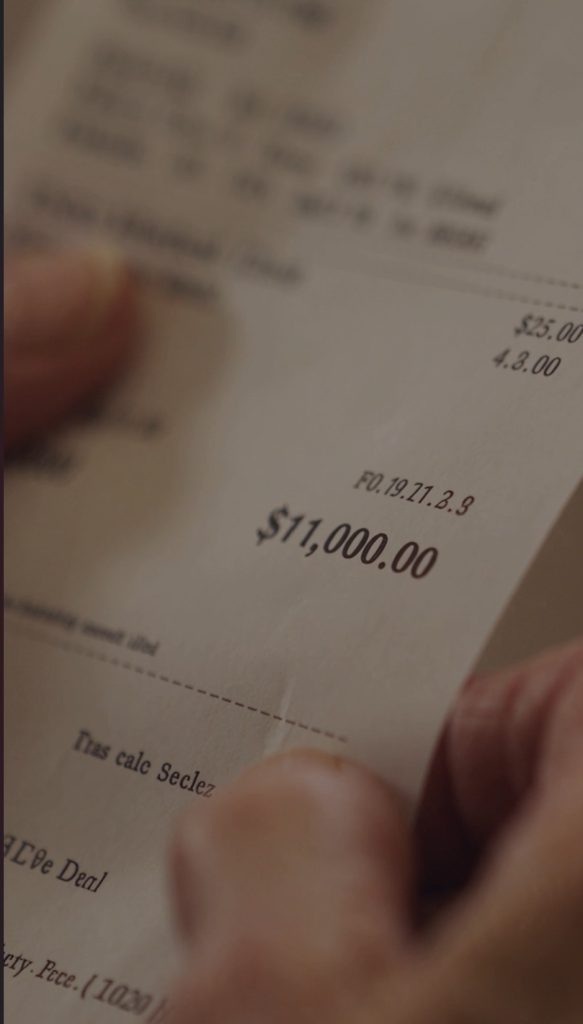
The number on the hotel bill blurred before my eyes: $11,000. Beyond the glass doors, my son was walking away with his wife, leaving me beneath a crystal chandelier to answer for a weekend I thought was a gift. He never looked back.
Two weeks earlier, Michael’s voice on the phone had sounded like the little boy I remembered.
“Mom, Danielle and I want to thank you for everything you’ve done for us. We want to take you somewhere special.”
At sixty-six, I had spent much of my life cleaning other people’s homes. I had raised Michael through difficult years, working until my hands ached, asking for little in return. But hearing those words nearly brought me to tears.
He promised a five-star hotel, my own suite, spa treatments, and beautiful meals.
“You deserve it, Mom.”
I believed him.
Friday morning, Michael and Danielle arrived in a polished black sedan. She wore expensive designer clothes, and he had on sunglasses and his familiar confident smile. I barely noticed the luxury.
All I saw was my son.
The hotel had towering marble columns, golden lights, and music drifting through its enormous lobby. Looking down at my old brown dress and worn shoes, I suddenly felt terribly out of place.
Michael noticed.
“Relax, Mom. You’re just as important as anyone here.”
I wanted to believe that more than anything.
My suite was larger than my apartment. The windows overlooked a beautiful garden, the bed felt impossibly soft, and even the bathroom towels seemed luxurious.
I sat on the mattress, running my fingers across the sheets.
My son had done this for me.
For once, I felt cherished.
The weekend passed in quiet walks, wonderful breakfasts, and dinners I could never have afforded. For a little while, I forgot the rent, the exhaustion, and the years spent scrubbing floors so Michael could have a better life.
Saturday night, we sat on the terrace overlooking the city.
Michael raised his glass.
“To you, Mom. For everything you sacrificed for me.”
Danielle smiled as tears slipped down my cheeks.
I thought I was finally hearing gratitude.
I didn’t know what Sunday would cost me.
That morning, Michael asked me to meet them in the lobby.
“We’ll check out together,” he assured me. “Don’t worry.”
When I arrived, they were already speaking with the receptionist.
Michael embraced me, placed a folded paper in my hand, and whispered, “Thanks for the stay, Mom.”
Then he walked away.
I unfolded the paper.
Eleven thousand dollars.
I looked toward the entrance, but Michael and Danielle were already disappearing into the morning traffic.
My legs weakened.
I earned eight hundred dollars a month cleaning houses. Michael knew that. He knew there was no savings account, no hidden fortune, nothing that could possibly cover this bill.
“Cash or card, ma’am?” the receptionist asked gently.
Several guests turned toward me.
“I… I don’t have it.”
My voice sounded painfully small.
Then footsteps approached from behind the counter.
An elderly woman with silver-white hair stepped forward. She looked over eighty, dressed in a simple hotel uniform, yet there was something quietly commanding about her.
The receptionist hesitated.
“Emma, you don’t have to—”
The woman raised one hand, then studied my face.
“You’re Mr. Harrison’s daughter.”
My breath caught.
My father’s name. I hadn’t heard anyone speak it in decades.
“Yes,” I whispered. “I’m Sandra.”
Tears gathered in her eyes.
“I worked for your father for thirty-three years.”
Slowly, she reached into her pocket and withdrew a yellowed envelope. Its edges were worn, but the name across the front remained unmistakable.
Sandra.
“Before he died,” Emma said, her voice trembling, “he told me that someday you’d come here. Alone. Lost. And when that day came, I was to give you this.”
I stared at the envelope.
My father had been dead for more than thirty years.
Yet somehow, he had anticipated a moment I could never have imagined.
Emma extended her trembling hand.
And as my fingers reached toward that sealed message, one question overwhelmed every other thought.
What had my father known that I didn’t?
The answer was still waiting inside. 👇
The envelope trembled between our hands. Before I could open it, Emma glanced at the receptionist and spoke with a firmness that made the young woman straighten.
“Please ask the manager to come to my office. And don’t process that bill yet.”
She guided me through a quiet corridor into a small office overlooking the hotel’s garden. Inside were framed photographs, an old wooden desk, and a brass clock ticking softly against the silence.
“Your father helped build this place,” Emma said.
I looked at her, bewildered.
“Not the hotel you see today. It was a modest establishment when he became a partner. He worked harder than anyone I ever knew.”
I remembered my father as a stubborn, quiet man who rarely spoke about money. We had grown distant during the difficult years of my marriage, when I insisted on raising Michael without accepting help.
We had both been too proud to close the distance before he died.
Emma gently pushed the envelope toward me.
“Read it, Sandra.”
Inside was a letter written in the familiar, uneven handwriting I hadn’t seen since my father’s funeral.
My fingers stopped moving.
My dear Sandra,
If Emma has given you this letter, I imagine life has brought you to a difficult place.
I cannot know what happened or who brought you here. But I know you, my girl. You’ve always been willing to carry a burden just because someone you love asked you to.
I should have told you something before we lost so many years to silence.
When you refused my help, I thought you were refusing me. I was wrong. You wanted to prove you could survive, and instead of being proud of your courage, I let my pride come between us.
I never stopped loving you.
And I never stopped making sure there would be somewhere you could turn if the world became too heavy.
Ask Emma about the papers.
Everything I put aside was meant for you.
Love, Dad.
By the time I reached the final words, tears had soaked the bottom of the page.
For thirty years, I had believed my father died disappointed in me.
I pressed the letter against my chest, remembering the last conversation we had shared. I had told him I didn’t need his money. He had gone quiet, and neither of us knew how to take back the hurtful things that followed.
Emma waited until my breathing steadied.
Then she unlocked a drawer.
Inside was a thick folder containing documents, bank statements, and a photograph of my father standing outside the original hotel.
“He sold his ownership interest shortly before he died,” she explained. “He placed the proceeds into a trust for you. I was appointed to help administer it.”
I stared at her.
“But nobody told me.”
“We tried, Sandra. Letters went to your old address. They were returned. Later, I was told you had moved away and didn’t wish to be contacted.”
Her voice cracked.
“I should have kept looking. I’m sorry.”
She opened the folder to a recent financial statement.
The balance was large enough to make my breath catch.
Not an unimaginable fortune.
But enough to give me security for the rest of my life.
Enough that I would never again have to choose between paying rent and buying groceries.
I covered my mouth.
For years, I had cleaned bathrooms and scrubbed floors while the money my father left me remained untouched.
Then Emma said something that changed the temperature of the room.
“Three weeks ago, someone called asking about this trust.”
I slowly lowered my hands.
“Who?”
She hesitated.
“Your son.”
The ticking clock suddenly seemed unbearably loud.
Emma explained that Michael had discovered references to the trust while helping me sort through old family paperwork. He contacted the hotel’s administration, claiming to represent me.
But without my written authorization, he couldn’t access the money.
“He asked several questions about how you could transfer your interest to another family member,” Emma said quietly.
I stared at the documents.
The luxurious weekend.
The expensive dinners.
The toast on Saturday night.
And the eleven-thousand-dollar bill.
A terrible possibility began taking shape.
Before I could speak, someone knocked.
The hotel manager entered carrying a printed registration form.
“Mrs. Harrison,” he said carefully, “we’ve found something concerning.”
He placed the document on the desk.
At the bottom was my name.
And beneath it, a signature supposedly authorizing me to accept responsibility for the entire hotel bill.
I leaned closer.
“That isn’t my handwriting.”
Emma looked at the manager.
“Have you confirmed how this was submitted?”
He nodded grimly.
“The electronic authorization came from the account used by her son to arrange the reservation.”
My stomach tightened.
Michael hadn’t merely abandoned me with an enormous bill.
Someone had signed my name without permission.
The manager explained that the hotel would suspend collection while the authorization was investigated. He assured me I wouldn’t be required to pay simply because my name appeared on a disputed document.
But I barely heard him.
My phone began vibrating on the desk.
Michael.
For several seconds, I watched his name illuminate the screen.
Then I answered.
“Mom?” he said brightly. “Everything okay?”
I closed my eyes.
“Michael, where are you?”
A pause.
“Just heading home. Why?”
“I need you to come back.”
His voice changed.
“Is it the bill?”
I swallowed.
“Yes.”
Another pause.
Then he sighed.
“Look, Mom, I might be able to help. But we’d have to talk about some paperwork first.”
I looked at Emma.
She said nothing.
“Come back,” I whispered.
Forty minutes later, Michael and Danielle walked into the office.
My son’s confident smile faded when he saw the documents spread across the desk.
“What’s going on?”
I picked up the registration form.
“Did you sign my name?”
He glanced at Danielle.
“Mom, it’s complicated.”
“Did you?”
He rubbed his forehead.
“I was trying to arrange something that would benefit everyone.”
My hands began trembling.
“What does leaving me with eleven thousand dollars have to do with helping anyone?”
Michael pulled a folder from beneath his arm.
And suddenly I understood why he had returned.
Inside were documents transferring my interest in my father’s trust to him.
“I’ve got business problems,” he admitted. “Serious ones. I needed money quickly.”
He avoided my eyes.
“I thought if you understood the situation, you’d help.”
“You could have asked me.”
“You would’ve said no.”
The words came so easily that I almost didn’t recognize the man standing before me.
Danielle shifted beside him.
“Michael told me your mother had already agreed to help,” she said.
He shot her an angry look.
“Danielle, stop.”
She didn’t.
“He said the weekend was supposed to make things easier between you. I knew about the bill, but I didn’t know he’d signed your name.”
Her eyes filled.
“I shouldn’t have walked away, Sandra. I knew you couldn’t afford it.”
The room became very still.
Michael turned toward me.
“Mom, you don’t understand. If I don’t get this money, I could lose everything.”
I looked at my son.
For a moment, I saw him at eight years old, crying because he’d broken a neighbor’s window. I remembered taking extra cleaning jobs to pay for it, telling him that people made mistakes and the important thing was telling the truth.
Now he stood before me with papers designed to take away the security my father had left me.
“You knew I earned eight hundred dollars a month,” I said.
He stared at the floor.
“You knew what that bill would do to me.”
“Mom—”
“You held me on that terrace and thanked me for everything I’d sacrificed.”
My voice broke.
“Was any of that real?”
He opened his mouth.
Nothing came out.
And that silence hurt more than any answer.
I pushed the transfer documents back across the desk.
“I won’t sign these.”
Michael’s face drained of color.
“Please. You don’t know what’s going to happen to me.”
I looked at the forged signature.
“No, Michael. But I know what you were willing to let happen to me.”
The manager explained that the hotel had preserved its electronic records and would cooperate with an investigation.
Michael sank into a chair.
For the first time that weekend, his expensive clothes and polished appearance couldn’t protect him from what he had done.
I didn’t raise my voice.
I didn’t insult him.
I simply refused to conceal the truth.
The months that followed were painful.
Investigators reviewed the forged authorization, the booking records, and Michael’s communications about the trust. Faced with the evidence, he eventually admitted responsibility.
He pleaded guilty to fraud-related charges, received a criminal sentence that included supervised probation, and was ordered to make restitution.
His failing business closed. The black sedan was sold, along with many of the possessions he had used to convince everyone that his life was successful.
Danielle separated from him.
She gave investigators an honest account of what she knew and later sent me a handwritten apology. She didn’t ask me to excuse her actions.
I appreciated that more than she probably realized.
The hotel removed the disputed charges from my account and pursued the people responsible under its legal arrangements.
I never paid the eleven thousand dollars.
But some nights, lying awake in my apartment, I still heard Michael whispering, “Thanks for the stay, Mom.”
The words had become something I couldn’t easily forget.
Several months later, Michael requested permission to visit.
I agreed to meet him in a quiet public garden.
He arrived alone.
His face looked thinner, his clothes ordinary. He sat across from me on a wooden bench and held his hands together so tightly that his knuckles turned white.
“I kept telling myself I was going to fix it,” he said.
I waited.
“I thought if I could get the money, everything would work out. I convinced myself you would forgive me because you always did.”
He wiped his eyes.
“I treated your love like something I could spend.”
I looked away toward the trees.
For years, I had imagined that one sincere apology might repair any wound between us.
Now I understood that forgiveness and trust were different things.
“I love you, Michael,” I said. “That hasn’t disappeared.”
He started crying.
“But I can’t be the person who saves you from every consequence anymore.”
He nodded slowly.
“I know.”
“And I can’t promise things will ever be what they were.”
“I know that too.”
We sat together for a while, listening to leaves moving in the wind.
When we parted, I let him hug me.
But I went home alone.
And for the first time, that didn’t feel like abandonment.
I began using the trust carefully, with help from an independent adviser. I paid my debts, found a comfortable little home, and stopped accepting cleaning jobs that left my joints aching for days.
I kept working a few mornings each week for an elderly woman I’d known for years, not because I needed the money, but because we had become friends.
There were ordinary pleasures I had almost forgotten.
Buying fresh flowers without checking their price.
Sleeping without worrying about rent.
Opening the curtains and enjoying a slow breakfast.
Emma became part of those mornings, too.
I visited her at the hotel, and sometimes she came to my home for tea. She told me stories about my father that I had never heard, including how he quietly paid an employee’s medical expenses and how he remembered the names of every person who worked beside him.
One afternoon, she invited me back to the hotel garden.
The same garden I had admired from my suite.
We followed a stone pathway toward an old rosebush beside a weathered bench.
Emma stopped.
“There’s something else your father wanted you to have.”
I looked at her in surprise.
She pointed toward the roses.
“Do you remember planting these?”
I stared.
Then I noticed a small, pale stone beneath the leaves.
An uneven heart had been carved into its surface.
My knees weakened.
I remembered that stone.
I had scratched the heart into it as a little girl while my father worked outside our old family home.
“He brought the rosebush and the stone here when your childhood house was sold,” Emma explained. “When the hotel was renovated, he made sure they were preserved.”
I knelt beside the flowers.
The stone was rough beneath my fingers.
All those years, I had believed that everything connected to my childhood had disappeared.
But my father had kept this tiny piece of it alive.
Emma sat beside me.
“He used to say you were the only person who ever made this place feel like home.”
I pressed my fingertips against the little heart.
Suddenly I understood something that money alone could never have given me.
My father hadn’t known that Michael would betray me.
He hadn’t predicted an eleven-thousand-dollar bill or a terrible Sunday morning.
He had simply known that life could be cruel, that pride could leave people separated for too long, and that his daughter might someday need to know she was still loved.
He had left me a way home.
Emma reached into her handbag and withdrew one final photograph.
It showed my father seated on the same garden bench, holding a little girl in a yellow dress.
Me.
I recognized the dress immediately.
My mother had sewn it by hand.
On the back, in my father’s handwriting, were six words.
“Wherever Sandra Is, My Heart Belongs.”
I couldn’t speak.
Emma wrapped an arm around my shoulders, and for a long time we remained beside the roses, two elderly women remembering a man whose love had outlived his mistakes.
Later that evening, we shared dinner at my house.
Nothing extravagant.
Just warm soup, fresh bread, and tea served in mismatched cups.
Emma laughed when I told her I had finally bought a new dress, although I still preferred my old brown one on quiet mornings.
Outside, the last light softened across the garden.
There were still wounds in my family. Michael was rebuilding his life, and the distance between us would take patience, truth, and time. But those wounds no longer controlled every part of mine.
I had friends.
I had a safe home.
I had learned that protecting myself didn’t mean I had stopped loving my son.
And I had finally stopped measuring my worth by how much I could sacrifice for someone else.
Before Emma left, I placed my father’s photograph on the mantelpiece beside a small vase of roses.
Then I walked her to the door.
She squeezed my hand.
“Your father would be proud of you, Sandra.”
I smiled through tears.
For once, I didn’t need anyone to prove those words were true.
That night, I switched off the lights, settled into my favorite chair, and watched the moonlight fall across the photograph.
The house was quiet.
There were no bills waiting to frighten me.
No footsteps walking away.
No desperate need to earn somebody’s affection.
Only the soft scent of roses, the warmth of a home that was mine, and the comforting thought that somewhere in the long, difficult journey of my life, my father’s love had never truly left me.
I touched the little photograph once more, whispered, “I’m home, Dad,” and finally allowed myself to rest.