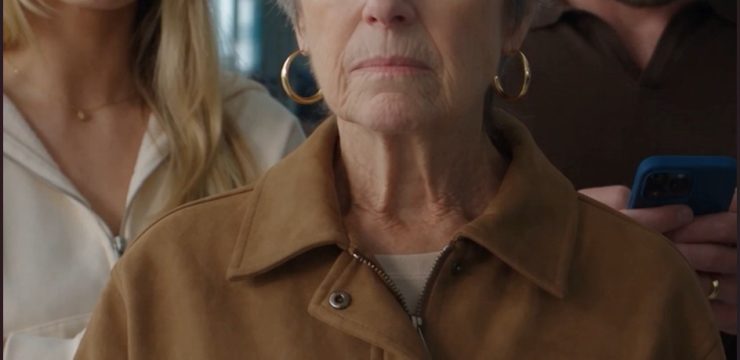
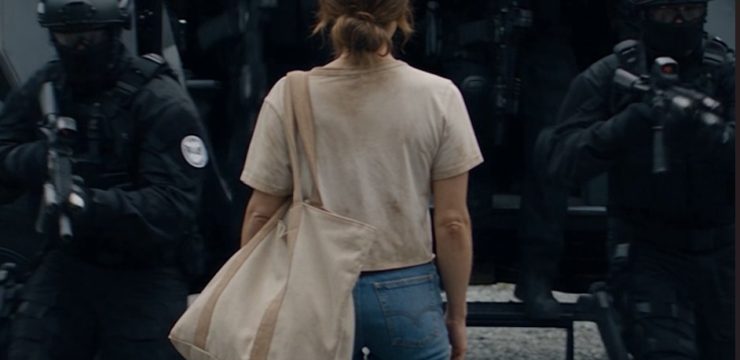
The dog froze in the doorway as if he had just seen someone who wasn’t supposed to exist. My coffee pot hovered above a half-filled mug, and suddenly, the quiet life I had spent years building felt dangerously close to falling apart.
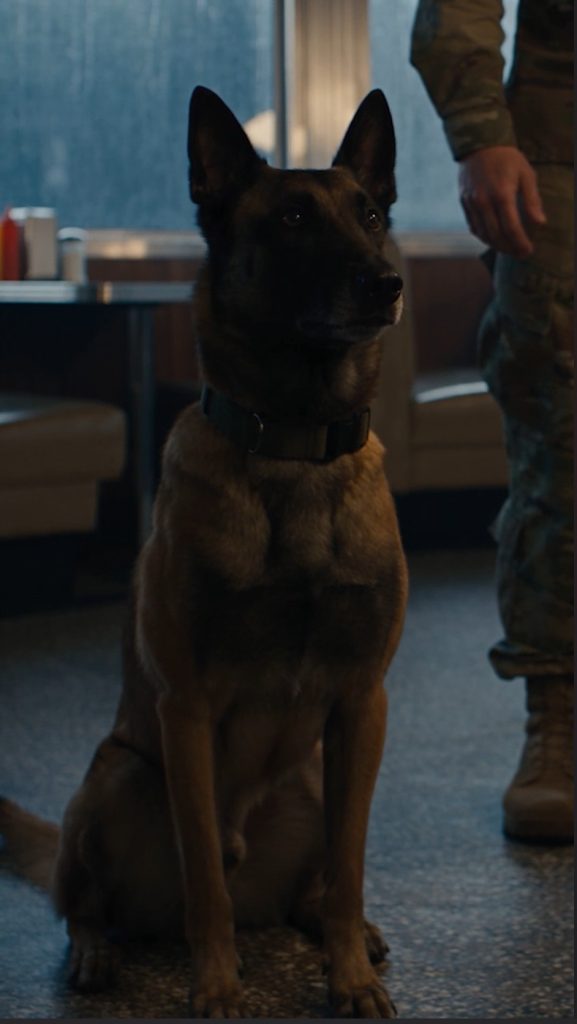
It was supposed to be another ordinary morning at the small-town diner. Coffee, familiar faces, the gentle clatter of dishes—nothing that required me to think about the life I’d left behind.
Then a military handler walked in with a Belgian Malinois at his side.
The dog’s name was Ranger.
He was trained to follow commands without hesitation. But the instant his eyes found mine, he stopped moving.
His handler gave a quiet instruction. Ranger ignored it.
Instead, the dog stared directly at me, ears raised, body perfectly still, as though he were searching for something he couldn’t quite understand.
Then he began walking toward me.
Slowly. Deliberately. His handler called him again, but Ranger barely seemed to hear.
The conversations around us faded. A customer lowered his coffee cup without taking another sip, while someone near the window turned to watch.
I could feel every pair of eyes following the dog across the diner.
His handler looked increasingly uncomfortable.
“I’m sorry,” he said, lowering his voice. “He’s never behaved like this before.”
I wanted to tell him there was nothing to apologize for.
Because I knew exactly what Ranger was doing.
He was trying to remember me.
I kept my expression calm, the way I’d learned to do whenever something threatened to disturb the ordinary life I’d carefully constructed. But the coffee pot felt heavier than it had moments earlier, and my fingers wouldn’t quite stop trembling.
Ranger came closer.
There was no aggression in his movements. Only an intense, almost painful concentration, as though the familiar face in front of him belonged to a memory he couldn’t reconcile with the present.
I looked at his handler, then back at the dog.
I could have stepped away. I could have pretended to be frightened, allowed the man to regain control, and continued serving breakfast as though nothing unusual had happened.
Instead, I lowered the coffee pot.
My serving tray rested beside me. I touched it lightly with my fingers, making the smallest sound, then moved my hand in a gesture so subtle that nobody watching should have noticed.
It was a signal I hadn’t used in years.
Ranger noticed.
Immediately.
His posture changed. The uncertainty in his eyes gave way to something sharper, something unmistakably familiar.
He moved one step closer.
My throat tightened.
For a moment, I forgot the customers, the counter, even the man standing behind Ranger. All I could see was the dog waiting for me to do something I had promised myself I would never do again.
I gave him a second silent command.
Ranger sat.
Not casually, not reluctantly, but with flawless military precision, directly in front of me, his attention fixed entirely on my face.
The silence became unbearable.
His handler stared at the dog, then slowly raised his eyes toward me. The embarrassment had vanished from his expression, replaced by disbelief.
“That shouldn’t be possible,” he whispered.
I knew he was right.
Because the woman standing before him was Hannah Reed—a quiet waitress with an uneventful life, someone whose past never seemed worth asking about.
That was who everyone in this town believed I was.
But Ranger remembered someone else.
Someone connected to a name I had spent years trying to bury.
Evelyn Hart.
I hadn’t heard that name spoken in so long, yet suddenly it felt louder than every sound in the diner.
The handler looked from Ranger to my trembling hand. I could almost see the questions forming behind his eyes.
And as he took one slow step toward me, I realized the dog hadn’t simply recognized my face.
He had recognized a part of my life that was supposed to have disappeared forever.
Now the man standing across from me was about to ask the one question I had spent years avoiding.
And I wasn’t sure I could survive giving him the answer. 👇
The handler stopped inches from the counter. His eyes dropped to the small scar across my wrist, then returned to my face.
“Who taught you that command?”
I swallowed. Ranger remained perfectly still, waiting for another signal.
“Before I answer,” I whispered, “I need to know whether your radio is transmitting.”
The man’s expression changed.
“No.”
“Your body camera?”
“Off. We’re on a scheduled break.”
I glanced toward the customers. A teenager near the window had lifted his phone, recording the scene.
“Please put that away,” I said.
Something in my voice made him lower it immediately.
The handler leaned closer.
“Staff Sergeant Owen Carter,” he said quietly. “I’ve worked with Ranger for three years. I’ve never seen him respond to anyone like that.”
I closed my eyes.
Three years.
Ranger had survived three more years of service while I had been hiding behind a coffee counter, pretending the sound of approaching footsteps didn’t frighten me.
“I trained him,” I said.
Carter went very still.
“That’s impossible. His original trainer was reported missing after an overseas convoy attack.”
I looked down at Ranger.
“She wasn’t missing.”
The silence between us stretched.
“She was told that staying alive meant never being found.”
Carter’s face drained of color.
“Evelyn Hart?”
Hearing my real name spoken aloud felt like someone opening a door inside a house I’d kept locked for years.
Before I could answer, Ranger gently pressed his nose against my hand.
I nearly broke.
I remembered the last time I’d touched that same familiar head.
There had been smoke, shattered glass, and the distant screaming of men calling for medics.
We had been escorting a convoy carrying emergency medical supplies when our vehicles were directed onto a supposedly safer route.
But the route wasn’t safe.
It was an ambush.
Three soldiers died that morning, including Eli Brooks, a young medic who had spent the previous evening showing me photographs of his mother’s garden.
For years, I had remembered his voice asking whether I thought he would make it home for Christmas.
He never did.
And the man responsible for sending us into that ambush had made certain the blame fell elsewhere.
Colonel Adrian Voss.
He had secretly diverted military supplies into a criminal network, then altered convoy records to conceal the missing shipments.
Our convoy had been placed in danger because Eli discovered discrepancies in the manifests.
Voss needed the evidence destroyed.
He nearly succeeded.
“I found the original routing order,” I told Carter. “The one proving Voss changed our instructions. I also recorded him threatening me when I confronted him.”
Carter’s jaw tightened.
“What happened to the evidence?”
“I kept it.”
“Where?”
I looked toward the kitchen.
“Somewhere nobody would think to search.”
Behind us, the diner’s owner, June, stood motionless near the swinging door.
She had hired me six years earlier without demanding answers about my past.
Now she was listening as the woman she knew revealed a life neither of us had ever discussed.
“Hannah,” she said softly. “Are you in trouble?”
I couldn’t look at her.
“Possibly.”
June reached for the front-door sign and turned it to CLOSED.
“Then everybody finishes their coffee somewhere else.”
Nobody argued.
When the last customer left, Carter removed his phone and contacted a federal investigator through a secure number.
I recognized the name he mentioned.
Special Agent Naomi Bell.
She had been one of the few people who knew Evelyn Hart was still alive.
When her voice came through the phone, my knees nearly gave way.
“Evelyn?”
“Hello, Naomi.”
A long silence followed.
Then she said, “Tell me you’re somewhere safe.”
I looked at the diner windows.
“I don’t know anymore.”
Naomi explained that federal investigators had recently uncovered financial records connecting Voss to the stolen supplies. But he had filed a sworn statement blaming the convoy’s unauthorized rerouting on me.
He had accused me of cooperating with the smugglers.
The accusation struck harder than I expected.
Even after everything, Voss was still using the dead to protect himself.
“He knows you’re alive,” Naomi said. “We’ve kept your location confidential, but he’s been searching for you. We need your evidence and your testimony.”
My fingers tightened around the phone.
“If I come forward, Hannah Reed disappears.”
“Your identity will become part of the proceedings,” she answered gently. “I can’t promise that nothing changes.”
I looked toward June, who was standing beside the register with tears shining in her eyes.
Then I looked at Ranger.
For six years, I had survived by refusing to make choices that frightened me.
But Eli’s mother still believed her son had died because of an ordinary operational failure.
And Voss was still free.
“I’m coming forward,” I said.
That evening, federal agents arrived discreetly through the rear entrance.
I retrieved a small waterproof envelope from beneath a loose floorboard in the pantry. Inside were the original routing documents, a storage device containing the recording, and a folded photograph of Eli laughing beside Ranger.
June watched me place everything on the table.
“You carried all this alone?”
I nodded.
She stepped forward and held my face between her hands.
“You should have told me.”
“I was afraid you’d look at me differently.”
“I am looking at you differently,” she whispered. “I’m wondering how you’ve managed to keep serving everyone breakfast while carrying something this heavy.”
That was when I finally cried.
Not quietly.
Not gracefully.
I cried with my hands pressed against my face while Ranger leaned against my legs.
The investigation moved quickly after that.
The documents matched financial transactions investigators had already uncovered. The recording captured Voss ordering me to destroy the original manifest and threatening to make me responsible for the convoy deaths.
But Voss refused to confess.
He insisted the evidence had been fabricated.
When the federal trial began months later, I entered the courtroom under my real name for the first time in years.
Voss sat beside his attorneys wearing an expensive suit, his gray hair neatly combed, his expression composed.
He looked older.
But I remembered his eyes.
I remembered those same eyes watching me from across a desk when he warned that nobody would believe a junior officer over a decorated colonel.
During cross-examination, his attorney produced a document bearing what appeared to be my signature.
According to the document, I had personally approved the route change.
A murmur spread through the courtroom.
My stomach dropped.
Voss looked at me.
And smiled.
For one terrible moment, I was back in that military office, hearing him explain how easily a person’s reputation could be destroyed.
Then the prosecutor approached the evidence table.
“Ms. Hart, do you recognize this document?”
“Yes.”
“Is that your signature?”
“No.”
“How can you be certain?”
I lifted my head.
“Because the original routing order has a different authorization number. Colonel Voss altered the electronic copy after the ambush. The original is the document I preserved.”
The prosecutor displayed both documents.
The differences were small.
A timestamp.
An authorization code.
A handwritten amendment bearing Voss’s initials.
But together, they exposed the forgery.
Then the courtroom heard the recording.
Voss’s voice emerged from the speakers, unmistakable and cold.
He ordered me to destroy the records.
When I refused, he threatened to blame me for the convoy disaster.
No one moved.
I watched Voss’s smile disappear.
He looked toward his attorneys, but neither could erase what the entire courtroom had just heard.
When the jury later returned guilty verdicts on the conspiracy, fraud, and obstruction charges, he stared straight ahead.
Months afterward, the judge imposed a lengthy prison sentence. His appeal would not erase the evidence or restore the career he had built on a lie.
As officers escorted him from the courtroom, Voss turned toward me.
For once, he had nothing to say.
I had imagined that moment for years.
I thought I would feel victorious.
Instead, I sat motionless, staring at the empty chair he had left behind.
Three soldiers were still dead.
Six years of my life were still gone.
Justice had arrived, but it couldn’t return what had been stolen.
Outside the courthouse, a woman waited beside the steps.
I recognized her immediately.
Eli’s mother.
Her hair had turned almost entirely white since the last photograph I’d seen.
For a moment, neither of us moved.
Then she approached.
“I’ve wanted to meet you,” she said.
My throat closed.
“I’m sorry about Eli.”
She shook her head.
“Don’t apologize for something he would never have blamed you for.”
I tried to answer, but no words came.
She reached into her handbag and removed a small photograph.
Eli stood beside Ranger, grinning, his uniform dusty and his eyes bright.
“He wrote home about you,” she said. “He told me you were the reason everyone felt safer when things went wrong.”
I covered my mouth.
For six years, I had believed the families of those lost would hate me if they knew I had survived.
Instead, Eli’s mother took my hands.
“Thank you for not letting the truth die with him.”
We stood together on the courthouse steps while traffic passed and the afternoon sun warmed the stone beneath our feet.
For the first time, I allowed myself to remember Eli without seeing only the moment he died.
I remembered his laughter.
His terrible jokes.
The photographs of his mother’s garden.
And the way he always saved Ranger a little piece of chicken.
Several weeks later, I returned to the diner.
June was behind the counter when I walked in.
She looked up, studied my face for a moment, then reached for a coffee cup.
“Same as usual?”
I smiled.
“Same as usual.”
She poured my coffee without asking which name I intended to use.
That kindness meant more than she could have known.
Carter arrived shortly afterward with Ranger walking calmly beside him.
He carried a folder beneath one arm.
“There’s something I wanted to show you,” he said.
I recognized the military seal on the cover.
It was an old field report from the morning of the ambush.
“I requested the complete incident record during the investigation,” Carter explained. “Some of it was withheld for years.”
He opened the folder and handed me a page.
I read the first lines.
Then I stopped breathing.
According to the report, the rescue team had initially been unable to locate me.
The convoy wreckage was scattered across a wide area, and smoke had made visibility almost impossible.
But Ranger had refused evacuation.
He had broken away from the soldiers trying to secure him and repeatedly returned to one particular section of wreckage.
Eventually, he pulled at a rescuer’s sleeve until the man followed.
There, beneath a collapsed section of the vehicle, they found me.
Unconscious.
Barely breathing.
Alive.
I stared at the page.
For six years, I had believed a passing patrol had found me by chance.
I had believed Ranger had been evacuated without knowing whether I survived.
But he had known exactly where I was.
And he had refused to leave.
Carter waited while I struggled to speak.
“There’s something else,” he said.
He placed another document on the counter.
Ranger’s retirement papers.
After years of service, the military had approved his retirement. Carter had brought him through town that morning while completing his final transfer arrangements.
“I wasn’t planning to stop here,” Carter admitted. “But he became restless when we drove past. He kept looking toward the diner.”
I looked down at Ranger.
He was sitting beside my chair, watching me with the same unwavering attention he’d shown on the morning everything changed.
“He knew,” I whispered.
Carter nodded.
“I think he recognized where you were before either of us understood it.”
Then he turned the retirement paperwork toward me.
The section for the receiving caretaker was still blank.
“If you’re willing,” Carter said, “I’d like to recommend you as the person who takes him home.”
I stared at the page.
For years, I had believed that staying alive meant letting go of everyone and everything I loved.
But Ranger had spent those years serving, remembering, and somehow finding his way back to me.
I reached down.
He placed his head against my knee.
“Yes,” I whispered.
Carter smiled.
And for the first time since entering the diner, he looked relieved rather than bewildered.
Ranger came home with me that week.
June helped me arrange a place for his bed beside the kitchen window. Eli’s mother sent a small package containing the photograph of her son and a handwritten note thanking me for giving Ranger a peaceful retirement.
Carter visited whenever his duties brought him nearby.
He never treated me like a mystery again.
Just someone who knew his old partner better than anyone else.
One Sunday morning, June invited everyone to the diner before opening.
Eli’s mother brought homemade biscuits. Carter arrived with flowers for June, who pretended not to notice how carefully he’d selected them.
We sat together beneath the soft morning light, sharing breakfast without uniforms, testimony, or unanswered questions between us.
Ranger lay beneath the table, his head resting across my feet.
At one point, June called from behind the counter.
“Hannah, could you help me with the coffee?”
I stood automatically.
Then she paused.
“Or Evelyn. Whichever you prefer.”
The room grew quiet.
I looked at the people around me.
These were the people who knew what had happened.
They knew about the woman who had run, the men who had died, the years spent hiding, and the dog who had somehow brought the truth back into the light.
And none of them was asking me to choose between the woman I’d been and the woman I’d become.
I smiled.
“Either one is fine.”
June nodded and handed me the coffee pot.
As I passed Ranger, he lifted his head.
Without thinking, I gave him the tiny hand signal I’d once been afraid to use.
He rose, walked beside me, and settled quietly at my feet.
Outside, sunlight spilled across the diner’s windows. Inside, familiar voices filled the room, and the scent of fresh coffee drifted through the air.
I looked down at the old dog who had crossed years of silence to find me.
Then I rested my hand gently on his head.
For the first time in six years, I wasn’t waiting for the past to catch up with me.
I was exactly where I belonged.
And when Ranger finally closed his eyes beside my chair, I knew that neither of us would ever have to search for home again.