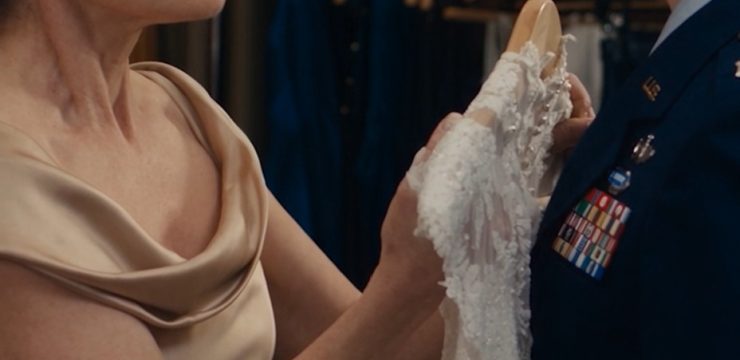
“Pack your things and get out of my house.”

The words cut through the kitchen while Catherine Montgomery’s hands remained submerged in cold dishwater. Behind her, the roasted chicken sat untouched. Her son stood in the doorway, disturbingly calm.
“Your house?” she whispered.
“If you refuse assisted living, Mom, you can’t stay here,” David replied.
Beside him, Emily leaned against the doorframe, glossy red nails tapping her cream sleeve. She looked relieved. Somehow, that hurt even more.
David’s name was on the deed. But Catherine’s savings had renovated the kitchen, built the porch, and paid for the staircase runner Emily proudly called her own design.
Three years earlier, after Albert died, David had begged Catherine to leave the Queens apartment where she and her husband had spent most of their marriage.
“We’ll take care of each other,” he had promised.
She believed him.
Catherine sold the apartment and handed over nearly everything she had earned during thirty-two years of sewing wedding dresses. David called the house a family investment.
She called it home.
At first, the small upstairs bedroom hardly bothered her. Neither did the gradual change from helping to serving: cooking every meal, cleaning, ironing David’s shirts, and watching Peter and Alice whenever Emily went shopping or traveling.
She adored the children. Every Friday, Peter got his favorite chocolate cake. Every night, little Alice fell asleep against her shoulder.
But gratitude slowly disappeared. Eventually, nobody even said please.
Emily filled social media with photographs of restaurants, birthdays, vacations, and smiling family gatherings.
Catherine was never in them.
Then Clarice’s jewelry vanished: the pearl brooch, amber necklace, silver bracelet, and amethyst ring.
David barely glanced up when Catherine told him.
“You probably misplaced them.”
“At your age, memory slips happen,” Emily added sweetly.
Six months later, Emily posted photographs from Cancun. In one, she raised a cocktail toward the camera.
Catherine’s missing silver bracelet glittered around her wrist.
Catherine stared at the photograph without speaking.
She had stopped arguing.
She had started watching.
One evening, passing the hallway, she overheard Emily laughing on the phone.
“A few more months, and she’ll be in assisted living. Then I can turn that depressing bedroom into my walk-in closet.”
Another laugh followed.
“She still thinks David’s a good son.”
Now, standing in the kitchen, Catherine understood how long this moment had been planned.
Emily expected tears. David expected an argument.
They received neither.
Catherine carefully dried her hands.
“All right, David. I’ll pack.”
Upstairs, she filled an old leather suitcase with clothes and three photographs: Albert, newborn David, and her mother.
Her fingers lingered on Albert’s picture. For one painful moment, she nearly broke.
Then she closed the suitcase.
When she returned downstairs, Emily was barely concealing her triumph.
The doorbell rang.
Outside waited a black limousine.
Henry Montgomery stepped onto the walkway—Albert’s closest friend, former business partner, and one of the wealthiest men in the state.
He passed David without acknowledging him.
“Are you ready?” he asked Catherine.
“Yes.”
“What’s going on?” David demanded.
Catherine looked at her son.
“The house is all yours now.”
And she walked away.
The following morning, Henry escorted her into a Midtown law firm.
Attorney Oliver Samson welcomed them into a private conference room. A blue folder lay waiting on the polished table.
Inside were Albert’s notarized will, shareholder records, a power of attorney, and transfer documents.
Catherine turned a page.
Her breath caught.
Her signature appeared beneath an authorization.
The handwriting was almost perfect.
But she had never signed it.
“These documents approved several transfers,” Oliver explained.
Suddenly, the missing jewelry, the accusations about her memory, David’s control over paperwork, and the pressure to enter assisted living formed a terrifying pattern.
Henry’s jaw tightened.
Oliver pointed to one line.
“This is where David made his mistake.”
Then he removed the final document.
It concerned something directly connected to Albert. Something Catherine had trusted David to handle after her husband’s death.
Something worth far more than the house or everything she had invested in it.
Catherine read the opening lines.
Her trembling stopped.
“What exactly did my son try to transfer?”
Oliver slowly pushed the document toward her and placed his finger beside David’s name.
And Catherine was one breath away from discovering what her son had truly tried to take from her. 👇
Oliver’s fingertip remained motionless against the paper.
“Your late husband’s shares in Montgomery Textiles,” he said quietly. “Forty-one percent of the company he helped build with Henry.”
Catherine looked up, confused.
“Albert told me those shares weren’t worth very much.”
“They weren’t, years ago,” Henry answered. “But the company expanded. A major distribution agreement changed everything.”
Oliver turned the document slightly.
“Your husband’s interest passed to you under his will. Today, those shares are worth several million dollars.”
The air seemed to leave the room.
Catherine stared at Albert’s name, remembering the evenings he came home exhausted, smelling faintly of machine oil and fabric dye.
She remembered sewing wedding gowns late into the night when his business struggled.
“He told me we were building something together,” she whispered.
Henry swallowed.
“You were.”
Oliver showed her another page.
“David submitted paperwork attempting to transfer your entire ownership interest to himself. The stated purchase price was one dollar.”
Catherine’s eyes settled on the figure.
One dollar.
Thirty-two years of work. A marriage. A lifetime of sacrifices.
Her son had tried to acquire it all for less than the price of a loaf of bread.
“Did he succeed?”
“Not completely,” Oliver replied. “The transfer required additional verification. Henry discovered irregularities in the company’s shareholder records before the transaction could be completed.”
He opened the forged power of attorney.
“David represented that you had authorized him to manage your financial affairs. These signatures must be examined, but the documents already contain serious inconsistencies.”
Catherine touched her wedding ring.
“Why didn’t anyone tell me?”
Henry lowered his eyes.
“David handled your husband’s estate correspondence. He told us you wanted him to manage everything while you grieved. I should have spoken to you directly.”
Catherine looked toward the window.
For three years, she had believed herself dependent on her son’s generosity.
All that time, he had known she possessed something he wanted.
Oliver’s voice softened.
“There’s another reason we needed you here.”
He placed a financial instruction beside the transfer documents.
The proposed proceeds were not directed to Catherine’s account.
Nor entirely to David’s.
An account listed under Emily’s maiden name appeared among the receiving instructions.
Catherine stared.
“Does David know about this?”
“We don’t know,” Oliver replied. “But we intend to find out.”
That afternoon, Catherine asked them to arrange a meeting with her son.
Henry objected.
“You don’t owe him another opportunity to hurt you.”
“I know,” she said. “But I need to hear him answer me.”
Two days later, David and Emily entered Oliver’s conference room.
David looked irritated.
Emily wore a tailored coat and carried a designer handbag. Her expression changed when she noticed Catherine sitting beside Henry.
“What’s this about?” David asked.
Oliver placed the documents on the table.
“Your mother’s inheritance.”
David’s face lost its color.
Emily remained standing.
Catherine watched her son’s hands.
They had begun to shake.
“Tell me you didn’t know these were forged,” she said.
David looked at the documents.
Then at Emily.
“Mom, I was trying to protect you.”
“From what?”
He opened his mouth.
Nothing came.
“From owning something valuable?” Catherine asked. “From having money of my own?”
Emily stepped forward.
“Catherine, these matters are complicated. David was simply making arrangements for your future.”
Catherine slowly removed her phone from her handbag.
She opened Emily’s Cancun photograph and placed it beside the paperwork.
“Were my grandmother’s belongings complicated too?”
Emily looked down.
The silver bracelet gleamed on the screen.
For the first time, her polished expression faltered.
David leaned closer.
“You told me Mom gave you that.”
“She did,” Emily snapped.
Catherine’s voice remained steady.
“No, Emily. You took it.”
The room fell silent.
Oliver then presented the financial instructions.
“Perhaps you can explain why the proposed transfers included an account under your maiden name.”
David turned toward his wife.
“What account?”
Emily said nothing.
“Emily?”
“It was temporary,” she replied sharply.
“For what?”
“To keep the money protected!”
“From whom?” David demanded.
Her silence answered more than she intended.
Oliver explained that the documents appeared to direct part of Catherine’s inheritance into an account David did not control.
The attorney had already requested preservation of the relevant financial records.
David sat down slowly.
Catherine watched the realization reach him.
The woman he had helped push her from the house had been preparing to control the money herself.
Yet the discovery brought Catherine no satisfaction.
“Did you know I was never losing my memory?” she asked.
David covered his mouth.
“David. Look at me.”
He raised his eyes.
“Did you know?”
A long silence followed.
“Yes.”
The word seemed to empty the room.
Catherine remembered every frightened moment she had spent checking cupboards, questioning herself, wondering whether age was quietly stealing her mind.
“You let her make me doubt myself.”
David’s eyes filled.
“I thought once everything was settled, we could—”
“Put me somewhere convenient?”
He couldn’t answer.
“And my grandchildren?” Catherine whispered. “Were they supposed to visit me in that place after you took everything?”
David bent forward, his elbows resting on his knees.
Emily reached for his shoulder.
He pulled away.
“Don’t,” he said.
Catherine rose.
Her knees felt unsteady, but her voice did not.
“I loved you before you could speak, David. I held you when you were sick. I worked until my fingers cramped so you would have things your father and I never had.”
David started crying.
“I know, Mom.”
“No,” she replied softly. “If you had known what that meant, we wouldn’t be sitting here.”
Oliver explained that the evidence would be referred to investigators and that Catherine could pursue recovery of her property.
David looked up desperately.
“Mom, please. Think about Peter and Alice.”
Catherine closed her eyes.
Those children were the only reason she had tolerated so much.
When she opened them again, she looked directly at her son.
“I am thinking about them. I don’t want them growing up believing love means they can take whatever they want from someone who trusts them.”
She turned to Oliver.
“Proceed.”
The months that followed were difficult.
Investigators examined the forged documents, financial accounts, and communications surrounding the attempted transfer.
Records confirmed David’s participation.
They also uncovered Emily’s efforts to redirect money and evidence connecting her to Catherine’s missing jewelry.
The pearl brooch and several other pieces were recovered.
David eventually admitted that Emily had encouraged the plan, but he acknowledged signing paperwork he knew Catherine had never authorized.
In court, Emily pleaded guilty to charges involving fraud and theft. She received a prison sentence and was ordered to pay restitution.
The woman who had once smiled while Catherine packed her suitcase stood motionless as the sentence was delivered.
Her red-painted fingers tightened around the edge of the defense table.
Nobody applauded.
Catherine simply sat beside Henry, holding her grandmother’s recovered brooch inside her closed hand.
David also pleaded guilty to his part in the fraud.
His cooperation and lack of prior convictions were considered at sentencing, but they did not erase his responsibility.
He received a supervised sentence, financial penalties, and restitution obligations.
The house was eventually sold as part of the arrangements to repay what could be recovered from Catherine’s contributions and the couple’s financial wrongdoing.
Peter and Alice remained with David under court-approved family arrangements.
Catherine’s ownership of Albert’s shares was confirmed, and the attempted transfer was formally invalidated.
But recovering her inheritance did not restore her trust.
That loss required a different kind of reckoning.
One rainy afternoon, David came to Catherine’s new home.
She had purchased a modest house with a bright sewing room overlooking a small garden.
David stood on the doorstep, holding a paper bag.
“I brought the photograph of you and Dad from our first Christmas,” he said. “I found it while packing.”
Catherine accepted the bag.
He looked thinner.
Older.
“I kept telling myself I was doing what was best for the family,” he admitted. “But I liked having you there to do everything. And when Emily said we needed more money, I convinced myself you wouldn’t miss what you didn’t know about.”
Catherine looked at him for a long moment.
“You could have asked for help.”
“I know.”
“You could have told me the truth.”
His eyes dropped.
“I know.”
She ran her thumb along the folded edge of the bag.
“I don’t know when I’ll trust you again, David.”
He nodded, tears collecting beneath his eyes.
“I understand.”
“But I want you to become someone your children can trust.”
He wiped his face.
“I’ll try.”
“Then start by telling them the truth in a way they can understand. And stop asking people to forgive you before you’ve changed.”
He nodded again.
This time, he didn’t ask for anything.
Their relationship did not heal in one conversation.
There were difficult visits, awkward silences, and days when Catherine still couldn’t bear to hear his voice.
But David continued showing up for his children, attending counseling, and meeting his obligations.
Gradually, he learned to listen without defending himself.
Catherine learned that loving her son did not require surrendering her boundaries.
Meanwhile, Henry helped her understand the business Albert had left behind.
Catherine chose to keep her shares rather than sell them.
With part of her income, she opened a small dressmaking program for women who needed employment, confidence, or a place to begin again.
The first morning, she stood among sewing machines while sunlight fell across long tables covered with fabric.
Her hands moved naturally over a piece of white satin.
For the first time in years, her work belonged to her.
Then came a Friday evening that changed something quietly inside her.
Peter and Alice arrived carrying a chocolate cake, made with David’s help.
The frosting leaned to one side.
Alice proudly announced that she had stirred it herself.
Catherine laughed.
After dinner, Peter placed a thick, homemade album on the table.
“We made you something.”
Catherine opened it.
The first photograph showed her standing in David’s old kitchen, flour dusting her cheek.
The next showed her holding Alice asleep against her shoulder.
Then came photographs of Friday cakes, birthday decorations, bedtime stories, and Catherine kneeling beside Peter as she taught him to sew a loose button.
Page after page.
Photographs Catherine had never seen.
Peter watched her carefully.
“Mom always posted pictures without you,” he said. “But I kept taking my own because you were always doing the things I wanted to remember.”
Catherine pressed a hand against her mouth.
For three years, she had thought she was slowly disappearing from the family’s life.
But through the eyes of the children she loved, she had been at its very center.
On the last page, beneath a photograph of Catherine smiling with both grandchildren in her arms, Peter had written three words.
“Our Real Home.”
Alice climbed onto Catherine’s lap.
“Grandma, why are you crying?”
Catherine kissed her forehead.
“Because I’m happy, sweetheart.”
Peter leaned against her other shoulder.
Outside, evening settled gently over the garden.
From the kitchen came the familiar scent of chocolate cake. On the sewing-room table lay a half-finished wedding gown, its ivory fabric glowing in the last light.
Catherine looked at Albert’s photograph on the mantel.
For years, she had believed a home was something she could lose when someone else decided she no longer belonged.
Now, surrounded by the children who had never stopped seeing her, she understood.
Home had never been the expensive kitchen, the staircase, or the name on the deed.
It was this small room, these familiar voices, and the freedom to open her arms without fear.
She closed the photograph album and held her grandchildren a little closer.
For the first time since Albert’s death, Catherine Montgomery felt no need to prove that she deserved a place in her own life.
She was already home.