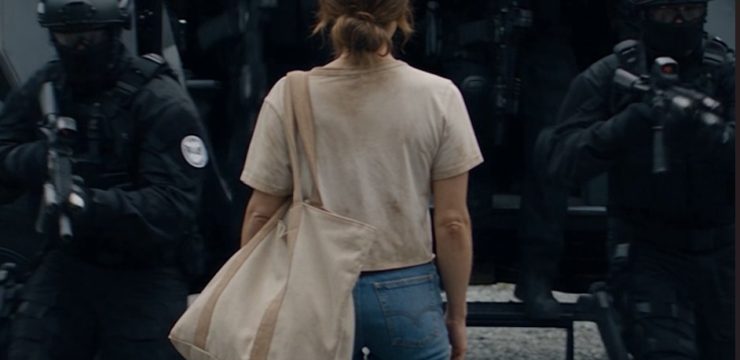
The slap cracked across the tarmac in front of thousands of service members. A Navy lieutenant stood motionless, her cheek burning, while the vice admiral who had struck her ordered military police to put her in restraints.
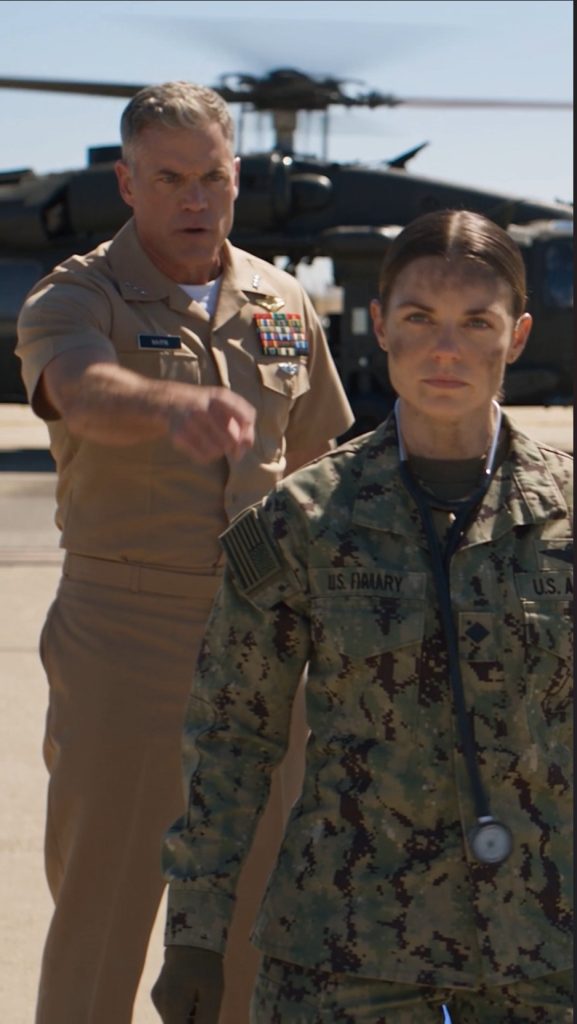
But she wasn’t looking at him. She was watching the wounded man she’d just pulled back from the edge of death.
Minutes earlier, the morning heat at Joint Expeditionary Base Little Creek had been almost unbearable.
Eight thousand service members stood in immaculate formation beneath a pale sky. White caps stretched across the airfield in perfectly aligned rows as Vice Admiral Harrison Cole approached the podium.
For Cole, it was the kind of morning that represented everything he valued: discipline, authority, absolute control.
Three hundred yards away, Lieutenant Evelyn Carter was fighting to stay awake.
Nearly forty-eight hours inside a medical tent had left her scrubs stained with iodine and sweat. Her hair was barely holding together, and exhaustion had settled deep behind her gray eyes.
Then came the helicopter.
A Blackhawk swept low over the tarmac, its rotors throwing dust and gravel across the inspection ground.
Cole stopped speaking.
Evelyn started running.
Before the helicopter door fully opened, she spotted the stretcher. The wounded man’s breathing was failing, and the young corpsman beside him looked terrified.
Evelyn dropped to her knees on the blistering concrete.
“Scalpel. Betadine. Bag him when I say.”
Her hands moved with the precision of someone who had performed the procedure under pressure before.
Behind her, polished shoes struck the pavement.
“Who authorized this?”
Vice Admiral Cole stood over her, two military policemen at his back.
Evelyn didn’t look up.
Her fingers were working at the patient’s throat. Every second mattered, and the man beneath her was running out of them.
“I asked you a question!” Cole snapped. “You’re disrupting a fleetwide inspection. Get this mess out of my sight.”
She continued.
The tube slipped into position.
Air entered the man’s lungs.
His chest finally rose.
Only then did Evelyn stand.
She was exhausted, covered in dust, and several inches shorter than the furious admiral towering over her.
“Sir,” she said quietly, “you’re standing inside my triage zone. Step back.”
A strange stillness spread across the nearby ranks.
A lieutenant had just instructed a vice admiral to move.
Cole’s expression hardened.
“You insolent little girl.”
Evelyn held his gaze.
“Move.”
His hand came across her face before anyone could intervene.
The sound carried over the concrete.
Her head turned sharply. A red mark began spreading across her cheek.
But Evelyn neither raised a hand to her face nor stepped backward.
She simply returned to her patient.
For a moment, nobody seemed to know what to do.
Then Cole’s voice shattered the silence.
“Detain her! Gross insubordination. Restrain her immediately!”
Evelyn checked the patient’s airway one final time.
“Package him,” she instructed the corpsman. “Surgical bay one. Tell Houseman the airway is secure.”
The stretcher rolled toward the medical facility.
She watched until it disappeared through the doors.
Then she turned and extended both wrists.
Sergeant Collins approached reluctantly. He had witnessed the assault. He had also witnessed the lieutenant save a man’s life while refusing to abandon him.
His hands hesitated as he fastened the zip ties, leaving them slightly loose.
“I’m sorry, Lieutenant,” he whispered.
Evelyn looked at him, then toward Cole.
“Don’t be,” she replied calmly. “He just wrote his own ending.”
Cole ordered them to take her away.
Collins gently gripped her restrained arm, and they began crossing the tarmac.
Behind them, thousands of service members remained silent.
And somewhere beyond the airfield, a military network was about to receive information that would make the vice admiral’s public humiliation of a combat nurse the least of his problems.
The first sign would appear on his own screen. 👇
A sharp electronic tone cut through the silence behind them.
Collins stopped walking.
At the podium, Cole stared at the military tablet mounted beside his prepared remarks. Its display had gone black, then illuminated with an unmistakable security notice.
ACCESS SUSPENDED. COMMAND CREDENTIALS REVOKED PENDING INVESTIGATION.
Cole tapped the screen.
Nothing happened.
He tried again, harder.
“Get my communications officer over here!”
But his communications officer was already approaching, his face drained of color.
“Admiral,” the officer said carefully, “Cyber Command has frozen your command account. They’ve also placed a preservation hold on your operational communications.”
Cole stared at him.
“On whose authority?”
“Fleet command, sir. The order was authenticated three minutes ago.”
For the first time that morning, Harrison Cole had nothing to say.
Across the tarmac, Collins felt Evelyn’s restrained wrists move slightly.
“Sergeant,” she whispered, “my patient.”
He looked toward the medical facility.
“I’ll find out.”
Before he could take another step, a black government vehicle pulled onto the airfield.
Two officers climbed out, followed by a woman wearing the insignia of a rear admiral.
Rear Admiral Margaret Voss had spent twenty-six years learning to recognize the difference between a mistake and a decision someone hoped would never be discovered.
She looked first at the restrained nurse.
Then at the red mark on her face.
“Remove those restraints.”
Cole marched toward her.
“Admiral Voss, this lieutenant deliberately disrupted a military ceremony and refused a direct order.”
Voss didn’t acknowledge him.
“Sergeant, I gave you an instruction.”
Collins cut the ties.
Evelyn slowly brought her hands forward. Thin red lines marked both wrists, but she barely noticed them.
Voss approached her.
“Lieutenant Carter, are you injured?”
“I’m able to perform my duties, ma’am.”
“That wasn’t my question.”
Evelyn’s expression changed for the first time.
Only slightly.
“My cheek hurts,” she admitted. “But I need to know whether my patient survived.”
Voss turned to an aide.
“Find out. Now.”
Then she faced Cole.
“Vice Admiral, you are relieved of command pending investigation.”
The words landed with more force than a shout.
Cole looked past her toward the thousands of service members watching.
“This is outrageous. You cannot remove a fleet commander because a junior officer became hysterical.”
Voss opened the folder in her hand.
“No,” she replied. “But I can remove one whose orders may have endangered wounded personnel.”
Cole went still.
The wind tugged at the corner of the papers.
Voss continued.
“At 0702, your operations office issued instructions restricting helicopter movement over this base during the inspection. At 0714, medical control requested emergency landing clearance for a critically injured service member.”
She looked directly at him.
“That request was delayed.”
Cole’s face tightened.
“Operational security.”
“Medical control warned that the patient had a compromised airway. Your staff received that warning.”
“I wasn’t personally informed.”
“Your authenticated command account acknowledged the message.”
No one spoke.
Voss turned another page.
“At 0721, someone attempted to alter the movement log. Cyber Command detected the unauthorized change while preserving records for an unrelated compliance review.”
Cole looked toward his communications officer.
The officer lowered his eyes.
“And at 0726,” Voss continued, “your staff tried to cancel the medical landing authorization again.”
Cole swallowed.
“You’re relying on incomplete information.”
“Then you will have an opportunity to explain it.”
His eyes moved toward Evelyn.
“You did this.”
She stared at him.
For nearly forty-eight hours, she had worked beneath harsh medical lights, drinking lukewarm coffee between casualties, trying to keep strangers alive long enough for someone else to take them home.
She hadn’t known anything about the command investigation.
And now the man who had struck her was looking at her as though she had orchestrated his destruction.
“No, sir,” she said quietly. “I treated your casualty.”
A door opened at the medical building.
The young corpsman came running.
Evelyn turned so quickly she nearly stumbled.
“How is he?”
The corpsman stopped, breathless.
“Houseman’s got him in surgery. He’s stable enough for the procedure. Lieutenant, he has a chance.”
Evelyn shut her eyes.
For a second, the entire airfield seemed to disappear.
Her shoulders dropped, and she pressed her fingertips against her forehead.
Then she asked, “Did his oxygen hold?”
“Yes, ma’am. It held.”
A shaky breath escaped her.
Only then did she begin to tremble.
Voss noticed.
“Lieutenant Carter, you need medical attention yourself.”
Evelyn shook her head.
“I need to give Houseman a proper handoff.”
“You will,” Voss said. “And afterward, I need your statement.”
Cole stepped forward.
“This is a disgrace. That woman openly defied me!”
Voss closed her folder.
“She ordered you to leave an active treatment area. You struck her while she was providing emergency care.”
“I was maintaining discipline!”
“No, Admiral.”
Voss’s voice remained level.
“You were demanding obedience from someone whose duty required her to protect a life, even when you were standing in her way.”
Cole opened his mouth.
Nothing came out.
Behind Voss, two military investigators approached.
She stepped aside.
“Vice Admiral Harrison Cole, you are being detained for questioning. Your command authority has been suspended, and your communications and movement records have been secured.”
One investigator asked Cole to surrender his identification credentials.
His hand hesitated over the card clipped to his uniform.
For years, men had stepped aside whenever he approached.
Now nobody moved for him.
He surrendered the card.
Several months later, the completed investigation established that Cole had knowingly approved restrictions delaying emergency medical movement, ignored repeated warnings, and subsequently authorized attempts to conceal the timeline.
Witness statements corroborated Evelyn’s account of the assault.
The military proceedings that followed ended with Cole’s dismissal from service and a criminal conviction connected to the assault and obstruction of the investigation.
There were no cameras inside the room when the judgment was delivered.
Evelyn sat near the back, holding a paper cup of water she never drank.
When Cole was led away, she didn’t smile.
She watched him disappear through the doorway, then placed the untouched cup on the bench.
Collins sat beside her.
“Is it enough?” he asked.
Evelyn considered the question.
“I don’t know if anything makes what happened disappear.”
Collins nodded.
“But he can’t do it again.”
She looked toward the closed door.
“No,” she said. “He can’t.”
That evening, Evelyn returned to the hospital where the wounded service member had spent weeks recovering.
His name was Petty Officer Daniel Mercer.
The first time she saw him awake, he couldn’t speak because of the airway equipment, but he had gripped her hand so tightly that she had to gently ask him to let go.
Now he was sitting upright, a healing scar visible above the collar of his hospital shirt.
A little girl sat beside his bed, carefully drawing stars onto a folded piece of paper.
Daniel smiled when Evelyn entered.
“There’s someone I want you to meet.”
The girl looked up.
“This is my daughter, Lily.”
Evelyn crouched to her height.
“Hello, Lily.”
The child studied her for a moment.
“Daddy said you helped him breathe.”
Evelyn swallowed.
“He had a lot of people helping him.”
Lily glanced at her father, then back at Evelyn.
“But you’re the one who stayed.”
Something tightened inside Evelyn’s chest.
She looked at Daniel.
He nodded slowly.
“I remember your voice,” he said. “Not everything. Just someone telling people what to do. I was terrified, but I could hear you.”
Evelyn sat in the chair beside his bed.
“I was afraid we were losing you.”
Daniel reached for his daughter’s hand.
“You didn’t.”
For a long moment, Evelyn couldn’t answer.
Then Lily held out her drawing.
It showed three figures beneath a bright yellow sun. One was lying on a bed, another was a little girl, and the third wore blue medical scrubs.
Across the top, in uneven letters, were four words.
THANK YOU FOR DADDY.
Evelyn held the paper carefully with both hands.
And cried.
Not the restrained tears she had swallowed on the tarmac.
Not the exhausted tears she had hidden between medical shifts.
She bent forward, covered her face, and let herself feel what nearly losing that stranger had cost her.
Daniel said nothing.
Neither did Lily.
The little girl simply moved closer and rested one small hand against Evelyn’s arm.
Weeks afterward, the Navy held a new ceremony at Little Creek.
This time, it wasn’t an inspection.
It was a recognition of the medical teams, flight crews, and emergency personnel whose work had protected lives under extraordinary pressure.
Evelyn hadn’t wanted to attend.
She disliked being photographed. She disliked speeches even more.
But Collins had asked her personally.
“Just come,” he’d said. “There’s something you should see.”
When she arrived, the airfield looked almost exactly as it had that terrible morning.
The same pale sky.
The same shimmering concrete.
Rows of white caps stretching toward the horizon.
For a moment, Evelyn couldn’t move.
Collins noticed her hesitation.
“You okay?”
She looked down at the spot where the stretcher had been.
“I can still hear it sometimes.”
He didn’t ask which sound she meant.
Instead, he stood beside her until she was ready.
During the ceremony, Rear Admiral Voss spoke briefly about the responsibility of leadership and the courage required to protect others when doing so came at a personal cost.
Then she invited Evelyn forward.
But before Evelyn reached the podium, something unexpected happened.
The entire formation turned toward the medical facility.
Eight thousand service members, moving together.
Not toward an admiral.
Not toward a flag officer’s podium.
Toward the doors through which Daniel Mercer’s stretcher had disappeared.
Evelyn stopped.
Collins leaned closer.
“We wanted you to know something,” he whispered. “That morning, when everyone went quiet, you thought you were standing alone.”
Her eyes moved across the formation.
“We weren’t looking away from you, Lieutenant. We were watching someone do what we all swore we’d do.”
Then the young corpsman stepped forward from the front rank.
He was no longer trembling.
In his hands was a small framed photograph of the medical team outside surgical bay one.
Every person in it had signed the border.
On the back, Houseman had written a message.
The patient lived because every member of the team did their job. And because one lieutenant refused to stop doing hers.
Evelyn pressed the frame against her chest.
This time, when the formation stood silent, she understood.
There was no fear in it.
Only respect.
At the edge of the airfield, Daniel waited with Lily, his recovery still visible in the careful way he walked.
When Evelyn came down from the podium, Lily ran toward her carrying another drawing.
This one showed a helicopter beneath an enormous blue sky.
Everyone in it was standing.
Everyone was smiling.
Evelyn knelt, and Lily wrapped both arms around her neck.
Nearby, Collins laughed softly as Daniel embraced the corpsman who had helped bring him home.
The late-afternoon sun fell across the tarmac, warming the concrete that had once burned beneath Evelyn’s knees.
She glanced toward the podium one last time.
Then Lily took her hand.
“Are you coming to dinner with us?”
Evelyn looked at Daniel, at the corpsman, at Collins standing beside them with the easy familiarity of people who had carried something difficult together.
“I’d like that,” she said.
And for the first time in a very long while, she left the airfield without looking back.
She walked into the evening with a child’s hand in hers, surrounded by people who no longer needed saving, only somewhere to sit together and be grateful they were home.