“Please take this.”
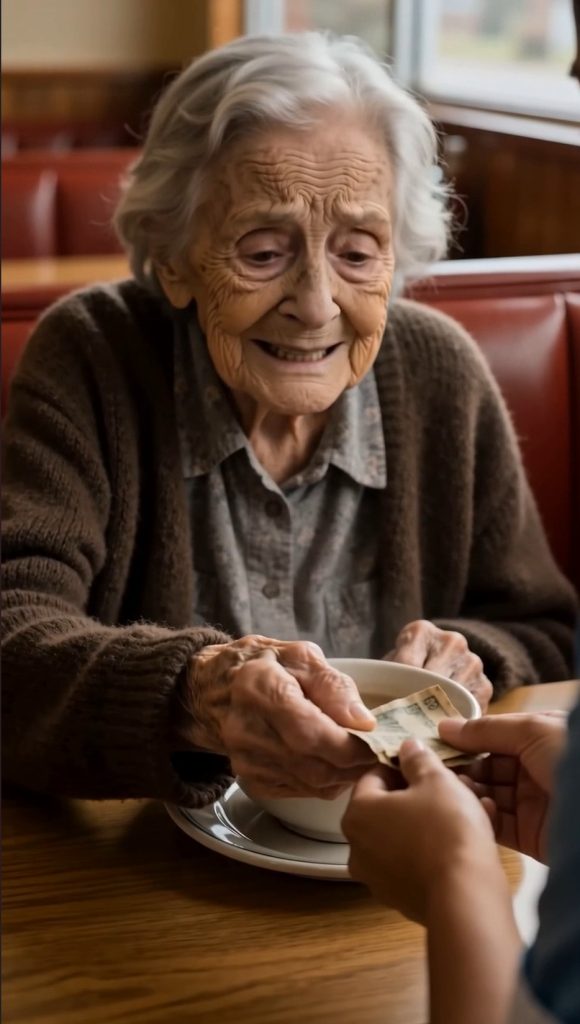
The old woman held out a folded piece of paper, her trembling fingers refusing to let go. Across the table, a waitress stared at it, unaware that the next few words would connect a simple act of kindness to something buried in her own family’s past.
But only moments earlier, everything had seemed ordinary.
The diner was warm and familiar, filled with red vinyl booths, soft yellow lights, and the quiet clinking of spoons against ceramic bowls. People ate, talked, and carried on with their evenings.
Nobody paid much attention to the elderly woman who stepped inside.
Her cardigan had faded with age. Her hands shook slightly, and the deep lines across her face suggested a lifetime of burdens she had learned to carry without asking for help.
She moved toward a corner booth.
Somewhere she wouldn’t be noticed.
But hunger wasn’t the only thing that had brought her through those doors.
She had come searching for an answer to one painful question.
Before she died, she wanted to know whether genuine kindness still existed.
And perhaps she was afraid of what she might discover.
A waitress wearing a bright blue uniform approached her table. There was something unguarded about her smile, something gentle that made the older woman look up.
A steaming bowl of soup was placed before her.
“Here’s your meal. Enjoy.”
Such ordinary words.
Yet the woman didn’t reach for her spoon.
Instead, she stared at the bowl, watching the steam rise between them. Her hands remained in her lap, and something troubled passed across her tired face.
Then she looked up.
Her eyes held an expression the waitress couldn’t quite understand.
Shame.
And fear.
Not the fear of going hungry another night.
The fear of admitting, aloud, how little she had left.
“But I don’t have any money,” she whispered.
The confession hung between them.
The waitress could have taken the soup away. She could have explained the diner’s rules, called someone else over, or quietly reminded the woman that meals had to be paid for.
There were so many ways to make rejection sound reasonable.
But she did none of them.
“Don’t worry,” she said softly. “It’s on me.”
The old woman went still.
For a moment, she seemed unable to understand what she’d heard.
Then her expression changed.
It wasn’t quite happiness. It was something heavier, the kind of emotion that surfaces when someone has spent too long expecting the worst and is suddenly offered gentleness instead.
Her eyes softened.
She gave a small, almost fragile nod.
And then, instead of touching her soup, she slipped a trembling hand inside her clothing.
The waitress watched quietly.
From an inside pocket, the woman withdrew a small piece of paper.
It had been folded so many times that the creases were deeply worn. Its edges looked fragile, as though one careless movement might tear it apart.
Yet the woman handled it with extraordinary care.
She extended it across the table.
“Please take this.”
There was something in her voice that made the waitress hesitate.
This wasn’t an ordinary thank-you.
The paper appeared to mean far more to the stranger than the warm meal sitting untouched between them.
The waitress accepted it gently.
“What’s this?” she asked.
The old woman didn’t answer immediately.
Instead, she studied the waitress’s face with an intensity that made the silence suddenly uncomfortable.
It was an unsettling look.
Not the curious glance of someone meeting a stranger.
It was as though she had been searching for this particular face for a very long time.
Then, almost too quietly to hear, she spoke.
“It’s the only reason I knew I had to find you.”
The waitress frowned.
Find her?
Before she could unfold the paper, the old woman spoke again, her voice barely above a whisper.
“Your mother left it with me the night she disappeared.”
And the paper was still unopened. 👇
The waitress’s fingers tightened around the fragile paper.
For several seconds, she couldn’t move. The familiar sounds of the diner seemed to retreat, leaving only the low hum of the refrigerator behind the counter.
“My mother?”
The old woman nodded.
“But my father said she abandoned us.”
The words escaped before the waitress could stop them. She had spent most of her life learning to say them without emotion, as though repetition could make them hurt less.
“What’s your name?” the woman asked.
“June.”
The old woman’s mouth trembled.
“I know, sweetheart.”
June carefully opened the paper.
Inside was a handwritten letter. The ink had faded, but the first words were clear enough to make her knees weaken.
My Dearest June,
If you ever read this, please understand that leaving you was the most terrible thing I have ever done.
I did not leave because I stopped loving you.
I left because I was afraid of what he would do if I stayed.
I tried to take you with me. I tried more than once.
Whatever anyone tells you, please remember that you were never unwanted.
You were the reason I kept going.
Love, Mom.
June read it twice.
Then a third time.
She knew that handwriting.
There had been a birthday card tucked inside an old photograph album at home. Its message had been short, but June had memorized every curve of the letters.
Her father had always said it was the last thing her mother wrote before walking away.
June pressed the letter against the table.
“Where is she?”
The old woman looked toward the diner’s front windows.
“Her name is Ruth. I knew her when she came to the women’s shelter where I volunteered. She was frightened, and she was trying to find a way back to you.”
June’s breathing grew shallow.
“Then why didn’t she?”
The woman lowered her eyes.
“Because your father made sure she couldn’t.”
June slowly shook her head.
Her father, Daniel, owned this diner. He had raised her, paid her bills when she struggled, and given her a job when she needed one.
He was strict. Sometimes cold.
But the man described in that letter seemed impossible to reconcile with the father she knew.
The old woman opened her worn handbag.
Inside were several envelopes tied with a faded ribbon.
“Your mother wrote to you for years. Some letters came back. Others disappeared. She eventually stopped knowing where to send them.”
June examined the envelopes.
Dates.
Postmarks.
Her childhood name written carefully across each one.
One envelope had been returned because the address was no longer valid.
Another bore a postal notation indicating that delivery had been refused.
June recognized her father’s handwriting on the forwarding instructions.
She pushed her chair back.
“No.”
The old woman reached toward her but stopped short of touching her hand.
“I’m sorry.”
June looked toward the office behind the counter.
Her father’s office.
The same room where she had once cried over a school assignment about her family, while Daniel told her that some people simply weren’t capable of staying.
Suddenly, that memory felt different.
“Is he here?” the old woman asked.
June nodded.
Then she stood.
Her coworker, Maria, looked up as June approached the office door.
“June? Are you okay?”
June couldn’t answer.
She knocked once and opened the door.
Daniel sat behind his desk, reviewing invoices beneath a fluorescent light.
He looked irritated.
“What is it?”
June placed the letter before him.
“Tell me this isn’t real.”
His eyes moved down the page.
The change in his expression was almost imperceptible, but June saw it.
His jaw tightened.
He stopped breathing for a moment.
Then he pushed the letter away.
“Where did you get that?”
“An old woman brought it.”
Daniel stood so suddenly that his chair struck the wall.
“Where is she?”
June stepped backward.
“Dad. What happened to Mom?”
“Your mother left. I’ve told you that a hundred times.”
“Then why did you refuse her letters?”
He stared at her.
June lifted one of the envelopes.
“Why did you tell me she never tried to contact me?”
Daniel reached for it.
June pulled it away.
“Answer me.”
For the first time in her life, she saw something other than authority in her father’s face.
Fear.
He walked past her into the diner.
The old woman was still sitting in the corner booth.
Daniel stopped several feet away.
“You.”
She met his eyes.
“Hello, Daniel.”
“I told you to stay out of our lives.”
The sentence fell into the quiet diner.
Maria stopped wiping the counter.
Two customers turned around.
June stood behind her father, staring at him.
“You know her?”
Daniel didn’t answer.
The old woman rose slowly, gripping the edge of the table.
“I kept quiet because you frightened me,” she said. “I won’t do it anymore.”
Daniel’s face reddened.
“You have no idea what you’re interfering with.”
“I know exactly what happened to Ruth.”
He moved closer.
“She was unstable. She couldn’t take care of a child.”
June watched the old woman’s expression harden.
“She came to the shelter with injuries. She told us what you threatened to do if she tried to leave with June.”
“That’s her word against mine.”
“Not anymore.”
The woman took another envelope from her handbag.
Inside were copies of records Ruth had preserved: dated letters to legal advisers, evidence of attempts to arrange contact with June, and documents concerning savings Ruth had set aside for her daughter.
Daniel looked at the papers.
For the first time, he seemed uncertain where to put his hands.
The old woman pointed to a bank document.
“Ruth discovered money had been transferred from an account she had established for June. She never authorized those withdrawals.”
Daniel’s voice sharpened.
“That money paid for this place. It paid for June’s upbringing.”
June felt the floor tilt beneath her.
“You took Mom’s money?”
“I provided for you!”
“You told me she didn’t want me.”
Daniel looked away.
June stepped forward.
“Did you know she was writing?”
Silence.
“Did you know she was trying to find me?”
Daniel rubbed his forehead.
“She would have ruined everything.”
June’s lips parted.
He hadn’t denied it.
All those years, she had carried the belief that she was somehow unworthy of her mother’s love.
And the person who had taught her that lie was standing directly in front of her.
“You let me think she hated me.”
Daniel’s voice dropped.
“I did what I thought was necessary.”
June wiped her cheek with the back of her hand.
“No. You did what was necessary for you.”
Maria came around the counter and stood beside her.
Daniel glanced toward the watching customers, realizing that the authority he had always possessed inside these walls was slipping away.
“You’re making a spectacle of this,” he snapped.
June removed her apron.
She folded it carefully and laid it on the counter.
“Then I’ll stop working for you.”
Daniel stared at the apron.
“You’ll regret that.”
June’s hands shook, but her voice remained steady.
“I already regret believing you.”
The old woman gathered the documents.
“Ruth’s lawyer has the originals,” she said. “She decided the truth couldn’t stay hidden anymore.”
Daniel looked from the papers to his daughter.
For once, he had nothing left that could make her obey.
The investigation that followed uncovered more than June had imagined.
The retained bank records and financial evidence revealed unauthorized transfers and forged signatures connected to Ruth’s savings. June also learned that Daniel had deliberately interfered with attempts to restore contact between mother and daughter.
He lost ownership of the diner when his financial affairs collapsed under scrutiny. Later, after legal proceedings, he was convicted for the financial crimes his records exposed.
June attended the sentencing.
She didn’t speak to him.
When he was led away, she felt no sudden triumph.
Only the strange, painful silence left behind when a lifelong lie finally disappears.
But another decision had been waiting for her since that first evening.
Back at the diner, before Daniel’s downfall, the old woman had asked a question June hadn’t been prepared to answer.
“Would you like to see your mother?”
June stared at her.
“She’s alive?”
The woman nodded.
“She has been looking for you, June. She never stopped wanting to find you.”
June covered her mouth.
“Where?”
“Nearby. She asked me to come first because she was afraid you wouldn’t want to see her.”
June looked down at the letter.
Every unanswered birthday.
Every school performance where she had searched the audience.
Every Mother’s Day she had pretended didn’t matter.
She wanted to run toward the woman who had written those words.
She also wanted to ask why finding each other had taken so long.
“I don’t know what to say to her.”
“You don’t have to know.”
June stood beside the booth for a long moment.
Then she whispered, “Please call her.”
When Ruth finally entered the diner, June recognized her before anyone spoke.
Not because she looked exactly like the photographs.
She didn’t.
Time had changed her face, silvered her hair, and placed years of worry around her eyes.
But there was something familiar in the way she held her hands together, uncertain whether she was welcome.
Ruth stopped just inside the doorway.
“June?”
June tried to answer.
Nothing came.
Her mother took one hesitant step.
“I don’t expect you to forgive me.”
June’s eyes filled.
“Did you really try?”
Ruth nodded, tears slipping down her cheeks.
“I tried, sweetheart.”
“Even when I got older?”
“Especially then.”
June swallowed.
“I thought you forgot me.”
Ruth pressed a hand against her chest.
“Not for one single day.”
June crossed the distance between them.
She didn’t know who reached first.
Only that suddenly her face was against her mother’s shoulder, and Ruth was holding her with the desperate tenderness of someone afraid to loosen her arms.
They stayed that way while the diner carried on quietly around them.
There were years to explain.
Questions that deserved difficult answers.
Trust that would have to be rebuilt slowly.
But neither woman stepped away.
In the months that followed, they began with small things.
Coffee at Ruth’s kitchen table.
Walks through the neighborhood.
Old photographs spread across a couch.
Some conversations ended in tears. Others in laughter that surprised them both.
June learned that healing wasn’t the same as pretending nothing had happened.
And Ruth learned to give her daughter room to grieve the years they could never recover.
Maria helped June find work while the legal case proceeded. Later, when the diner became available under new ownership arrangements, June returned to the familiar red booths, this time as one of the people helping run it.
The old woman, whose name was Ada, became a regular visitor.
She no longer sat hidden in the corner.
Ruth joined her whenever she could.
One evening, June brought Ada her usual bowl of soup.
Ada smiled.
“You know, there’s something I never told you.”
June sat across from her.
“What?”
Ada glanced at Ruth, who was arranging napkins nearby.
“Many years ago, your mother worked here too, before you were born.”
June turned toward Ruth.
“You never told me that.”
Ruth smiled faintly.
“I suppose there are still a few stories we haven’t reached.”
Ada touched the edge of her bowl.
“One evening, I came in with almost nothing in my purse. I was hungry and too embarrassed to ask for help.”
June grew still.
“Your mother was serving tables,” Ada continued. “She brought me soup. When I admitted I couldn’t pay, she smiled and said four words.”
June looked at Ruth.
Ada’s eyes glistened.
“It’s on me.”
Ruth covered her mouth.
June stared at both women, finally understanding why Ada had looked so heartbroken when she’d heard those same words.
“I never forgot that kindness,” Ada whispered. “And when Ruth needed somewhere safe to go, I wanted to be the person who opened a door for her.”
June reached across the table and held her hand.
The letter had brought them together.
But the kindness that had passed from one woman to another, through years of separation and fear, had given them the courage to begin again.
Outside, evening settled over the quiet street.
Inside, the red booths glowed beneath warm lights, and the soft clatter of dishes filled the room.
Ruth slipped into the seat beside her daughter.
Ada lifted her spoon.
And for the first time in many years, three women who had spent so long searching for something they feared was lost sat together around a table, with no one waiting to leave.