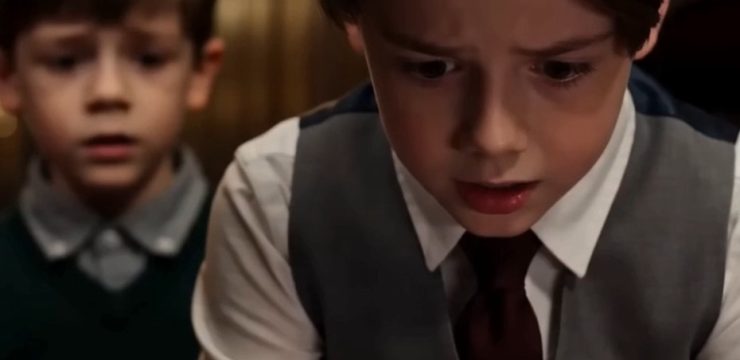
The necklace had gone missing with her. Now a little boy was standing at her grave, clutching those same worn beads, and the man who thought he had cried his last tear for her felt something inside him give way.
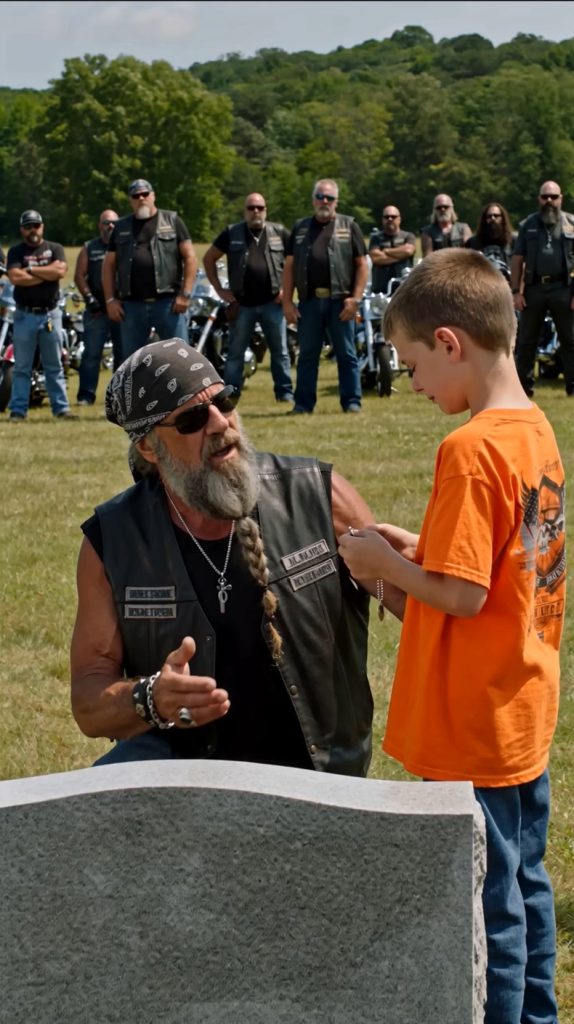
Around them, motorcycles stood silent beside the cemetery’s bright green grass. The bikers who had come to honor Marina watched as the child in the orange shirt stared at her plain gray headstone, holding the necklace so tightly that his small knuckles pressed against the string.
The older biker recognized it immediately.
He remembered those beads against Marina’s leather vest, through summer heat and pouring rain. She had worn them constantly. Even on the night she disappeared, the necklace had been with her.
He had believed that part of her story was closed.
But here it was, in the hands of a child none of them had expected to find at her grave.
The man with the braided gray beard lowered himself onto one knee. From that height, he could see how hard the boy was trying to keep his face still, how his eyes kept returning to the stone as though it might offer him an answer.
“Why do you have this?” the biker asked, struggling to steady his voice. “She never took it off.”
The boy looked down at the beads. For a moment, he seemed unable to speak, and the older man wondered whether he had frightened him.
Then the child’s eyes filled with tears.
“She gave it to me,” he whispered. “In case she didn’t come back.”
Behind them, the line of bikers shifted. No one needed to ask who the boy meant. There had only ever been one woman who belonged to the heart of their club the way Marina had.
She had been the only woman allowed to wear its founder patch. She had tended wounds, hidden runaways, and protected secrets that other people could not afford to have exposed.
Once, she had even taken a bullet intended for someone else.
The older biker knew all of that. He also knew there were parts of Marina’s life she had never explained, silences he had learned not to press.
But he had never imagined that one of those silences might arrive at her grave wearing an orange shirt.
The child rubbed his thumb over a bead. When he finally spoke again, his voice was barely strong enough to carry.
“She said if something happened to her, I had to come here.” He glanced at the man’s beard. “I had to wait for the man with the gray braid.”
The biker stopped breathing for a beat.
Marina had expected him to be here. Somehow, she had believed the boy would find him. And she had entrusted this child with the necklace she never removed.
“Did she tell you anything else?” he asked.
The boy hesitated, then reached into his pocket. He pulled out a folded scrap of paper, its creases worn so thin that the older man was afraid it might tear when he opened it.
He took it carefully. Every biker behind him had fallen quiet.
Six words were written inside, in a message that seemed to turn the cemetery cold.
“He must never learn whose son.”
Below the sentence was Marina’s name.
The biker’s fingers began to shake. He lifted his eyes from the paper to the boy’s face, and suddenly he saw what grief had kept him from noticing.
The child had Marina’s eyes.
He looked down at the note again, knowing there was one question he could no longer avoid.
And the boy was still waiting for him to ask it. 👇
The older biker folded the note carefully, although his fingers no longer seemed to obey him.
“What’s your name, son?”
“Noah.”
The answer came softly, almost swallowed by the open air.
“And who brought you here?”
“Aunt Ruth. She’s waiting by the gate.”
The biker glanced toward the cemetery entrance. An elderly woman stood beside a faded blue car, watching them with an expression that made his stomach tighten.
He recognized her.
Ruth had helped Marina shelter children who had nowhere safe to go. She had attended the funeral but never mentioned a boy.
Before he could speak, Noah tugged gently at his sleeve.
“She said there was something inside.”
“Inside what?”
The child lifted the necklace.
“One of the beads. She made me promise not to open it until I found you.”
A voice suddenly interrupted them.
“That’s enough. The boy’s upset.”
The biker turned.
Grant Mercer, the club’s longtime treasurer, was walking toward them. His polished boots pressed into the damp grass, and a silver ring flashed on his hand.
Grant had handled the funeral arrangements. He had also been the first to tell the club that Marina’s motorcycle had gone off the road.
Now his eyes were fixed on the necklace.
“Give me that,” he told Noah. “I’ll make sure it gets somewhere safe.”
The boy immediately stepped backward.
His reaction was small, but unmistakable.
The older biker rose slowly, positioning himself between Grant and the child.
“He’s already somewhere safe.”
Grant’s mouth tightened.
“Don’t make a scene at her grave.”
“Then stop reaching for something that doesn’t belong to you.”
For several seconds, neither man moved.
Behind them, the bikers had stopped talking. Grant glanced toward the others, seemed to reconsider, and stepped away.
But the older biker had seen something he could not forget.
Grant hadn’t looked surprised to see the necklace.
He had looked frightened.
The biker knelt beside Noah again.
“Listen to me. Whatever Marina left you, we’re going to protect it. And we’re going to protect you.”
Noah searched his face.
“She said you’d say something like that.”
The man’s throat tightened.
For the first time since Marina’s death, he felt something stronger than grief.
He felt responsible for what happened next.
Ruth joined them at the cemetery gate. When she saw the necklace in Noah’s hands, her shoulders sagged.
“She told me to bring him when the club came to visit her grave,” Ruth explained. “I wanted to tell you sooner. But Marina was terrified someone would find him.”
“Someone like Grant?”
Ruth looked away.
That was answer enough.
They took Noah to the clubhouse, where the walls were covered with photographs of riders who had come and gone. Marina appeared in dozens of them, always wearing that familiar necklace.
The boy stopped before one photograph.
“That’s her.”
His finger rested against the glass.
The older biker watched him carefully.
“Did she visit you often?”
Noah nodded.
“Whenever she could. Sometimes she couldn’t stay long. But she always came back.”
He hesitated.
“Until she didn’t.”
No one in the room knew what to say.
At a wooden table beneath the photographs, Ruth helped Noah find the unusual bead. It was darker than the others and had a faint seam around its middle.
The boy twisted it exactly as Marina had taught him.
It opened.
Inside was a tiny memory card.
The older biker stared at it.
Then he reached for his phone and called the detective who had investigated Marina’s death.
By evening, they understood why Grant had been so desperate to take the necklace.
The card contained copies of financial records, messages, and recordings Marina had collected over several months.
Grant had been stealing money from the club’s emergency fund, including donations intended to shelter runaway children and pay medical bills for injured riders.
Some transfers carried Marina’s forged signature.
Others led to accounts controlled by Grant.
But the worst discovery was an audio recording.
Marina’s voice sounded steady, though exhausted.
“I’m not letting you take another dollar from those kids.”
Grant answered with a threat.
“Then you’re going to regret looking through my books.”
The older biker gripped the edge of the table.
He had heard that voice countless times.
He had trusted it.
Grant had stood beside him at Marina’s funeral, speaking solemnly about loyalty while helping carry the coffin.
The detective continued examining the files.
Among the records was a message Marina had sent Grant shortly before her fatal ride, telling him she intended to hand everything to the authorities.
Investigators reopened the motorcycle evidence.
What had initially been treated as a road accident now demanded a different explanation.
The older biker wanted to confront Grant immediately.
Instead, he looked toward Noah, asleep on the clubhouse couch beneath a borrowed jacket.
He remembered how the child had recoiled from Grant’s outstretched hand.
Then he made the harder choice.
He gave the evidence to the detective and agreed to let the investigation proceed.
Two days later, Grant arrived at the clubhouse demanding to know why his access to the club’s accounts had been suspended.
The room was crowded.
Every member had been called to hear the truth.
The detective stood near the doorway.
Grant spotted him and stopped.
“What’s this supposed to be?”
The older biker placed copies of the financial records on the table.
“Marina found out.”
Grant looked down.
For an instant, his expression emptied.
Then he laughed.
“You’re trusting paperwork over a man you’ve known twenty years?”
“She recorded you.”
Silence spread through the room.
Grant’s face changed.
“She had no right going through my things.”
“She was protecting children.”
“She was going to destroy everything!”
The words came out louder than he intended.
The older biker stepped closer.
“So you destroyed her instead?”
Grant’s jaw tightened.
“I never meant for her to die.”
Nobody moved.
The detective spoke quietly.
“What did you mean to happen, Mr. Mercer?”
Grant looked toward the exit.
Two officers were already standing there.
His shoulders dropped.
“I only wanted her off that bike. I thought if she got scared enough, she’d leave it alone.”
The older biker stared at him.
“Her brakes?”
Grant said nothing.
The detective had already told him that investigators had uncovered evidence of interference with the braking system.
Now Grant had connected himself to the very act that killed her.
He tried to take back his words.
But the detective stepped forward.
“Grant Mercer, you’re under arrest.”
The sound of handcuffs closing seemed impossibly loud.
Grant looked around the room, searching the faces of the men who had once called him brother.
No one came forward.
One biker quietly removed the club patch from Grant’s vest before the officers escorted him outside.
The man whose life Marina had once saved turned toward the wall and covered his face.
The older biker remained beside the table.
For years, he had believed loyalty meant trusting the men who stood beside him.
Now he understood that Marina had been carrying the cost of that trust alone.
In the months that followed, Grant’s financial records, recordings, and the renewed investigation led to criminal charges for fraud and Marina’s death.
Faced with the evidence, he eventually pleaded guilty.
He was sentenced to prison, stripped of his position, and ordered to repay the stolen funds through restitution.
The money could not bring Marina back.
But the children she had protected would no longer have to depend on Grant’s promises.
The club established independent oversight for its emergency fund. Every expense would be documented, every donation accounted for.
And Marina’s name was placed above the door of the shelter Ruth helped operate.
Yet one question remained unanswered.
One evening, Ruth asked the older biker to visit her house alone.
Noah was in the living room, quietly arranging toy motorcycles along the windowsill.
Ruth led the biker into the kitchen.
“Marina wanted you to have something,” she said.
From a drawer, she removed an envelope.
His name was written across the front in handwriting he knew better than his own.
He opened it slowly.
Inside was a letter.
Marina had written it before her final ride.
She explained that she had discovered Grant’s theft and feared what he might do if he learned about Noah.
Grant knew her old relationship with the gray-bearded biker had once been more than friendship.
He knew how deeply the man still cared for her.
But he did not know about the child.
And Marina had been determined to keep it that way until Grant could no longer threaten them.
Then came the sentence that forced the older biker to sit down.
“Noah is your son.”
He read it again.
And again.
Nine years earlier, he and Marina had shared a brief, tender reunion before their lives pulled them in different directions.
He had never known she was pregnant.
Marina wrote that she had wanted to tell him countless times. But as Grant’s threats grew and her efforts to expose him became more dangerous, she feared their son would become a weapon against the man she loved.
She had entrusted Noah to Ruth, believing the secret would keep him safe.
Now the six words on the cemetery note made sense.
“He must never learn whose son.”
They had never been meant to keep the truth from Noah’s father.
They had been a warning about Grant.
The older biker pressed the letter against his chest.
For a long time, he could not speak.
Ruth sat beside him without touching him.
Finally, he whispered, “She thought she had to carry all of this herself.”
“She thought she could tell you when it was over,” Ruth answered.
He lowered his head.
“I would have protected them both.”
“I know.”
From the living room came the soft clatter of a toy motorcycle falling against the floor.
The biker lifted his face.
“Does Noah know?”
Ruth nodded.
“Marina told him his father was a good man. She wanted him to hear the rest from you.”
The man stood, then stopped at the kitchen doorway.
He had faced accidents, violence, and loss.
But nothing had prepared him to tell a little boy that the person he had been waiting for was his father.
Noah looked up when he entered.
“Did you read her letter?”
The older biker nodded.
“Yes.”
The child studied him.
“Are you mad she didn’t tell you?”
He sat on the floor beside him.
“No, son. I wish she’d had the chance. I wish I’d known you sooner.”
Noah picked up a blue toy motorcycle.
“She said you liked blue bikes.”
A tear slipped down the man’s cheek.
“She remembered that?”
“She remembered lots of things about you.”
The boy pushed the motorcycle toward him.
“Do you want to play?”
The older biker took it.
“I’d like that very much.”
They stayed on the floor until the evening light faded, moving little motorcycles between the furniture.
Neither tried to explain all the years that had been lost.
For the first time, they were simply together.
As the months passed, Noah began spending more time with his father, while Ruth remained the steady presence who had helped raise him.
Some nights, the boy asked about Marina.
His father never pretended the answers were easy.
He told him about the wounds she had bandaged, the frightened children she had sheltered, and the way she always noticed when someone was struggling to be heard.
He also admitted that she had been afraid.
Noah listened carefully.
“Was she brave anyway?”
His father smiled through tears.
“Especially then.”
One spring afternoon, the entire club returned to the cemetery.
This time, there were no accusations, no secrets waiting to be uncovered.
Noah walked between his father and Ruth, wearing a small leather vest the bikers had made for him.
The necklace rested beneath his shirt.
At Marina’s grave, the boy took his father’s hand.
“Do you think she knew we’d find each other?”
The older biker looked at the weathered headstone.
Then he looked at the boy.
“She did more than hope for it.”
Noah reached beneath his collar and lifted the beads.
“She told me these were special.”
“They were.”
“She said they weren’t just something to remember her by.”
His father turned toward him.
“What did she say?”
Noah smiled faintly.
“She said they were the way to find my way home.”
The older biker closed his eyes.
He had spent so long believing the necklace was the last thing Marina had lost.
Now he understood it had been the final thing she had given.
A path back to the family she had tried so desperately to protect.
He knelt beside the boy and wrapped both arms around him.
Noah held on.
Behind them, the bikers stood quietly while the afternoon sunlight moved across Marina’s stone.
Later, when they rode home, Noah sat safely in Ruth’s car, watching his father’s motorcycle travel just ahead.
At the house, the older biker opened the door and stepped aside.
Noah entered carrying his little blue motorcycle.
He placed it on the shelf beside a framed photograph of Marina.
Then he turned around.
“Dad?”
The older biker went still.
It was the first time the boy had called him that.
“Yeah, son?”
Noah held out his hand.
“Can we go outside for a while?”
His father took it.
Beyond the doorway, the evening was quiet. The motorcycles were parked, the windows glowed warmly, and Ruth was setting the table inside.
The boy walked beside him into the fading sunlight, the old beads resting safely against his heart.
And for the first time, neither of them was waiting for someone to come home.
They were already there.