Every day, a dog cried out from the place where he was chained. He was thin, weak, and neglected. The barking carried far enough for a nearby couple to hear. They had no idea how badly he was hurt.
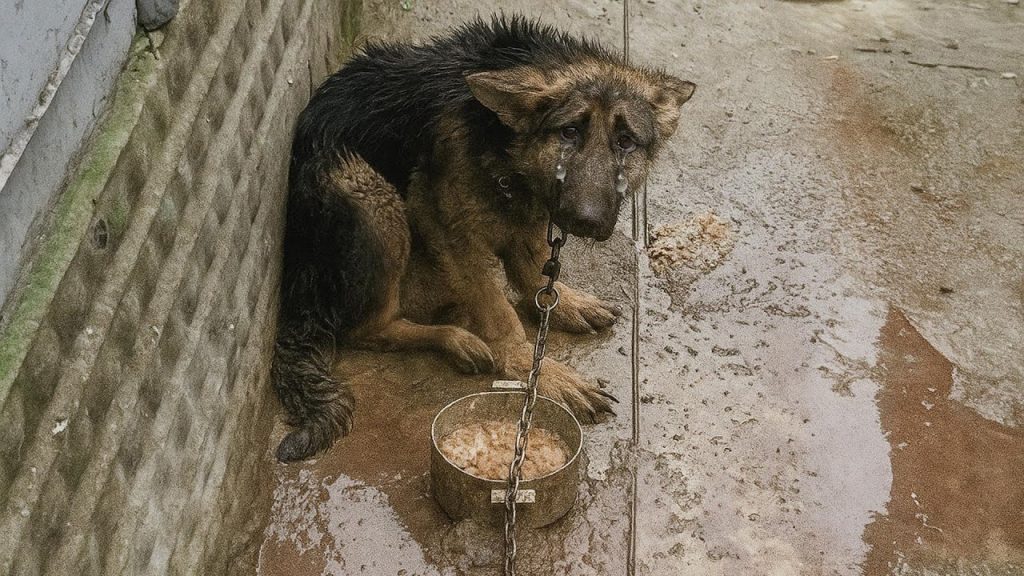
Alpha spent his days outdoors, surrounded by dirt and trash. He slept on cold, filthy concrete. There was no comfortable resting place to ease his tired body, no loving attention to reassure him, and no sign that his owner cared about the suffering taking place so close by.
He barked desperately, day after day. His cries spoke to the loneliness of a dog left without comfort. Alpha could not explain what hurt. He remained chained, waiting for kindness that never arrived.
The couple living nearby heard him regularly. His barking haunted them. For the wife, hearing his desperate cries repeatedly became unbearable. She told her husband that they needed to do something for the dog.
Together, they approached Alpha’s owner and asked whether they could take him in. The answer came immediately. The owner agreed to give Alpha up without hesitation, showing little concern for the animal he had left outside. There was no struggle to persuade him, no indication that losing Alpha meant anything to him.
For Alpha, however, that brief exchange changed the direction of his life forever.
The couple brought him home, where the full extent of his neglect became painfully clear. His paws were sore, scarred, and infected, with bleeding areas caused by the dirty, muddy conditions in which he had been living. Even the simple contact of his feet with the ground had become part of his suffering.
His body carried such a strong odor that one bath was not enough. His rescuers washed him three times in succession, trying to remove the grime that had accumulated while he was left outside. It was an ordinary act of care, but it marked an extraordinary contrast with the life he had known. Someone was finally paying attention to his needs.
Yet cleaning his coat and caring for his paws could not solve the most serious problem. Alpha was unable to walk normally. His right leg trembled repeatedly, and the pain behind those movements was impossible to ignore. The couple took him to a veterinarian, hoping to understand what was wrong and what could be done.
The examination brought distressing news. Alpha’s leg was broken. He needed urgent surgery to repair it, including the placement of a metal plate. Without that intervention, he faced the prospect of never walking again.
It was a frightening discovery for a dog who had already endured so much. His injuries were not simply evidence of a harsh past. One of them now threatened the freedom to move that every active dog should have the chance to enjoy.
The operation was successful. But surgery was only the beginning of the work required to help Alpha recover. The next challenge would demand patience from everyone caring for him, especially because being still did not come naturally to this curious dog.
Alpha loved to explore. Now, when he finally had people looking after him and a chance at a better life, he had to remain quiet and limit his movements. Running and jumping were out of the question. Even licking the surgical stitches had to be prevented so the wound could heal properly.
For his new family, recovery meant showing up for the small, necessary tasks again and again. They cleaned the wound, changed his bandages every day, and carefully followed the restrictions that stood between Alpha and further injury. None of it was glamorous. All of it mattered.
There is a special kind of devotion in caring for an animal through the slow part of healing. It means understanding that love is not only a welcome home or a comforting touch. Sometimes it is a clean bandage, another careful day of rest, and the patience to put a dog’s recovery ahead of everything he wants to do.
That was the care Alpha received. The same dog who once lay neglected on dirty concrete now had people committed to helping his body mend. Where there had been indifference, there was attention. Where there had been isolation, there was a family willing to stay beside him through a difficult recovery.
Eventually, his stitches were removed, and Alpha could begin learning to walk again. Those steps mattered because they led to something that had once seemed painfully uncertain. He progressed from walking to running, then to jumping. The improvement astonished even his veterinarian.
The dog whose right leg had once shaken in pain was moving with a freedom that the couple had fought to give him. It did not erase everything he had endured. It did show what medical treatment, careful rehabilitation, and steady affection could make possible together.
When summer arrived, his new family took him swimming. The cool water became part of a happier life, offering a gentle way for Alpha to move and helping him heal, physically and emotionally. He was no longer a dog confined to a patch of concrete. He could experience the world alongside people who wanted him there.
Today, Alpha joins his family on camping trips, hikes, and swimming outings. He sometimes walks with a slight limp, a reminder that his injured leg has a history. But that uneven step does not define him. Neither does the chain, the dirt, or the loneliness of his earlier life.
What defines this chapter is the choice a nearby couple made when they refused to ignore his cries. They could not undo Alpha’s suffering. They could give him treatment, safety, patient care, and the chance to discover what being loved feels like.
Alpha’s story leaves a simple truth behind: a life marked by pain is never beyond the reach of compassion. Sometimes the beginning of a new life is one person hearing a cry and deciding it deserves an answer.