She had newborn puppies to protect, but someone had taken away her freedom to protect them. In an isolated part of Serbia, a mother dog had been abandoned with her babies and chained in place. She could not leave to search for food, find water, or lead her little family somewhere safer.
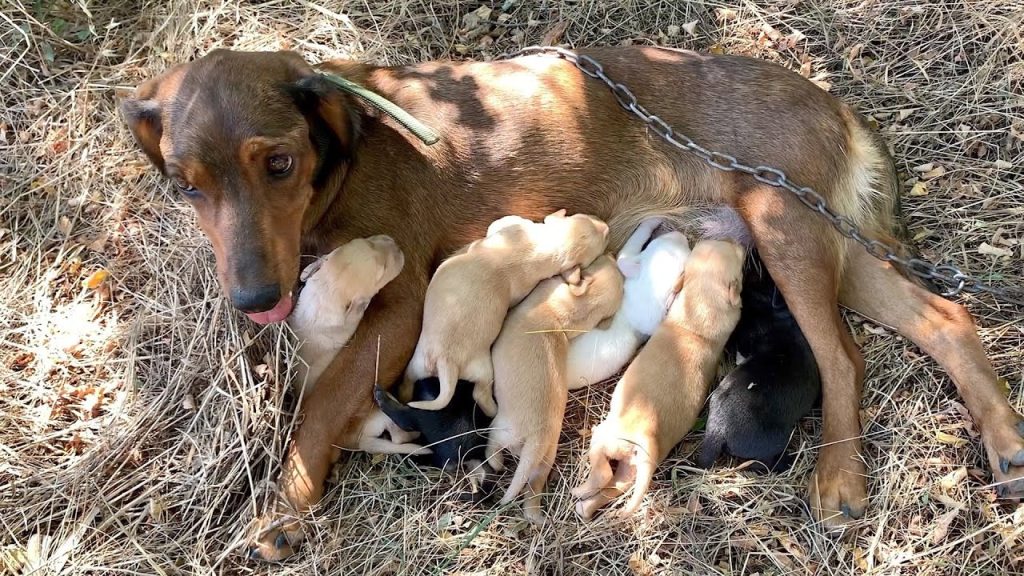
For this dog, even the most basic choices had been taken away. The chain around her neck kept her near her puppies, but it also trapped her in the very place where they had been left. She had no way to seek what they needed beyond the reach of that chain.
Her puppies were still so young that they depended entirely on her. They could not understand why their world had become this lonely patch of ground. They knew only the presence of their mother, the one source of comfort they had. And she, despite everything that had been done to her, was still there with them.
The rescue team discovered the little family in that deserted area. The sight was difficult to accept: a mother with newborn babies, abandoned where help and shelter were not readily available, and a chain preventing her from moving freely. This was not simply a dog left outdoors. Someone had made certain she could not walk away.
One of the rescuers approached her carefully. A frightened animal caring for newborn puppies needs more than a quick hand reaching toward a collar. She needs an opportunity to recognize that the person coming closer does not mean harm. The man understood that his manner mattered as much as his intention.
He spoke to her gently in Serbian. “Zdravo,” he said, offering a simple hello. He called her “Mama,” a small word that acknowledged the role she was still trying to fulfill under impossible circumstances. His calm voice was an attempt to reassure her before he tried to remove the chain.
There was sorrow in his reaction, but also disbelief. Looking at what had been done, he wondered aloud how anyone could chain a mother dog so she could not leave. His words gave voice to the cruelty of the situation without needing to exaggerate it.
A dog should never have to choose between staying with her babies and reaching the food or water that could keep her going. This mother had not even been given that choice. She was forced to remain, with her newborns beside her, dependent on the possibility that somebody would find them.
And somebody had.
The rescuer continued approaching with patience. His gentle words helped ease the fear that stood between the mother and the people trying to save her. He did not treat her as a problem to be moved out of the way. He treated her as a living creature whose safety and trust mattered.
Once she was calm enough for him to help, he removed the chain from her neck. It was a simple action with enormous meaning. A restraint that had made survival more difficult was finally gone. The mother dog was no longer fastened to the place where she had been abandoned.
But freedom alone was not the end of this rescue. Her puppies were still newborns. They could not be left behind, and their mother needed a safe place to care for them. The team gently gathered the little ones, making sure the family could leave together.
The rescuers then brought the mother and her babies into their vehicle. The chain had kept her captive; now people were helping her move toward safety. What changed was that she would no longer have to meet those needs alone in an isolated place.
As they prepared to leave, the rescuer spoke another reassuring sentence in Serbian: “Hajde sad ideš kod nas.” In English, his message was simple: “Come on, now you’re going home with us.” There was no grand promise in those words. There was something more practical and precious: a safe destination for a family that had been abandoned.
The mother and her puppies were taken to the rescue shelter, away from the danger and deprivation they had faced. There, food, water, veterinary attention, and ongoing care could become part of their new circumstances. Their future would no longer depend on whether a stranger happened to pass the place where they were chained and left.
The puppies still had growing to do, and their mother still had the responsibilities of caring for them. Being rescued did not erase what had happened, and it did not mean that the family had already found permanent homes. The shelter offered something necessary before any of that could happen: a protected place where their needs could finally be addressed.
For the people who came to help, saving this family meant more than carrying puppies and unfastening a chain. It meant recognizing that these animals had been made vulnerable through no choice of their own. The mother had been denied the freedom to seek safety, yet she had remained with the babies who depended on her.
There is a particular sadness in seeing such devotion met with abandonment. Newborn puppies know nothing of human decisions. They cannot understand why they have been left in an empty place, or why the mother they rely on cannot move beyond a length of chain. Their needs are ordinary: warmth, nourishment, protection, and the steady presence of their mother.
Those needs should never have been treated as unimportant. Thankfully, the rescuers recognized them. By approaching gently, removing the restraint, and taking the entire family to safety, they gave this mother something she had been denied: the chance to care for her puppies without being trapped.
A loving permanent home may still be ahead for each of them. The ending that matters is real enough. A mother dog and her newborns were found, freed, and brought somewhere safe. One chain was taken away. In its place came the possibility of a kinder life.