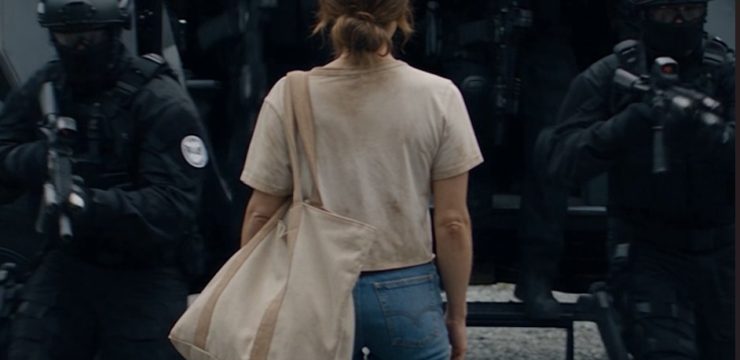
For one long second, nobody moved.
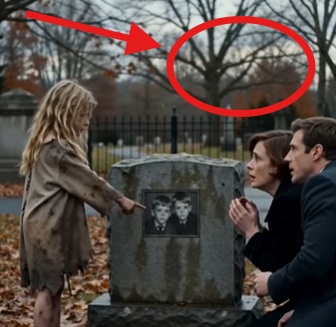
Not the father. Not the mother. Not even the little girl standing barefoot at the edge of the cemetery with mud on her heels and something impossibly familiar tied around her wrist.
A blue string. Braided. Worn soft from time.
The kind a child makes when he wants to believe the world is still an adventure.
The father saw it first. His eyes locked onto that small loop of faded blue, and everything inside him went absolutely still — the way a man goes still when reality cracks open and something impossible begins to pour through. Because he knew that bracelet. He had laughed the day his youngest son made it. His boy had called them “adventure bands,” had braided one for himself and one for his brother, had announced with complete seriousness that anyone wearing one was protected from danger. The mother had taken a photograph. It sat on the mantle back home beside two white candles that had been burning for months.
And now one of those bands was tied around the wrist of an orphan child he had never seen before in his life.
His throat tightened into something that barely allowed words through.
“Where did you get that?”
The girl looked down at the string the way children do when they’ve stopped noticing something precious — as though it had simply always been part of her. Then she answered with the quiet certainty of someone who didn’t understand why the question mattered.
“He gave it to me when we hid.”
The mother made a sound that lived somewhere between a gasp and a sob, a sound that had no proper name because grief had not prepared her for this particular moment. Because in that single sentence, the entire shape of everything they had suffered shifted beneath their feet.
Not dead. Not buried. Hidden.
The girl turned and walked toward the cemetery gate without being asked, and the parents followed without a single word between them, because there were no words yet for what was happening. Leaves broke softly under their feet. The road beyond the iron fence looked too ordinary, too indifferent, for the magnitude of what this child was quietly unraveling.
She spoke in the fragmented way children do when they don’t realize that every sentence is quietly destroying the adults walking beside them.
There had been smoke, she said. They had been told to stay beneath the beds. But then a woman came. Not a firefighter. Not a nun. A woman the girl described only by what she drove — a red car — and by what she did in the confusion of that terrible night.
The mother stopped walking for one full heartbeat.
Because St. Agnes had not simply burned. There had been whispers afterward — records that could not be located, an investigation that closed faster than it opened, donors whose names appeared nowhere in any report, nuns who were quietly transferred before anyone thought to ask them questions. The fire had consumed more than a building. It had consumed accountability.
The father turned back to the child.
“What did the woman do?”
The girl shrugged the way only the very young can — a shrug that carries no weight because she did not yet understand the weight of what she was carrying.
“She sold the pretty ones first.”
That was the sentence that ended every remaining hope of a simpler explanation.
The boys had not died in the fire. They had survived it. And in the chaos of that night, someone inside those walls had made a deliberate choice — to move certain children out before any official could arrive to count who remained among the living.
The mother pressed both hands over her mouth. The father kept walking, but the grief in his stride had been replaced by something harder and colder and far more focused. He was no longer a man in mourning. He was a man who had just understood exactly what kind of darkness he was walking into.
At the far edge of the orphanage grounds, where the property met a line of overgrown hedges, the girl stopped beside a low outbuilding — boards nailed across the lower windows, a service door hanging slightly crooked on its hinges. She lifted one small hand and pointed upward.
“They sleep upstairs,” she said quietly, “when the men come.”
The mother’s knees nearly gave beneath her.
Because from somewhere above them — muffled through old wood and plaster, but unmistakable to a mother who had spent months drowning in the absence of it — came a sound.
A laugh. A boy’s laugh. Then a second voice, hushing the first one too quickly.
The father moved toward that door before the sound had finished reaching him, every last trace of numbness burned clean away.
The girl reached out and caught the mother’s sleeve before she could follow. She looked up with eyes that had seen far too much and understood far too little of what they had witnessed. And she said the words that broke the mother in a way nothing else had quite managed to break her.
“They still call for you at night.”
That was the cruelest part. Not that the boys were alive — though that alone was almost more than a heart could hold. But that they had survived long enough, and suffered long enough, and hoped long enough to still be calling for her in the dark.
The mother turned back once toward the graves they had kept. Two white headstones catching the gray afternoon light. Flowers left by hands that had believed they were saying goodbye.
They had grieved children who were waiting to be found.
And somewhere above that crooked door, behind those boarded windows, two boys who still wore the hope of adventure bands were about to hear their mother’s voice again.