For one long second, nobody in that grand hotel lobby remembered how to breathe.
The last note from the piano still trembled in the air, alive and impossible, hanging there like something that didn’t belong in this world anymore — because it didn’t. That melody hadn’t existed for years. And the man sitting at the bench hadn’t played a single note in just as long.
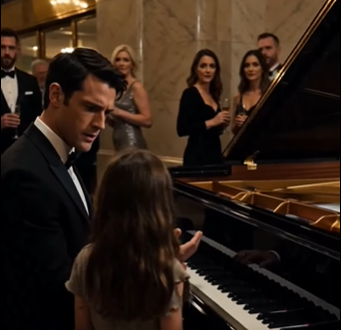
His right hand had been silent for longer than most people in that room could remember. An accident had stolen the movement. The doctors had offered explanations. His family had offered condolences, then pressure, then silence of their own kind. Wealth had eventually stepped in — not as celebration, but as insulation. A way to keep the grief at a comfortable distance where it looked like composure.
He had learned to live behind the piano without ever touching it. A beautiful prop. A monument to everything gone wrong.
Then a small girl walked in from off the street, sat down uninvited at those ivory keys, and played.
But that wasn’t even the part that undid him.
It was what she wore around her neck.
A tiny silver charm. A single musical note, handcrafted and deliberately unique. He recognized it the way a man recognizes the face of someone he once loved more than sleep, more than sense, more than his own careful survival. Because he had designed that charm himself. He had commissioned it years ago, before the accident, before the grief, before life became something he simply endured rather than lived. He had it made for his wife after they wrote their first song together. She wore it every single day without exception. And on the night she disappeared, it was still fastened around her neck.
The police used the word disappearance.
The newspapers used worse words.
His family used the word shame and told him to let it go, to move forward, to stop looking backward at a woman who was clearly never coming home.
He never stopped looking.
He just got quieter about it.
Now this little girl — this child in a torn dress who had walked into a polished, glittering room full of polished, glittering people — stood in front of him wearing the one object in all the world that should have been lost forever.
His voice came out raw.
“Where did you get that?”
The girl touched the charm gently, the way children touch things that feel important without fully understanding why.
“My mom gave it to me.”
The room seemed to tilt beneath everyone’s feet. The guests stopped pretending to look entertained. They stood very still instead, caught inside a story that wasn’t theirs but felt uncomfortably real, the way certain truths always do when they surface in the wrong places at the wrong moment.
He asked for her mother’s name.
The girl didn’t answer immediately. She looked at the piano instead, as if she were listening for something beneath the silence.
“At night,” she said softly, “she used to tap songs on the windowsill. She said your music still lived in her fingers, even when everything else was gone.”
That single detail destroyed him more completely than anything else could have.
Because that was her. That was exactly her. That specific habit, that specific way of carrying love even when love had no place left to go. No one could have told a child that detail. No one else had ever known it. It was the kind of thing that only exists between two people in the quiet of a private life, the kind of thing that disappears when one of those people disappears.
Except it hadn’t disappeared.
It had been preserved. Carried forward. Handed down.
He sat down on the piano bench, not with grace, but with the particular weight of a man who has just watched something impossible become undeniable. The girl stepped closer. She wasn’t afraid. She moved like she had been sent for exactly this moment and she knew it.
“She told me,” the child whispered, “if your hand moved before your face smiled, then I found the right man.”
He understood immediately. His hand had moved first. Before hope arrived. Before denial could form. Before a single word left his mouth. The music had come back through his fingers before his mind had even caught up with what was happening.
The girl reached into the pocket of her dress and placed a folded scrap of paper on the lid of the piano. Just a few penciled notes. Half-finished. Ancient. His melody — the unfinished one from the night everything ended. But at the bottom, written in a different hand, was a final line he had never written himself.
Her hand.
Beneath the melody she had written four sentences that unmade and remade him in the same breath:
I hid so they couldn’t destroy her too. If she finds you, play the ending.
He held the paper for a long time. He looked at the girl. He looked at his hand, the hand that had been silent for years, the hand that had just remembered itself without his permission.
And then, slowly, he placed his fingers on the keys.
The first notes broke apart.
Then they held.
Then they soared.
Every person in that lobby stood completely still and finally understood what they were witnessing. This child had not wandered in looking for attention or charity. She had walked through that door carrying the missing half of a woman, a love story, a melody interrupted by forces that thought they could erase it entirely.
She had carried her mother’s message across years and silence and distance — and somehow, against every reasonable expectation, she had found the right man, in the right room, at the right moment.
His hand was moving again.
And somewhere, the song was finally finished.