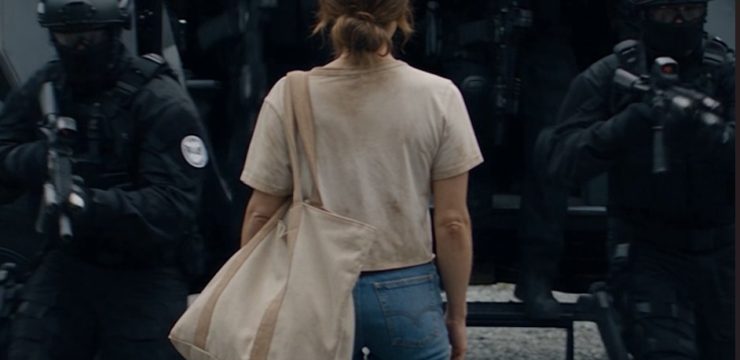
Nobody in that roadside diner moved.
Not the waitresses gripping their order pads.
Not the leather-clad bikers sprawled across the booths.
Not even the giant they all called Rex.
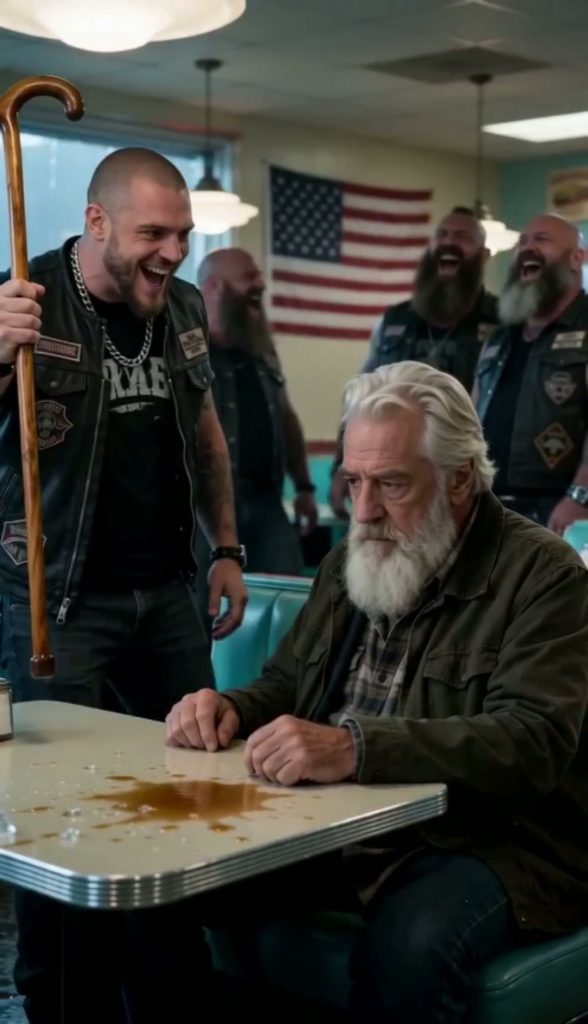
The words hung in the air like smoke that wouldn’t clear.
Your grandfather’s cane.
Rex stared at the frail old man as though he had misheard him — as though the universe had made some kind of clerical error. The kind of man who bent over tables with a walking cane and a quiet voice didn’t belong in the same sentence as someone like Rex. Rex, who had walked into this diner twenty minutes ago like he owned the county. Rex, who had knocked the cane out of the old man’s hands without looking back, who had laughed, who had let his crew laugh with him.
But the old man hadn’t flinched. He had simply waited.
Then the diner door swung open.
Two men in dark, well-fitted suits stepped inside alongside a woman carrying a structured leather file case. They weren’t law enforcement — they didn’t need to be. The way they moved through the space made every body in the room quietly rearrange itself without a single word being spoken. One of them bent smoothly, retrieved the cane from the floor, and returned it to the old man with both hands, as if it were something precious.
The old man — Mr. Hale — accepted it without once looking away from Rex.
“What game are you playing?” Rex asked. But the crack in his voice gave him away.
Mr. Hale didn’t answer the question. Instead, he said two simple words.
“Take off the vest.”
Rex’s entire frame went rigid.
“No.”
One of his own crew behind him muttered his name — a warning, a question — but Rex didn’t turn around.
Mr. Hale gave the quietest nod toward the woman with the file. She opened it. She removed a single photograph and placed it flat on the table between them.
It showed a young man in a leather vest, standing beside a motorcycle, smiling the kind of reckless, beautiful smile that belongs to people who don’t yet understand consequences. On the inside collar of his vest was a faded silver hawk patch — the exact same one sewn into Rex’s.
Rex looked down at it.
Then he went completely still.
Because the man in that photograph had his eyes. His jawline. His exact crooked half-smile, the one Rex had always assumed meant nothing beyond genetics he’d never been able to trace.
The old man spoke again, and this time his voice carried the weight of decades.
“His name was Ethan Hale. He was my son.”
The whole diner held its breath.
Rex’s voice came out quieter than anyone had ever heard it. “My mother told me my father was dead.”
Mr. Hale’s expression tightened. “He is,” he said. “For twenty-two years.”
Rex swallowed. “Then how do you know me?”
The old man rested both weathered hands on the cane and answered like every single word cost him a piece of his breath. “Because Ethan vanished before he could bring you home.”
The woman slid a second photograph from the file — older, the corners worn soft with time. A younger Ethan stood outside a trailer beside a pregnant woman, one hand resting protectively over her belly, both of them squinting in sunlight they thought would last forever.
Rex’s face went pale as chalk.
That woman was his mother.
“I had people searching for him for years,” Mr. Hale said. “But after Ethan was killed, your mother ran. She believed I held her responsible for drawing him away from the family. I never did.” His voice roughened at the edges. “I simply never found her in time.”
Rex stared at the photographs the way a person stares at something they suddenly can’t unsee. All the leather and the laughter and the carefully built armor of who he had decided to be — it all looked thin now. Unconvincing. Like a costume he had never quite grown into.
“My mom,” he started. Then stopped. “She passed away last winter.”
The old man closed his eyes for one long moment. When he opened them, they were wet.
“She kept you from me because she was frightened,” he said. “And I stayed away too long because I was too proud to reach further.” He looked at Rex with the kind of honesty that leaves no room for softness. “We both failed you. There is no other way to say it.”
That landed harder than any shout ever could have.
One of the bikers in the back silently dropped into a booth, all the bluster gone out of him.
Rex looked down at the silver hawk patch on his vest. “My mother re-stitched that every time it came loose,” he said slowly. “She told me it was the only thing my father ever left me.”
Mr. Hale reached into the inside pocket of his coat and produced a small metal tin. Inside, nestled carefully, was an identical patch — faded, preserved, kept safe across more years than Rex had been alive.
“Your grandmother made two of them,” the old man said. “One for Ethan. One to stay at home.” His voice broke, cleanly, like something that had been held together a long time. “I never imagined I would see the other one again.”
Rex’s face changed in that moment. The arrogance dissolved. The hard edge fell away. He looked suddenly younger — more like a boy who had been handed too much loss and too little explanation, and had built an entire identity around never admitting either.
He looked at the cane. At the broken glass still scattered on the floor. At the old man’s steady, grieving eyes.
“I didn’t know,” he said.
Mr. Hale nodded slowly. “I know.”
Rex took one step forward. No one behind him made a sound.
He bent down and picked up the old man’s fallen napkin from the table, then stood there holding it, looking almost ashamed that such a small gesture was all he had to offer after everything.
“I’m sorry,” he said, and his voice held none of its earlier bravado. “I thought you were just some old man passing through.”
Mr. Hale gave a sad, tired half-smile. “I was,” he said quietly. “Until I saw my son looking back at me through your face.”
That broke what little remained of Rex’s composure.
His eyes filled. He pulled off the leather vest, turned it over in his hands, looked at the silver hawk patch stitched carefully inside — and for the first time in his life, he understood exactly why his mother had cried every single time her fingers touched it.
“My real name isn’t Rex, is it?” he asked.
Mr. Hale’s grip tightened on the cane. “No,” he said softly. “Your name is Eli Hale. Ethan chose it before you were even born.”
Eli — because that is who he had always been — let out a breath that sounded like something finally releasing after years of being held in too tight. He lowered himself into the booth across from the old man, like his legs had simply decided they were done pretending the floor was solid.
For a long, full moment, grandfather and grandson looked at each other across the same table where humiliation had begun only minutes before.
Then Eli asked the question that had been missing from the center of his entire life.
“Did he want me?”
Mr. Hale answered without a single hesitation.
“With everything he had.”
Silence settled over the diner again. But this time it wasn’t the silence of shock or cruelty or held breath. It was the silence of something enormous finally coming to rest — the kind of quiet that only arrives after a long search ends.
Mr. Hale slowly extended the cane across the table.
Eli looked at him, confused.
The old man’s voice shook — just slightly, just enough. “Help me up.”
Eli stood immediately. He stepped forward and placed the cane carefully into his grandfather’s hand. Then, just as carefully, he offered his arm.
The old man took it.
And in the middle of that roadside diner, with shattered glass still on the floor and dark vehicles waiting quietly outside, the man who had walked in swinging his cruelty around like a birthright helped his grandfather to his feet —
not because anyone told him to,
not because the room was watching,
but because something older and deeper than pride had finally called him by his real name,
and for the first time in his life,
he had answered.