Nobody expected the truth to come out the way it did — not through a confession, not through a confrontation planned in advance, but through a glass of orange juice hurled across a room by a woman who thought she was untouchable.

The maid stood in the center of the living room, her uniform soaked through, her hands trembling at her sides. She wasn’t crying yet. She was past the point where tears come quickly — she was somewhere deeper, somewhere that takes years of silence and suffering to reach.
The man of the house stepped through the doorway and felt the air change immediately. Something was wrong. The kind of wrong you feel in your chest before your brain catches up.
“What happened here?” he asked.
Nobody answered at first.
The woman in white — his wife, his partner, the woman he had built a life with — sat on the sofa with her chin lifted and her hands folded in her lap, perfectly composed. Too composed. The kind of composure that only exists when someone has done something they refuse to feel guilty about.
The maid’s hand moved slowly to her stomach.
That single gesture changed everything.
He saw it. He understood it before she even spoke.
“She threw it at me,” the maid finally whispered. “And I — I felt something. I think I need to sit down.”
His eyes dropped to her belly. Then snapped back to his wife’s face.
“It’s not what it looks like,” his wife said immediately, her voice sharp and practiced. “She made a scene. She ruined the afternoon and—”
“Be quiet.”
He didn’t raise his voice. He didn’t need to.
The silence that followed was heavier than any shouting could have been. His wife went pale for the first time. Because she recognized something in his tone that she had never heard before — a line being crossed that couldn’t be uncrossed.
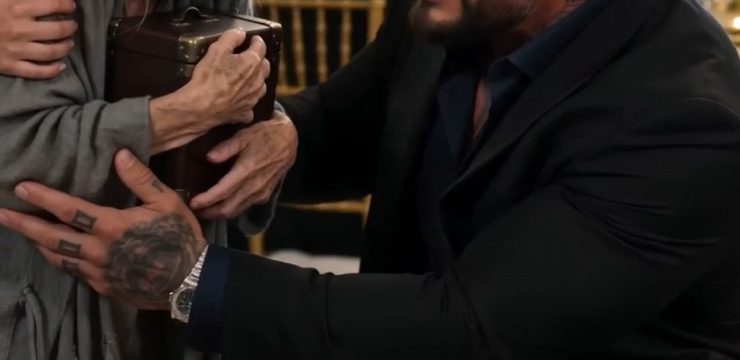
He crossed the room and dropped to one knee beside the maid, right there on the expensive carpet, in his pressed suit, without a moment of hesitation. The juice soaking into the fabric didn’t seem to register to him at all.
He reached toward her carefully, like he was afraid of what he might find out next.
“Are you hurt?” he asked her.
She nodded once. Then looked past him toward the woman in white.
“She said I should go make another one,” the maid whispered.
The words landed like a stone dropped into still water.
His wife stood up. “You can’t possibly be serious right now. She is just the help—”
He rose slowly and turned to face his wife. His expression had shifted into something she had never seen on him before. Not rage. Something colder than rage.
“No,” he said quietly. “She isn’t.”
The room tilted.
He turned back to the maid, and when he looked at her, every wall he had built around himself seemed to come down at once.
“She was trying to tell me something,” he said, almost to himself. “She came to me and you told me she was lying. You told me it was nothing. That she was confused.”
His wife’s composure began to fracture at the edges.
“I was protecting our marriage,” she said.
He let out a short, hollow sound that was nothing close to laughter.
“Protecting us,” he repeated. The words tasted like ash in his mouth.
He turned back to the maid. When his eyes met hers, the anger drained completely from his face. What replaced it was something rawer and far more painful — a man face to face with the consequences of his own absence. His own willful blindness.
His gaze dropped slowly to her stomach.
Then lifted to her eyes.
“Is the baby mine?”
The question hung in the air long enough that every person in that room felt it physically.
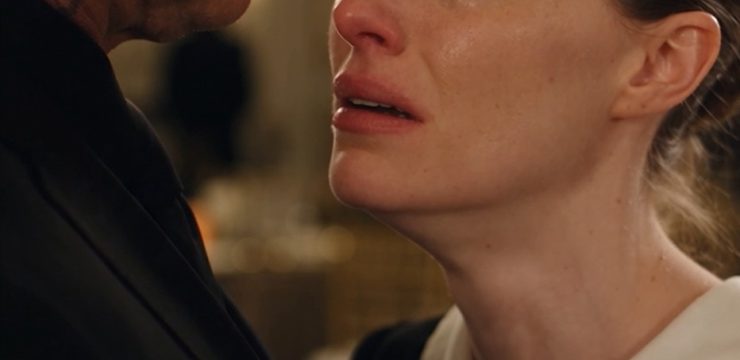
The maid didn’t answer right away. She was crying now, not dramatically, not loudly, but in the way people cry when they have been carrying something unbearable alone for far too long and the weight has finally become impossible.
She nodded.
His wife actually stumbled backward.
He went completely still.
He looked at the orange stain spreading across the maid’s uniform. At her shaking hands. At the broken glass beside her on the floor. At the woman on the sofa who had known the truth and buried it deliberately to preserve herself.
Something in his face set like concrete.
He walked to the maid and took her hands gently in both of his. He helped her to her feet, steadying her carefully, making sure she was balanced before he let go.
Then he turned to his wife.
“Get out of this house.”
She stared at him with wide eyes that had lost all their careful polish.
“You’re choosing her over me? Over everything we have?”
He looked at the maid. At the swell of her belly. At the child — his child — that had almost been put in danger today by a woman’s cruelty and his own failure to pay attention sooner.
He answered without raising his voice.
“I’m choosing my child.”
His wife’s composure shattered completely. The polished, untouchable woman in white came apart at the seams right there in her own living room, and not a single person in that room moved to comfort her.
Because the maid had broken down too — quietly, exhaustedly, with her forehead resting against the chest of the man who had finally, too late and yet somehow just in time, shown up to protect her.
The orange stain had dried into the carpet by then.
But it didn’t matter anymore what it looked like on the outside.
What mattered was what it had finally forced out into the open — a secret, a child, and a family that had existed in silence for far too long, finally demanding to be seen.