The shopping mall was loud and bright, filled with the kind of ordinary busyness that makes people look straight ahead and keep moving. Parents pushed strollers. Teenagers scrolled through phones. Shoppers juggled bags and to-do lists, wrapped up in the comfortable numbness of routine. Nobody noticed the woman sitting near the entrance — or rather, nobody allowed themselves to.
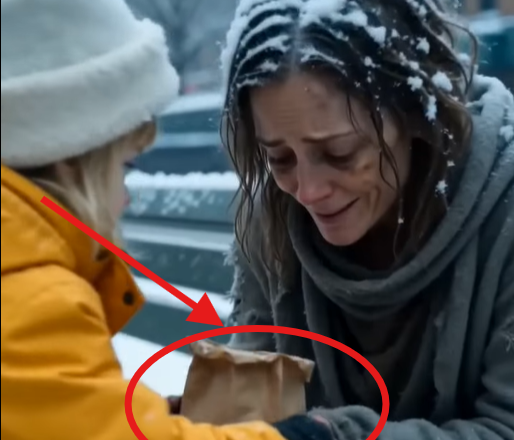
She was tucked against the wall just far enough to seem like she wasn’t there. Her coat was too thin for the weather outside. Her hands, rough and reddened from the cold, rested in her lap like two things she no longer knew what to do with. In front of her sat a small cardboard sign. Most people who passed it didn’t bother to read it. They simply walked faster.
But one person stopped.
She was six years old, maybe seven. Her name was Maya, and she was holding a paper bag that smelled like warm food — a soft pretzel and a small cup of soup her father had just bought her from the food court nearby. She had been looking forward to it all morning.
Maya stood completely still, staring at the woman with the quiet, unblinking attention that only children are capable of. There was no judgment in her gaze. No discomfort. No performance of pity. Just pure, unfiltered seeing — the kind adults slowly unlearn as the years go by and the walls go up.
Her father was a few steps behind her, distracted by his phone, when he realized his daughter was no longer walking beside him. He turned and felt his chest tighten. Maya was crouching down, eye level with the woman on the ground.
He started to move toward her. He told himself it was about safety. But somewhere beneath that, he knew it was also about something harder to name — the discomfort of being seen standing still while your child does something you haven’t found the courage to do yourself.
He was still several feet away when Maya opened the bag.
“This is for you,” she said, in a voice so steady it didn’t sound like it belonged to a child at all. “Daddy bought it for me, but you need it more.”
The woman looked up slowly, the way people do when they’ve spent a long time trying not to hope. Her eyes were glassy, not quite focused. Her hands trembled slightly as she reached out and accepted the bag.
And then Maya did something that stopped her father completely in his tracks.
She reached out and took the woman’s hand — calloused, cold, cracked at the knuckles — and held it gently inside both of her own small, warm palms. She didn’t hesitate. She didn’t look around to see who was watching. She simply held on, the way a child holds something they don’t want to let go of.
Her father stood frozen. He had been ready to step in, to redirect, to explain to Maya later why you have to be careful, why you can’t just — but the words dissolved before they formed. He couldn’t move. He couldn’t speak.
He could only watch.
Maya looked into the woman’s eyes — truly looked, the way almost no one had in a very long time — and said the words that would quietly rearrange something inside every person who later heard this story retold.
“You need a home,” Maya whispered.
Then, slowly, a single tear slid down her cheek.
“And I need a mom.”
Four words. Small and plain and devastating in the way that only the truth can be.
The woman stopped breathing. Not dramatically — just for one second, a pause so deep it felt like her whole body needed to absorb what had just happened. Her face crumpled, then steadied, then crumpled again. Years of being looked through, of being reduced to a problem or a discomfort or simply nothing at all — and here was this child, this tiny, serious girl, looking at her as if she were the most important person in the room.
Which, in that moment, she was.
Behind them, Maya’s father stood with his hand half-raised and his mouth open and something inside his chest cracked clean open. He thought he had done a good job. He thought he had held things together since Maya’s mother left. He thought his daughter didn’t notice the silence at the dinner table, the empty chair, the way he changed the subject whenever she brought up certain things. He had worked so hard to paper over the gap.
And his six-year-old daughter had just said, in front of a stranger and a food court full of people who’d gone suddenly very quiet, exactly what neither of them had ever said out loud.
They both needed someone. They just hadn’t known how to say it.
The snow was beginning to fall again outside the glass doors of the mall. Inside, nobody was walking fast anymore. A few people had stopped entirely, pretending to look at their phones or adjust their bags, but not really. They were listening. They were remembering. They were feeling something they hadn’t expected to feel on a Tuesday afternoon.
Nobody moved to rush the moment. Even the noise of the mall seemed to dip, just briefly, as if the world itself leaned in.
Children have a way of saying the things we’ve buried so deep we’ve forgotten they’re there. They haven’t yet learned to look away, to keep moving, to dress up their fear as wisdom. Maya hadn’t been taught to see past that woman. So she didn’t.
She just saw her.
And sometimes, being truly seen — even once, even for a moment — is the thing that reminds a person they are still real. Still here. Still worth something to someone in this world.
Maya’s father eventually walked over. He crouched beside his daughter. He didn’t pull her away.
He stayed.