The ceremony had barely begun when the doors swung open — and everything the groom had spent years carefully constructing began to fall apart in front of two hundred guests.
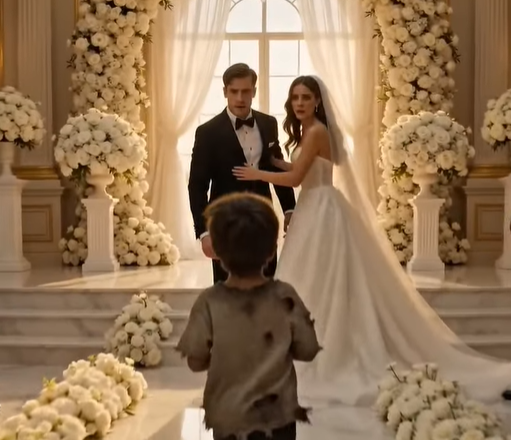
No one moved toward the aisle. No one reached for a glass of champagne. No one even breathed too loudly. The flowers were perfect. The lighting was golden. And yet every single person in that grand ballroom sensed, in the marrow of their bones, that something was terribly, irreversibly wrong.
A little boy stood at the entrance to the room.
He couldn’t have been older than six or seven. His feet were bare against the cold marble floor. His clothes were worn and too small for his frame. And in his small, trembling hand, he held a bracelet — the kind that doesn’t come from a department store. The kind that gets engraved. The kind that someone buys when they’re celebrating something they believe will last forever.
The groom saw it from across the room.
And that was when his face changed.
Not in the way a man’s face changes when he’s confused, or startled, or offended. It changed the way a man’s face changes when something buried deep has finally been unearthed — when a truth he thought he’d outrun has just caught up with him at the worst possible moment.
The bride noticed it too.
She had been watching him the whole time, waiting for him to say something, to do something, to deny whatever this child’s presence seemed to be suggesting. But he didn’t. He stood there with his jaw tight and his eyes glassy, staring at that little bracelet like a man staring at a mirror he had avoided for years.
The little boy’s voice broke the silence.
“She said not to hate you.”
That one sentence did what no dramatic speech, no tearful accusation, and no confrontation ever could. It cracked something open in the groom’s chest — something visible, something irreversible. Because hatred, as painful as it is, gives people something to push against. Mercy offers nothing to defend yourself from. Mercy simply stands there and waits.
To understand why that moment mattered so deeply, you have to go back to before the mansion, before the wealth, before the engagement that was designed as much for business as it was for love.
There had been a girl.
She wasn’t from money. She wasn’t polished or connected or the kind of person who got invited to galas. She was quiet, and kind, and she loved him in the way that only the most earnest people know how to love — without conditions, without strategy, without an exit plan.
He loved her too. In secret. The kind of secret that feels like protection when really it’s just fear wearing a disguise.
When she became pregnant, the world he had been building with one foot in each direction finally forced him to choose. His family made their position clear. His future in-law’s world beckoned with promises of wealth and status. And he told himself a story that too many men have told themselves in moments of cowardice: that she would be better off without him. That the child would be fine. That leaving was somehow the merciful thing to do.
He didn’t come back. Years passed. The engagement happened. The invitations were sent. The flowers were chosen. And somewhere across town, a woman raised a son alone — a son who wore his father’s face and carried his father’s bracelet and was told, even at the end, not to hate the man who never returned.
She died before she could see what the boy would do with that grief.
But she left him a letter.
He handed it to the groom there in front of everyone. And the groom opened it with shaking hands, right there at the altar, surrounded by silk tablecloths and crystal glasses and two hundred people who had come expecting to celebrate.
The words inside were simple. They always are, when someone has had years to distill the truth down to its purest form.
She had never wanted his money. She had only ever wanted their son to know his father’s face.
The room was absolutely still.
And then the bride stepped away.
Not with tears or screaming or accusations hurled across a flower-filled room. Just one quiet, deliberate step to the side — the kind of movement that says everything a long speech never could. She had been prepared to marry a man who’d made mistakes. She had not agreed to marry a man who had spent years pretending those mistakes didn’t exist in the form of a little boy with bare feet and no father.
The guests watched. No one knew what to say. Because this was no longer a wedding interrupted by an inconvenient surprise. This was a reckoning — quiet, patient, and long overdue.
The little boy stood in the middle of it all, small and still and steady in a way that made grown adults feel ashamed of themselves. He had walked into a room full of strangers and delivered a truth no adult in that building had been brave enough to speak.
His mother had raised him to forgive what most people couldn’t.
And in doing so, she had handed her son something no inheritance, no estate, no carefully arranged alliance could ever provide.
She had given him his dignity.
And in the end, standing barefoot on that marble floor, he was the only one in the room who hadn’t lost his.