Nobody stopped for them at first.
That’s the part that’s hardest to sit with — the idea that two small children could be sitting on a cold sidewalk, sharing scraps from a torn cardboard box, while the world walked right past them. People glanced. People looked away. Because looking away is so much easier than feeling something you don’t know how to fix.
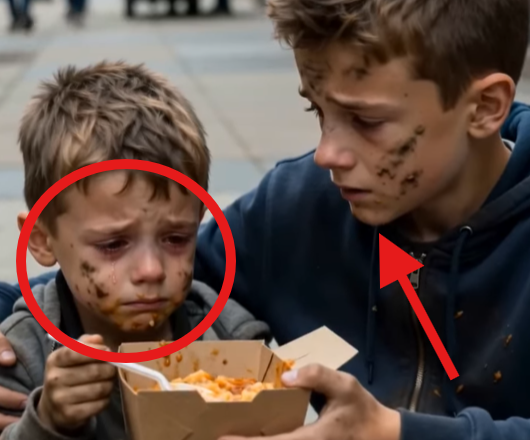
The two boys — Evan, the older one, and his little brother Tommy — weren’t making a scene. They weren’t crying loudly or waving their arms. They were simply doing what hungry children do when no one is watching: surviving. Evan held the box close to his chest like it was something precious, and maybe to him, it was. It was all they had that afternoon.
The café owner who stepped outside was not moved by what she saw. She was annoyed. She crossed her arms and told the boys, in the way some people speak to stray animals, that they needed to move along. That they were bothering her customers. That they were doing this for attention.
Evan looked up at her quietly and said, “We weren’t bothering anyone.”
And in those four words, there was a kind of dignity that most grown adults spend their whole lives searching for.
It was in that moment that a stranger approached. An older man, holding a paper coffee cup from that very same café, slowing his steps as his eyes landed on the two boys. Something shifted in his face — not pity, exactly, but recognition. The kind of look a person gets when the universe taps them on the shoulder and says: pay attention.
He crouched down slowly, the way older men do when their knees remind them of every year they’ve lived, and he asked the boys their names.
Tommy hid behind his brother immediately. Children always know when an adult is safe or not — they feel it before they can explain it.
But Evan whispered their names. “Evan. And this is Tommy.”
The man’s expression changed in a way that was difficult to describe. Like a door opening inside him that had been locked for a very long time.
“Who is your mother?” he asked.
Evan looked down at the sidewalk. “She was a waitress,” he said softly. Then he pointed toward the café window. “She worked there before she got sick.”
The café owner went rigid.
The stranger turned to her slowly, and when he spoke, his voice carried something heavier than anger. “You told me your sister moved away.”
The woman went pale.
Evan’s eyes went wide. “You knew our mom?”
The old man’s coffee cup slipped from his fingers.
“She was my daughter.”
The world seemed to hold its breath.
The café owner shook her head, stepping forward quickly, telling her father not to listen to them — that they were just boys on the street, looking for a handout. But Evan reached into his torn jacket with small, careful hands and pulled out a photograph that had been folded and unfolded so many times the creases had gone soft and white.
In the photo, a young woman stood smiling in front of the café, sunlight catching her hair, a baby in each arm. Her whole future in front of her. Her whole heart visible in that smile.
On the back of the photo, written in ink that had faded almost to ghost, were three words.
Dad, forgive me.
The old man covered his mouth with a trembling hand.
And the café owner — the woman who had called these boys a nuisance, who had stood in the doorway of her own business while her nephews sat hungry on the sidewalk — her voice cracked open.
“She had nothing,” the woman said. “I didn’t want them coming here and ruining everything I built.”
Evan turned to look at her. His face held something no child his age should have to carry — the specific pain of realizing that someone who was supposed to love you had chosen not to.
“You’re our aunt?” he asked.
She looked away. She couldn’t meet his eyes.
Tommy began to cry. Not loudly — just the quiet, exhausted crying of a child who has been holding it together for too long.
The old man didn’t say another word to his daughter. He simply opened his arms and pulled both boys into him, his hands shaking as he held them. He whispered, “I didn’t know. I swear to God, I didn’t know.” And the way he said it — broken and certain all at once — made it clear he was telling the truth.
Evan held onto his grandfather the way children grip something they’re terrified of losing. Like if he let go, the whole moment might dissolve back into the cold sidewalk and the empty cardboard box and the world walking past.
The old man straightened up slowly, keeping one hand on each boy’s shoulder. He looked at his daughter standing in the doorway of her café, and when he spoke, his voice was quiet but unshakeable.
“You called my grandchildren trash.”
Her face crumpled.
“No child in this family,” he said, “eats from the sidewalk again.”
He reached down and took the cardboard box from Evan’s hands — that worn, empty little box the boy had been clutching all afternoon — and set it aside.
And for the first time that day, Evan stopped reaching. Stopped bracing. Stopped holding everything together by himself.
Because someone had finally seen him. Someone had finally said: you belong to me, and I am not letting go.
That is what family is supposed to do. Not just in the beautiful moments, but especially in the ones that happen on cold sidewalks, when a little boy is too proud to cry and too hungry to pretend everything is fine.
Sometimes love arrives late. But when it finally comes, it changes everything.