She was maybe seven years old, wearing a dress that had been washed too many times, standing at the entrance of one of the most expensive restaurants in the city. Her shoes were scuffed. Her hair needed brushing. And she was alone.
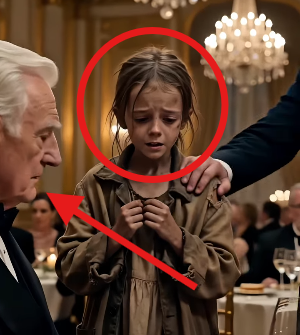
The hostess moved toward her immediately, polite but firm, already preparing to redirect the child somewhere more appropriate. But the little girl didn’t flinch. She stood her ground with the kind of quiet dignity that doesn’t come from money or privilege — it comes from being raised by someone who, despite having very little, never let her feel small.
“I need to speak to the man who owns this place,” she said clearly.
A ripple of discomfort moved through the room. Heads turned. Forks paused mid-air.
The security officer stepped forward and placed a firm hand on her thin shoulder — not unkindly, but with the clear intention of escorting her out. That’s when she opened her small fist and held something up. Something that caught the candlelight and made the nearest server inhale sharply.
A ring.
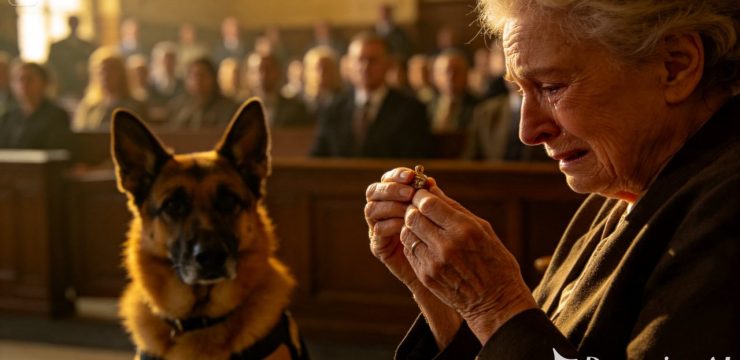
Not costume jewelry. Not something from a gift shop. A ring of unmistakable quality, worn smooth in places from years of being held, treasured, and grieved over.
Word traveled to the back of the room the way it always does in places where people pretend not to notice things while noticing everything. And the old man — the one everyone had gathered to honor that evening, the one with the gray at his temples and the expensive suit and the long, impressive name on the reservation — stood up slowly and walked toward the entrance.
He stopped when he saw her.
His face went still in a way that had nothing to do with composure.
She extended the ring toward him without a word.
He took it. And in the moment it landed in his palm, something behind his eyes broke open. Because he knew it. He had known it the instant he saw it. He had placed that ring on a woman’s finger many years ago — a woman his family had forced him to leave behind, a woman they told him had moved on and forgotten him, a woman whose name he had quietly carried in a locked room inside his chest ever since.
“Who is your mother?” he asked, and his voice had already begun to fracture.
The girl swallowed. The whole room held its breath.
“Her name is Rosa.”
That name landed like a stone dropped into still water, the ripples spreading outward and inward all at once. The old man’s chair scraped hard against the floor as he rose too quickly. He didn’t hear it. He didn’t see the watching eyes or the parted lips of the other guests. He only saw the child — really saw her — and the recognition that moved through him was almost unbearable. The shape of her eyes. The particular way she held her chin up even while afraid. Rosa was everywhere in this little girl’s face.
“Where is she?” he whispered.
The child clutched the edge of the nearest table. Her knuckles whitened.
“She’s sick,” she said softly. “She’s staying in the old rooms behind the train station.”
His eyes filled. He did not look away.
The girl glanced down for just a moment, gathering something — courage, maybe, or the memory of what her mother had asked her to say — and then she looked back up at him.
“She told me that if you still cared… you would come.”
And that was it. That was the sentence that undid decades of armor, decades of telling himself he had moved on, decades of building a life around the absence of the one person who had ever made him feel fully known.
He didn’t think. He didn’t hesitate. He dropped to his knees right there beside her, tuxedo and dignity and the watching eyes of two dozen wealthy strangers completely forgotten. His hand trembled as he reached up and gently touched her cheek.
“What’s your name, sweetheart?”
“Lila.”
He closed his eyes for a moment. When he opened them, they were wet.
He could see Rosa in everything about this child. Not just her features, but her character — the way Lila had walked into a room full of people who could have dismissed her and stood there anyway. The way she had delivered that message with such careful tenderness even while hungry and frightened. Rosa had raised this little girl alone, and she had raised her beautifully.
“I thought she was gone,” he said quietly, almost to himself.
Lila looked at him with eyes that had seen more than a child her age should have to see.
“Mom said you would say that.”
He let out a long, unsteady breath. Then he stood, turned to the security officer who had not moved a single inch, and said in a voice that left no room for question:
“Get my car.”
The officer moved immediately.
The old man turned back to Lila. He reached out and brushed the tangled hair gently away from her face, the way a grandfather might — or a father — or simply a man who suddenly understood that he had been given something back he thought the world had permanently taken from him.
“You’re eating first,” he said quietly. “A real meal. Then you’re going to take me to your mother.”
Lila stared at him. For a moment, she looked as though she might cry — not from sadness, but from the specific relief of a child who carried too heavy a burden for too long and finally felt someone take part of the weight.
She nodded.
And in that glowing dining room, surrounded by candles and crystal and people who had come to celebrate a man’s worldly success, a barefoot little girl with a worn-out ring in her hand reminded everyone in that room — and perhaps the old man most of all — that the things we carry quietly in our hearts are often the most real things we have ever owned.
Some doors, it turns out, don’t close forever. Sometimes a child walks through them and opens everything back up.