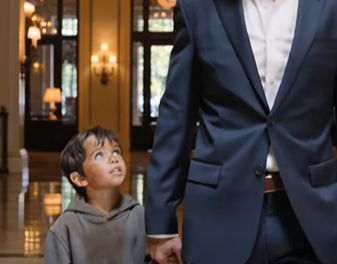
There are moments in life when a room changes without a single word being spoken. Not because of what someone says. Not because of a sound or a crash or a raised voice. But because of the kind of presence that walks through a door and rearranges everything — silently, completely, and without apology.
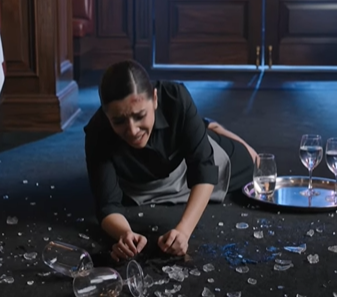
This was one of those moments.
It started, as so many things do, with someone being hurt.
The young waitress had been doing her job. That was all. She was moving through the evening crowd, balancing trays and managing smiles and trying to make it to the end of another long shift without incident. She had almost made it. Almost. And then came the shove — sudden, deliberate, unmistakable — and she hit the floor hard enough to split the skin at her forehead.
The customers around her froze. Some looked away. Some watched with the detached curiosity of people who have already decided that whatever is happening is not their business. The bald man who had knocked her down stood over her, not with regret on his face, not with embarrassment, but with the particular expression of someone who has spent a lifetime making other people feel small and has never once been held accountable for it.
Then the door opened.
The neon-blue light from outside split through the entrance for just a moment — long enough for a man in a gray waistcoat to step inside, a second figure closing the door quietly behind him. The blue light disappeared back into the glass. The room shifted.
The bald man’s face changed instantly.
Not confusion. Recognition.
And that single detail told the story before anyone said a word. This was not a stranger who had wandered into the wrong situation. This was the one man the bald man had been hoping — perhaps praying — would never arrive. You could see it in the way his jaw tightened. You could see it in the way his body, which had been so loose and confident just seconds before, suddenly forgot how to hold itself steady.
The waitress was still on the floor, blood at her temple, breath coming in uneven little bursts. She looked between the two men the way a person does when they are trying to figure out which direction safety is coming from. She had expected someone to call for a manager. She had expected someone to offer a hand or a napkin or an apology on behalf of a room full of people who had stood by and done nothing.
She had not expected this.
The man in the gray waistcoat did not kneel beside her. He did not rush to comfort her or ask if she was okay in that performative way that is more about the audience than the person hurting. He kept his eyes on the bald man and took one slow, deliberate step forward.
Somehow, that was more frightening than anything else he could have done.
The waitress tried to push herself up off the floor. She winced. She whispered, almost reflexively, “I’m okay—”
He cut her off without moving his gaze from the man across the room.
“No,” he said. Quietly. Calmly. “You’re bleeding.”
The room went completely silent.
Even the warm amber glow of the restaurant lights seemed to shift — seemed to cool — as though the atmosphere itself understood that something serious was now underway. The customers who had been pretending not to watch were now watching openly, and not at the woman on the floor. Every eye in that room had moved to the man standing near the door.
The bald man tried to laugh. He tried to frame the whole situation as something minor, something explainable.
“She’s staff,” he said. “She dropped the tray.”
It was exactly the wrong thing to say.
Because there is a very particular difference between how an innocent man responds to an accusation and how a guilty one does. An innocent man denies what he’s accused of. A guilty man explains away the person he hurt. He distances. He minimizes. He shifts the focus from what he did to what she failed to do.
The man in the gray waistcoat understood this immediately. You could see it in his expression — not surprise, not anger, but a quiet, settled certainty. He had already known enough before he walked through that door. Whatever he had seen, whatever he had heard, whatever information had brought him to this specific restaurant on this specific evening had already told him the truth.
Then the bald man’s hand moved — just slightly — toward his jacket.
The man by the door caught it instantly.
And something changed in his face. Something that had been controlled, measured, and carefully contained shifted into something else. Something that was not loud, not theatrical, not designed for the room to see. Something deeply, unmistakably personal.
That was the moment the waitress understood the part of this scene that made it truly terrifying: he had not arrived by coincidence. He had not wandered in at the right moment by luck or fate or some kind of dramatic timing. He had come because he had already been looking. He had come because someone — somehow — had led him here, and that someone had known exactly where to send him.
He had come specifically for the man who shoved her.
The bald man took one step backward.
Just one.
But that single step backward said everything a thousand words of explanation could never say. It confirmed the hierarchy of the room. It answered every unspoken question. It told every person sitting at every table exactly who held the real power here — and it was not the man who had shoved a waitress to the floor and called it her fault.
Sometimes, the most powerful thing a person can do is simply walk into a room.
And let everyone else figure out the rest.