Clara had worked the front desk of the Whitmore Grand for three years, and in all that time, no shift had ever prepared her for what happened on a quiet Tuesday afternoon.
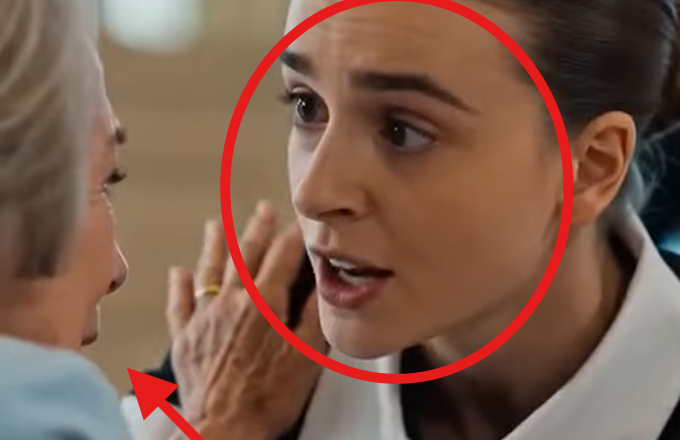
She was restacking the brochure display near the lobby entrance when the commotion began — not with shouting, but with something worse. The sound of a frail body being dragged across marble floors. The sharp clatter of a teacup shattering. And a man’s voice, low and commanding, cutting through the lobby air like a blade.
“Mother, stop making a scene.”
Clara turned. An elderly woman in a well-pressed gray suit was being pulled to her feet by a man in black, his jaw tight, a leather folder of papers tucked under one arm. The woman looked to be in her late seventies, maybe older. Her white hair was pinned neatly, but her dignity was being stripped from her in plain sight of every guest in the room.
Clara moved before she thought about it.
“Excuse me.” Her voice was calm, but her legs were not. “Ma’am, are you all right?”
She reached for the woman’s arm and steadied her gently, guiding her toward one of the velvet lobby chairs. The old woman clutched at her, eyes searching Clara’s face with an intensity that made the air feel different.
Then she reached out with shaking fingers and touched Clara’s wrist.
Right where the small, crescent-shaped birthmark had always been.
“My granddaughter had that mark,” the woman whispered. Her voice cracked under the weight of something she had clearly carried for years. “They told me she died.”
The man in the black suit went pale.
Not surprised. Pale. The kind of color that drains from a face when something buried threatens to surface.
Clara stood slowly, still holding the woman’s hand.
“Who told you that?”
The old woman lifted her gaze past Clara’s shoulder, to the man towering above them.
“My son.”
The lobby went silent. It was the kind of silence that falls when everyone in a room realizes they are witnessing something they were never supposed to see.
Clara turned to face him. Her voice was barely steady.
“You’re my father?”
He adjusted his cuff with practiced ease, the gesture of a man who had spent decades composing himself in difficult moments.
“This is absurd,” he said flatly. “She is unwell.”
But the old woman shook her head with more force than her small frame should have allowed.
“No.” Her voice was soft but absolute. “He took you after your mother passed. Your grandfather left this hotel and the family estate in your name. He said a baby would complicate everything. He said it would ruin his plans.”
Clara’s eyes filled before she could stop them.
Twenty-four years. Foster homes with rotating faces. Double shifts in this very building, standing behind this very desk, serving coffee to guests who would never know she was supposed to own the chair they were sitting in. She had always felt an unexplained pull to this place, something she could never name. Now it had a name.
The elderly woman reached into the pocket of her suit jacket and withdrew a photograph. Worn at the edges, the kind of image that had been taken out and looked at too many times to count. It showed a newborn wrapped in a cream-colored blanket, round-cheeked and sleeping, cradled in the arms of someone just out of frame.
On the back, written in ink that had faded to the color of old roses, were four words:
Clara, our little heir.
The man lunged forward.
Clara stepped back.
“No.”
The word came out steadier than she felt. She pressed the photograph against her chest like it was something sacred, because it was.
The old woman pointed to the leather folder still tucked under her son’s arm.
“He was trying to make me sign away the last piece of property your grandfather set aside for you. The only thing left he couldn’t touch without my signature.”
Clara looked around the lobby slowly. She took in the broken teacup on the marble floor. She looked up at the security cameras mounted above the front desk — cameras she had helped install during a renovation last spring. She looked at the guests seated nearby, every single one of them watching, some with phones already in hand.
Then she raised her own phone.
Her hand was trembling, but her voice was not.
“I recorded everything. From the moment you dragged her across this floor.”
Her father’s face did not collapse dramatically. It simply fell apart in stages, like a structure that had been quietly weakening for years finally meeting the weight it could not hold.
Outside the tall glass doors of the lobby, the sound of sirens rose and grew closer.
The elderly woman covered her mouth with both hands and broke into deep, quiet sobs. Not the cries of someone falling apart. The cries of someone who had been holding on alone for a very long time and could finally, mercifully, let go.
Clara knelt beside her chair and wrapped both arms around her grandmother’s small shoulders.
“I was here,” she whispered into the woman’s white hair. “I was right here the whole time. I never left.”
They stayed like that while the lobby stirred around them, while men in uniform came through the glass doors, while guests set down their coffee cups and watched.
In the middle of a grand hotel that had always been hers, the young woman they had tried to erase held the grandmother who had never stopped grieving her.
And for the first time in twenty-four years, Clara Whitmore was finally home.