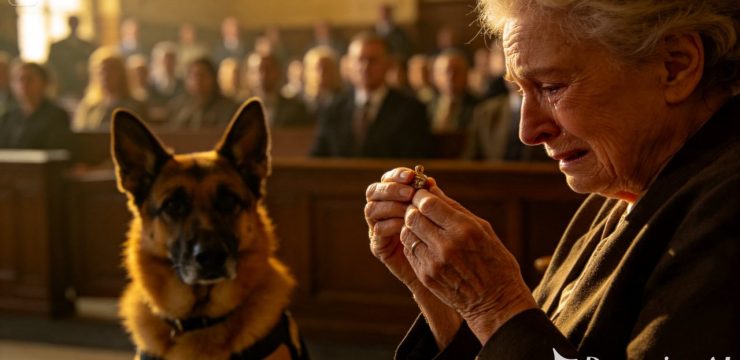
Elena stood in the center of the ballroom, surrounded by crystal chandeliers and the polite laughter of people who had never truly seen her. She had spent two decades being the kind of wife who smiled through the silence, who dressed beautifully for rooms that barely noticed her, who had learned to carry grief so quietly it had become part of her posture. Tonight was supposed to be a celebration. Instead, it was about to become the night her entire life cracked open.
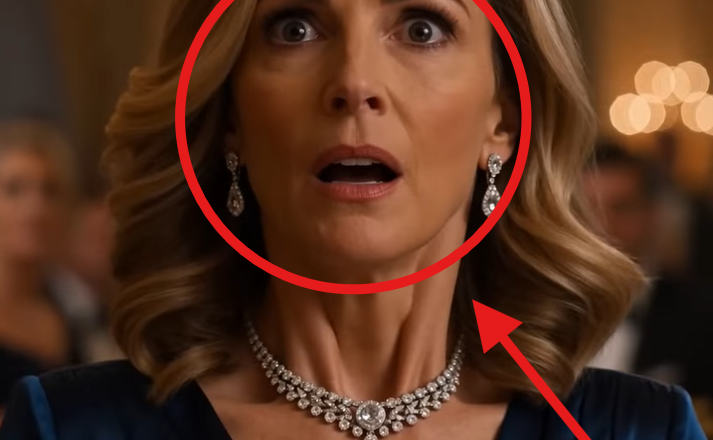
Her husband, Richard, stood at the podium with the confidence of a man who had never once doubted his own authority. He raised his glass, smiled at his business partners, and in a moment of careless arrogance that would define the rest of his life, he made a joke at her expense. Who would want his wife for ten dollars, he asked the crowd. The laughter that followed was polite but cutting. Elena stood very still. She had learned long ago how to survive these small humiliations.
Then a young man stepped forward from the edge of the room.
He was perhaps twenty years old, with dark eyes that held something ancient in them, something searching and certain at the same time. He had paid one million dollars at the charity auction — not for a painting, not for a trip, not for status. He had paid it simply to stand in that room. Simply to reach her.
Elena’s knees nearly gave out when he spoke.
He told her something that the world had convinced her was impossible. He told her that the baby she had been told did not survive — the child she had grieved in silence for twenty years, the son whose name she had whispered into the dark like a prayer with nowhere to go — had not died at all.
She heard the words, but her mind struggled to receive them.
A bracelet appeared in his hand. Small, worn, the kind a hospital places on a newborn’s wrist. Her name was on it. Her room number. The date she had spent two decades trying to forget but never could.
The young man’s voice trembled when he explained. His adoptive mother, a kind and ordinary woman, had given it to him before she passed. She had told him the truth with her last breath — that a wealthy man had paid the hospital to say the baby did not survive. That money had buried a child who was still breathing.
Elena covered her mouth. A sob came out that she had no power to stop.
Richard stepped down from the stage immediately. He called it a scam. His voice was controlled, authoritative, the same voice he used in boardrooms and courtrooms and every room where he had always been the most powerful person present. But for the first time, the room was not listening to him.
The young man looked at Richard with a calm that was more devastating than any anger could have been.
“The scam,” he said quietly, “was making her believe she was broken.”
Elena turned to her husband. She asked him with just two words — the simplest, most shattering question a wife can ask. You knew?
Richard said nothing. And in a room full of witnesses, his silence confessed everything.
The young man placed a folder on the table. DNA results. Hospital records. Payment transfers. A paper trail of a decision made by a young man under the influence of his father, who had believed that a child would interfere with a business merger. Twenty years of Elena’s grief, organized into documents.
She looked at her husband the way you look at a stranger who has been wearing the face of someone you loved. Every memory shifted. Every holiday. Every anniversary dinner where he had held her hand while she mourned. Every time she had apologized for being sad. Every time she had told herself she needed to move on.
She asked him how he could have let her grieve their son while he was alive and walking in the world.
Richard’s voice cracked. He said he was young. He said his father made him. He called it a mistake.
Elena absorbed each word.
Then she walked toward the young man. Her hand trembled as she reached up and touched his face. She asked him his name.
He told her: Daniel.
She whispered that she had chosen that name before she ever held him. Before she was told there was no one to hold.
He nodded. He already knew.
She pulled him into her arms. And the entire ballroom — the same crowd that had laughed at her ten minutes before — went completely silent as they watched a mother hold the son she had been mourning for twenty years. Some people looked away. Others could not stop staring. A few were crying without fully understanding why.
Elena held her son for a long moment. Then she turned.
She walked back to the table where her husband stood with his microphone and his excuses and the ruins of the story he had spent two decades carefully maintaining. She removed her wedding ring. She did not throw it. She did not make a scene. She placed it gently on the table in front of him.
She reminded him of the joke he had made at the beginning of the evening. Who would want her for ten dollars?
She told him her son had paid one million dollars to remind her she was priceless.
Then Elena walked out of the ballroom holding Daniel’s hand. She did not look back. Behind her, Richard stood alone on the stage, microphone in hand, facing a frozen crowd and a truth he could no longer shape, spin, or sell.
Some betrayals are too large to forgive. Some loves, however, arrive exactly when they are needed — not a moment too soon, and never too late.