The last note drifted upward and dissolved into the chandelier light like smoke.
Nobody moved. Nobody spoke. The entire ballroom — filled with silk dresses, champagne flutes, and people who had never once gone without anything — went completely still.
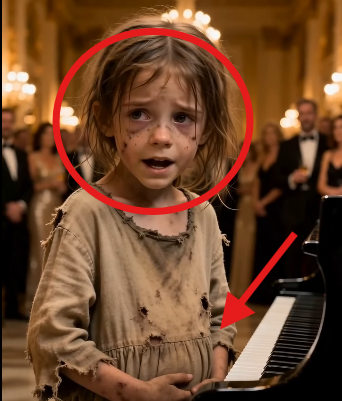
The little girl sitting at the grand piano slowly lifted her eyes. Her fingers hadn’t left the keys yet. She looked around at the frozen faces staring back at her, and for the first time that evening, she looked frightened. Not embarrassed. Not shy. Frightened — the way a child looks when she suddenly realizes she has done something she doesn’t fully understand.
And across the polished marble floor, the man who owned all of this — the ballroom, the estate, the champagne, the silence — walked toward her. His steps were slow. His hands were trembling at his sides. He was a man who had stood in boardrooms and never flinched, a man who had buried grief so deep that most people in that room believed he had simply moved on. But grief doesn’t disappear. It waits.
He stopped in front of her, and his eyes filled before he could do anything about it.
“That song,” he said, his voice barely above a whisper. “Who taught you that song?”
The girl swallowed. Her small shoulders rose and fell.
“My mama.”
The breath left his body like something had reached inside his chest and taken it.
He didn’t care about his suit. He didn’t care about the guests. He went down on one knee right there on the cold marble floor and looked at her — really looked at her — the way a man looks when he’s terrified that what he’s seeing might not be real.
“What was her name?” he asked.
The girl’s eyes dropped to her lap.
“Anna.”
He closed his eyes. Just for a moment. The kind of moment that holds years inside it.
A murmur moved through the room like a slow wave. People leaned toward each other. Because the older ones remembered. They had all heard the story, years ago — the fire, the tragedy, the wife who had vanished, and the little daughter who had never been found. He had searched. Lord, how he had searched. And then the searching had gone quiet, the way things do when the world decides it’s time to stop hoping.
But hope, apparently, had not gotten that message.
He opened his eyes and looked at her wrist. There it was. A small, crescent-shaped birthmark just below her inner wrist. His face crumpled for just a second before he steadied himself.
“My daughter had a mark just like that,” he said, his voice fractured at the edges.
The girl looked confused. Then something shifted in her expression — not understanding, not yet, but the beginning of it. The edge of something enormous.
“My mama told me,” she whispered, her voice so small it barely carried, “that if I was ever really hungry… I should find a place where the rich people were and play this song. She said my father would know it. She said he would always know it.”
The sound that came out of him was not a word. It was something older than words.
He reached into the inside pocket of his jacket, his fingers unsteady, and pulled out a small silver locket — worn smooth at the edges from years of being held. He opened it carefully, like it was something sacred, and turned it so she could see.
Inside was a photograph. A toddler sitting at a small piano. Blonde hair. Wide eyes. And a tiny crescent birthmark on her wrist, caught perfectly in the light.
The little girl stared at the photo for a long moment. Then she looked up at him. And whatever wall of confusion had been standing between them began, slowly, to come down.
His tears finally fell. He didn’t wipe them away.
“I have been looking for you for eight years,” he whispered. “Every single day. I never stopped.”
The room that had watched this child walk in with muddy shoes and tugged her coat and whispered about her being out of place — that room stood absolutely frozen. Some people looked at their hands. Some people looked at the floor. Because they knew, in that particular way that shame makes itself known, that they had failed her. That they had seen a hungry child and chosen to see an inconvenience instead.
But it was the woman in the gold dress who went the palest.
She had been standing near the door all evening, elegant and composed, the kind of woman who always knew which fork to use and exactly where to position herself to be admired. But now her face had gone to ash beneath her makeup, and she was very carefully not looking at anyone.
Because she was the one who had called security that night — years ago, before the fire, before everything — when a young woman named Anna had come to this very estate looking for help. She had been the one who said the woman was a nuisance. She had been the one who made sure she was turned away.
She had never told anyone.
She had carried that secret the way people carry things they can’t put down and can’t explain — quietly, and always just a little too aware of the weight.
The little girl didn’t know any of that yet. She was still looking at the man kneeling in front of her, and something in her eyes was softening, the way ice softens when warmth has finally been present long enough to matter.
Outside, the night went on as it always does — indifferent, unhurried.
But inside that ballroom, everything that had been broken and buried and given up on had just found its way back to the surface.
And every single person in that room would carry this moment with them for the rest of their lives — the night a little girl sat down at a piano, played one song, and changed everything.