The restaurant was exactly the kind of place where money spoke louder than manners. Crystal glasses caught the candlelight, a pianist played something soft and forgettable in the corner, and waitstaff moved between tables like shadows — efficient, invisible, and entirely beneath the notice of the guests they served. It was the kind of establishment where the wealthy came not just to eat, but to feel important.

At a prime center table sat a sheikh and his business associates. They were deep in conversation — laughing, leaning in close, raising their glasses. From a distance, it looked like a celebration. Up close, it was something else entirely. The sheikh commanded the table the way powerful men often do: with ease, with certainty, and with the quiet arrogance of someone who has never once been told no.
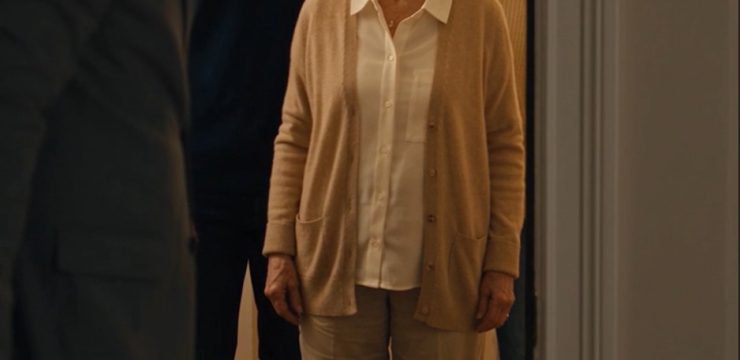
A young waitress approached the table. She wore her hair neatly pulled back, walked with calm assurance, and held herself with the kind of quiet dignity that has nothing to do with wealth and everything to do with character. She stopped beside the table, smiled professionally, and asked if they were ready to order.
The sheikh didn’t look at her right away. He let a pause stretch out — the kind of pause designed to remind someone of their place. Then he lifted his eyes slowly, as though she were an inconvenience he hadn’t scheduled.
“Nobody called you,” he said, his voice edged with mockery. “But since you’ve already shown up, write everything down on that little notepad of yours. I know people like you — it’s easy to mix things up.”
A quiet, uncomfortable ripple of laughter moved through the table. One of his partners chuckled. The woman said nothing. She simply opened her notepad and began to write.
Encouraged by the reaction, the sheikh pressed further. He questioned whether she understood numbers. He looked her over with dismissive eyes and made a remark about whether someone like her could possibly comprehend what they were ordering. It was the kind of cruelty that hides behind a smirk, the kind that powerful people use when they want to humiliate without technically saying anything outright.
His partners glanced at each other. A few looked away. No one said a word in her defense.
She continued writing. No flinch. No trembling lip. No watery eyes. Just steady hands and a calm face that revealed absolutely nothing.
When she finished, she closed her notepad and turned to leave. That was the moment the sheikh made his gravest mistake. Believing she wouldn’t understand him, he turned to his companions and made a remark in Arabic — casual, contemptuous, deeply offensive. He used a degrading word to describe her, and then, with a satisfied smirk, suggested that a girl like her would be perfect for his personal service. A possession. An afterthought in human form.
Laughter broke out at the table.
She stopped walking.
She turned around slowly, and for a long, breathless moment, she simply looked at him. The restaurant noise seemed to fade. The pianist kept playing, but no one was listening anymore.
And then she spoke — in clear, fluent, flawless Arabic.
“Just because I work as a waitress does not mean I am uneducated, or that I cannot understand what is being said around me. Your words are deeply offensive. I have long grown accustomed to men with money believing their wealth gives them the right to treat others however they please. But I am not an object. I am not available. I have a family. I have a husband. I have children who are waiting for me at home. And I will not be made to feel less than human at your table or anyone else’s.”
The restaurant went absolutely still.
Someone at a nearby table quietly set down a fork. The sound of it touching the plate was the only noise in the entire room.
She wasn’t finished.
“Your order will be ready in fifteen minutes,” she said simply, with complete composure.
Then she turned and walked away — the same measured, unhurried stride she had arrived with — and she did not look back once.
What happened next at that center table was something none of those powerful men were prepared for. The laughter was gone. The energy evaporated. Partners who had chuckled moments before were now staring at the tablecloth or scrolling absently through their phones. No one met the sheikh’s eyes.
And the sheikh himself sat motionless, watching her disappear into the back of the restaurant. For the first time all evening, he had nothing to say. No punchline. No recovery. No way to regain what he had just lost in front of every witness in that room.
There is a particular kind of silence that follows a moment like that. It isn’t empty — it is full. Full of recalibration, of embarrassment, of the sudden, uncomfortable awareness that you have just been measured and found deeply wanting. That was the silence that settled over his table and stayed there.
She never raised her voice. She never cried. She never called a manager or made a scene. She simply stood in the truth of who she was — a woman of education, of dignity, of family — and let that truth do what no outburst ever could.
What she understood, and what he clearly did not, is something that women of a certain wisdom have always known: real power doesn’t announce itself. It doesn’t need an audience or a title or a table at the best restaurant in the city.
Real power is knowing exactly who you are — and refusing, quietly and completely, to let anyone make you forget it.
She walked back to the kitchen, and she finished her shift.