A young woman in a red shirt walked up to the gates of a military base carrying nothing but a small envelope and a quiet kind of dignity that the soldiers at that checkpoint were about to tear apart piece by piece.
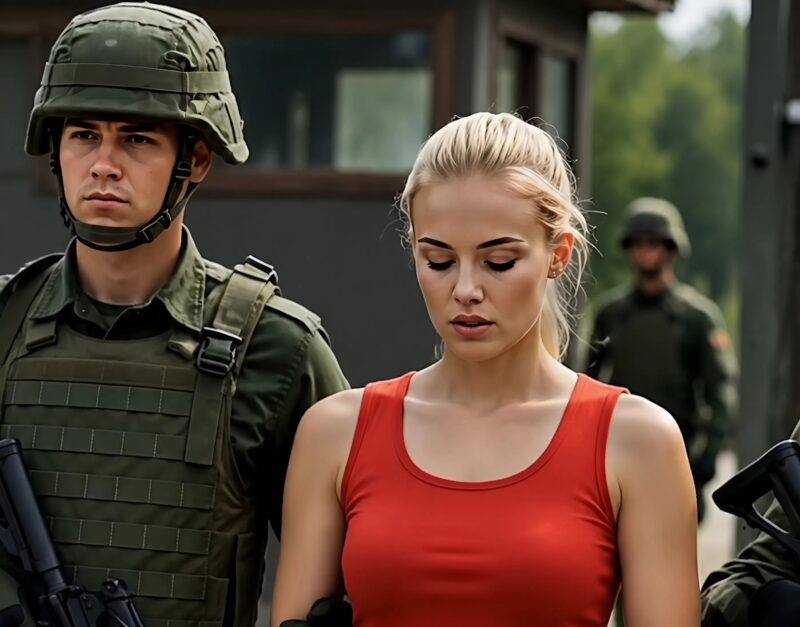
She looked no older than twenty-five. She had clearly traveled a long distance to get there — you could see the exhaustion around her eyes — but she held herself with a calm, steady composure that should have told those guards everything they needed to know. It didn’t. Instead, the moment she approached the gate and asked to speak with the base command, the mockery began.
“The command?” one soldier repeated, barely bothering to hide the smirk spreading across his face. “Are you serious right now?”
Laughter erupted from the men nearby. One of them circled around her slowly, deliberately, the way someone does when they want another person to feel small.
She tried again. She told them it was urgent. She told them she was expected. She held out the envelope in her hands with a steadiness that, in hindsight, must have taken everything she had.
Nobody cared.
One soldier snatched the envelope right out of her hands and held it up like it was a prop in some joke only he understood. When she reached for it — calmly, firmly, the way you’d reach for something that rightfully belongs to you — he shoved her hand away so hard she stumbled back a step.
Then someone said the words that changed everything.
“What if she’s filming this place? Times are dangerous now.”
That was all it took.
Within seconds, her phone was ripped from her hands, her arms were wrenched behind her back, and the cold snap of metal handcuffs clicked shut around her wrists — right there, in full view of the entire checkpoint. She let out a quiet cry of pain that the soldiers around her seemed to find amusing. One of the young recruits even pulled out his own phone to record the scene. There was laughing. There were cruel comments thrown at her like stones.
She lowered her head. She breathed slowly. She whispered — barely loud enough to hear — “You’re making a mistake.”
Nobody listened.
She stood there in handcuffs while soldiers joked about catching a spy, while recruits filmed her humiliation like it was entertainment, while the morning fog still hung low over the parade ground and the whole base went about its business as if nothing at all was wrong.
And then came the footsteps.
Fast, urgent footsteps echoing across the concrete from the direction of the headquarters building — and then a tall colonel in full uniform came running through the door. His face was pale. His expression was tight with something that looked very much like dread. He crossed the yard in long, quick strides, and when his eyes landed on that young woman standing in handcuffs at the checkpoint, he stopped so abruptly it was like he had walked into a wall.
For a moment, he just stood there. Staring at her. His face had gone completely white.
Then he shouted — and every single person on that base heard it.
“Do you even realize WHAT you’ve done?!”
The laughter stopped. The phone cameras went down. Every soldier near that gate went rigid.
The colonel walked straight to her, ordered the handcuffs removed immediately, and took the keys himself when no one moved fast enough. His hands were trembling as he worked the lock. When the metal finally fell away from her wrists, she slowly lowered her arms and winced — red marks already pressing into her skin where the cuffs had bitten down.
The recruits who had been laughing moments before suddenly found somewhere else to look. The soldier who had been the loudest, the cruelest, the one who had grabbed her and mocked her most openly — he had gone as pale as chalk.
“Colonel,” one officer finally dared to ask. “Who is she?”
The colonel was quiet for a long moment. He looked at her — really looked at her — and then he exhaled slowly.
“She is General Vorontsov’s daughter.”
The name landed like a weight dropping from a great height.
Everyone at that base knew General Vorontsov. He was the kind of man that even senior commanders spoke about carefully. Cold. Relentless. Deeply connected at the highest levels of military authority. A man who had personally commanded serious operations and who had never, not once, allowed an insult to those he loved to go unanswered.
The colonel turned back to the young woman, his voice dropping low and careful.
“Where is the general? He was supposed to arrive with you.”
She raised her eyes slowly. There was no anger in them. There was grief, and exhaustion, and something unshakeable underneath all of it.
“My father passed away three days ago.”
The silence that followed was absolute.
The colonel’s face changed completely. His voice dropped to almost nothing.
“What?”
She bent down quietly and picked up the envelope from the ground where it had been dropped. She held it out to him. He took it with hands that were still trembling, opened the papers inside, and as he read, the color drained entirely from his face.
One of the officers stepped closer.
“What does it say?”
The colonel looked up slowly. He looked at the soldiers by the gate — the ones who had laughed, the ones who had filmed, the ones who had snapped handcuffs onto this woman’s wrists while calling her a spy.
His voice was quiet. Measured. More frightening for how calm it had become.
“Before his death, General Vorontsov left written orders. This young woman is to be given full authority over the base’s charitable foundation. And he requested personally — in writing — that she be treated as family.”
Not one person near that gate made a sound.
The colonel folded the letter carefully and looked at the soldiers one final time.
“You have no idea what is coming for you when the higher command learns what happened here today.”
And standing there in the cold morning air, with red marks still visible on her wrists and her father’s final letter now in the hands of the man who ran his base, she said nothing at all.
She didn’t have to.