The morning sun had already turned brutal by the time every soldier in the unit assembled on the parade ground. Rows of uniformed men and women stood at rigid attention, shoulders squared, eyes forward. Nobody spoke. Nobody needed to. The tension hanging in the air told everyone that something deeply unusual was coming — something none of them would forget for a long time.
Two people stood alone in the center of that vast open space.
A colonel. And a young recruit named Anna.
Anna had only joined the unit a handful of days prior, yet her reputation had already preceded her. She was one of the highest-ranked graduates her military academy had ever produced — a sharpshooter whose accuracy left instructors struggling for words, a soldier who attacked every physical requirement without complaint and finished ahead of soldiers twice her experience. By every measurable standard, she was exceptional.
But excellence, it turned out, was not what the colonel valued most. What he valued was silence. Compliance. An unbroken chain of command where no voice rose above his own.
The trouble between them had started during a training exercise, when one of the younger soldiers took a bad fall — a failed jump that sent him crashing hard onto his back. The sound alone made those nearby wince. The young man lay on the ground, unable to rise, his face twisted in obvious pain.
The colonel’s response was immediate and unmoved.
“He’ll get up on his own,” he said flatly. “He’s not going to fall apart.”
Training was to continue. The unit was expected to step around the injured soldier and carry on.
Anna stepped out of formation instead.
She moved quickly to the young man’s side and looked back toward the colonel without flinching.
“He needs a doctor,” she said clearly.
“Return to formation!” the colonel barked.
“He needs help first,” Anna replied.
Every soldier on that field heard those words. And in that moment, something shifted — something quiet and irreversible. Because no one in recent memory had ever answered the colonel that way. Not in front of the entire unit. Not in a voice that carried no trembling in it whatsoever.
He never forgot it. And he never forgave it.
Days later, he arranged his response carefully. He ordered a full assembly on the parade ground — every soldier present, standing in neat formation, the sun pressing down without mercy. When the ranks were set, he called Anna forward.
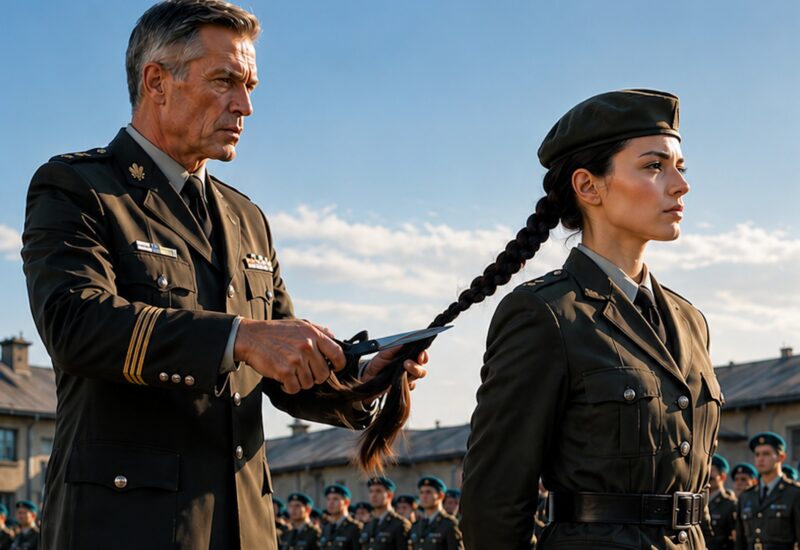
She stepped out calmly, her long dark braid falling nearly to her waist. Those who knew her understood that braid was something she took pride in — one of the few personal things a soldier is allowed to carry.
The colonel produced a large pair of scissors.
A nervous stir passed through the ranks like wind through tall grass. Several soldiers exchanged uneasy glances, understanding at once what was about to happen. No one moved. No one dared.
Anna stood perfectly still.
The colonel seized her braid and raised his voice so that every single person present could hear him.
“This will teach you not to argue with people who outrank you.”
The scissors snapped shut. The braid dropped to the ground. A silence so complete settled over the parade ground that the only sound was the distant hum of the morning.
He watched her. He waited.
He expected tears. He expected her composure to crack, her lip to tremble, some visible proof that he had broken something inside her. That was the point of all of it — not discipline, but destruction. Not correction, but control.
None of it came.
Anna did not move. Her face did not change. She stared straight ahead, as if she were alone on that field, as if the scissors and the braid and the colonel himself were nothing more than weather passing through.
That stillness seemed to reach somewhere deep inside the colonel and twist. He stepped closer.
“Do you think you’re special?” he demanded.
She said nothing.
“You’re just a recruit.”
Nothing.
“People like you break faster than anyone else.”
Her eyes remained fixed on the horizon.
“Without your hair, you finally look like a real soldier instead of a spoiled little girl.”
An audible murmur of discomfort moved through the assembled soldiers. Many of them shifted where they stood. A few stared at the ground. The colonel’s words were landing in a place that felt wrong to everyone watching — though no one yet had the courage to say so.
He wasn’t finished.
“You think far too highly of yourself,” he said. “Remember your place.”
Then Anna turned her head.
Slowly. Deliberately. She looked the colonel directly in the eyes for the first time since it all began. There was no fear on her face. There was no anger either. What sat there instead was something far more unsettling to a man like him — a calm so absolute it looked almost like pity.
“You can cut my hair,” she said quietly. “But I will not let you play with my honor.”
He smirked at her. “And what exactly are you going to do about it?”
What happened next unfolded in less than three seconds.
The colonel reached out and grabbed her shoulder — a sharp, forceful grip intended to shove her back toward formation. But Anna had trained in military hand-to-hand combat for years. Her body responded before her mind had finished processing the contact. She intercepted his arm, pivoted with precision, and used the full weight of his own momentum against him.
The colonel hit the ground hard.
The collective sound that rose from hundreds of soldiers was unlike anything that parade ground had ever heard — not cheers, not laughter, but a single shared intake of breath, a stunned silence that felt almost sacred.
No one who had watched it saw aggression in what she did. Every soldier present understood it for exactly what it was: a person defending herself from being physically handled without cause.
Before anything else could happen, a voice cut cleanly through the air.
“Enough.”
A general — unannounced, present for a surprise inspection — stepped forward from the edge of the crowd. He had been watching from the beginning. He had seen everything.
He looked first at the colonel rising slowly from the ground, then at Anna, standing at full attention as if nothing in the world had rattled her.
“A soldier is required to respect rank,” the general said, his voice carrying across the entire field. “But a commander is required to respect the dignity of those under his command.”
The silence that followed was different from all the ones before it. This one felt like a reckoning.
“Punishment does not give anyone the right to humiliate another human being.”
The colonel lowered his gaze. For the first time in years, he had absolutely nothing to say.
And Anna — still standing tall, chin lifted, eyes forward — had never looked more like the soldier she was born to be.