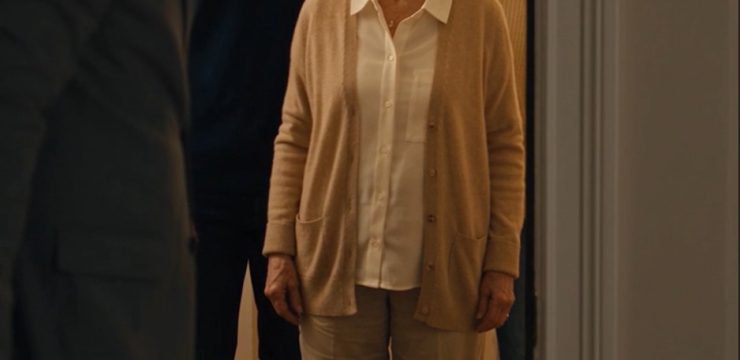
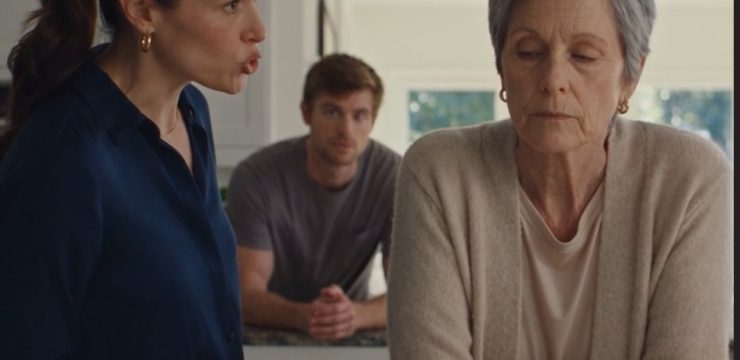
Nobody tells you how much a single touch can cost. Or how much it can give back.

She had been a nurse for over a decade — the kind of woman who showed up early, stayed late, and gave everything she had to patients who barely knew her name. But lately, life had been pulling her in two directions at once, and she was losing the battle on both fronts.
Her daughter had fallen ill. Not a small thing, not a passing cold — something serious enough that every hour of silence felt like a countdown. So she did what any mother would do. She kept her phone close. She checked for updates. She needed to know.
The hospital didn’t see it that way.
After one too many complaints from patients who noticed her glancing at her screen, the head doctor called her into his office. He didn’t ask for her side of the story. He didn’t inquire about her daughter. He simply looked across his desk and delivered his verdict.
“From now on, you’ll be working as an orderly. You’ll be bathing patients.”
She felt the floor shift beneath her. “Why are you doing this to me?” she asked, her voice tight with the effort of staying composed.
“Patients keep complaining that you’re always on your phone, staring at the screen.”
“My daughter is sick,” she said. “I need to know how she’s doing.”
He wasn’t moved. “I don’t care. Do what I said, or hand in your resignation.”
She had a mortgage. She had a sick child. She had no choice.
So she agreed.
Her first assignment came the very next morning. She was sent to care for a young man who had been living in that hospital room far longer than anyone should have to. He had lost all mobility from the neck down — years ago, in ways that no one fully explained to her. He could move his eyes. He could turn his head, just slightly. That was the whole of his world.
She entered quietly, the way she always did with patients who had learned to dread every footstep. She looked at him — really looked at him — the way most of the staff had long since stopped doing. Then she and another orderly carefully lifted him and brought him to the bathroom.
She ran the water. She checked the temperature twice — warm enough to comfort, gentle enough not to harm. She added a little foam. And then she began washing him, slowly and with more care than the task required of her. The room was hushed. Only the soft sound of water and her quiet movements filled the air.
She wasn’t thinking about what had been taken from her. She was thinking about him — this young man who had not felt the warmth of simple human kindness in longer than she could imagine.
And then something happened that stopped her cold.
She felt a hand close around her thigh.
She screamed. She jumped back. Her heart was slamming against her ribs as she stared at him, her mind trying to make sense of what had just occurred. But even as the shock burned through her, something else broke through — a memory, sharp and clear.
He was paralyzed from the neck down. Completely. He could not move his hands. He could not move anything below his jaw.
“Was that — was that you?” she whispered, her voice barely holding together.
“No,” he said softly, his eyes wide and frightened. “I didn’t do anything. I can’t… I can’t feel anything.”
“But you touched me. I felt it.”
“I don’t know how. I swear to you — I can’t.”
She called for the doctor. Not out of accusation — but out of something she couldn’t name yet. Something that felt, impossibly, like hope.
The head doctor arrived within minutes. He examined the young man with clinical precision, pressing along his arm, testing his responses. Then he stopped. He tested again. And when he looked up, his face had gone pale.
“That’s impossible,” he said quietly. “I was certain all his nerves were dead.”
He turned to the nurse, and his voice had lost every edge it carried the day before.
“You accidentally activated his ulnar nerve. What he experienced — what you both experienced — was a reflex. An involuntary muscular response. And do you understand what that means?”
She shook her head slowly, tears already blurring her vision.
“It means his nervous system isn’t as damaged as we thought. It means there’s a pathway. It means that if we begin rehabilitation now — the right kind, the intensive kind — there is a real chance he could regain mobility. He could walk again. He could have his life back.”
She pressed both hands over her mouth. Her shoulders shook. All the humiliation of the past weeks — being stripped of her title, reduced to what she was told was the lowest rung of hospital work — none of it mattered anymore. Because none of it had been meaningless. Even the punishment had led her here, to this room, to this man, to this exact moment.
She had been sent to do the simplest job in the building. She had done it with care, with patience, with a tenderness born from her own suffering. And somehow, that was enough. That was more than enough.
Life has a way of disguising miracles as ordinary days. A woman checking her phone for news of her sick child. A young man lying still in a room he had long since given up on. A bath. A moment of unexpected contact. A scream that turned into tears.
Nobody tells you that the worst days of your life might be quietly building toward something extraordinary. Nobody warns you that the moment you feel most broken might be the moment someone else’s world cracks open toward the light.
She learned it the hard way. And she learned it in the last place she ever expected — on her knees beside a bathtub, in a hospital that had tried to make her feel small.
Some touches heal more than skin. Some touches reach all the way down to where the silence lives — and wake it up.