There are moments in life that remind us, quietly but powerfully, that appearances can be deeply, profoundly deceiving. This is one of those moments — and once you hear it, you won’t forget it.
It started the way most ordinary mornings begin. The subway car was filled with the familiar sounds of a city waking up — the low hum of the train, the rustle of commuters settling into their seats, the occasional cough or shuffle of shoes against the floor. Nobody was looking for a confrontation. Nobody was expecting one. But sometimes, the universe has other plans.
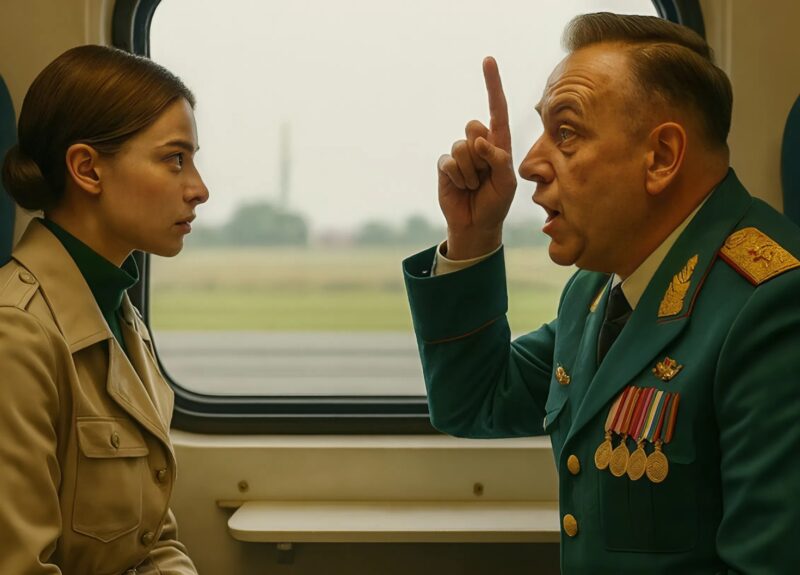
A young woman stepped aboard and found a seat. She was dressed simply — a neat, buttoned-up beige coat, her posture calm and composed, her expression unreadable. Nothing about her suggested she was looking for attention. She wasn’t on her phone. She wasn’t performing for anyone. She simply sat down, quietly, like any other passenger heading somewhere on an unremarkable morning.
Across from her sat a lieutenant colonel. His uniform was pressed to perfection, his medals arranged with military precision across his chest. He was the kind of man who had spent decades commanding rooms, earning deference, and carrying the weight of rank like a second skin. And from the moment his eyes landed on the young woman, something shifted in his expression.
He had noticed it — just barely visible beneath the collar of her beige coat — what appeared to be the dark green fabric of a military uniform. And something about that sight irritated him deeply. He assumed, without a second thought, that she was a civilian playing dress-up. Maybe chasing internet fame. Maybe simply disrespecting the uniform he had spent his entire adult life honoring.
He spoke to her the way some men in positions of authority speak when they have grown too comfortable with never being challenged. His tone was sharp, cutting, dismissive. He demanded to know why she was wearing military clothing. He didn’t ask — he ordered. And he did it loudly enough for the passengers around them to look up from their phones, their books, their private thoughts.
The young woman looked at him. Not with anger. Not with embarrassment. With a stillness that, in hindsight, should have been his first warning.
She told him, calmly and without raising her voice, that she had not given him permission to speak to her in that manner.
That only made things worse. The lieutenant colonel, his pride now fully ignited, cited his twenty years of military service like a shield. He raised his voice further. He told her to remove the coat. He turned what might have been a private misunderstanding into a very public spectacle, drawing every set of eyes in the train car directly onto them.
She let him finish.
Then she looked at him — steady, unhurried — and asked simply whether he was done.
Without drama, without theater, she unbuckled her belt and slipped off the beige coat.
What the lieutenant colonel saw beneath it stopped him cold.
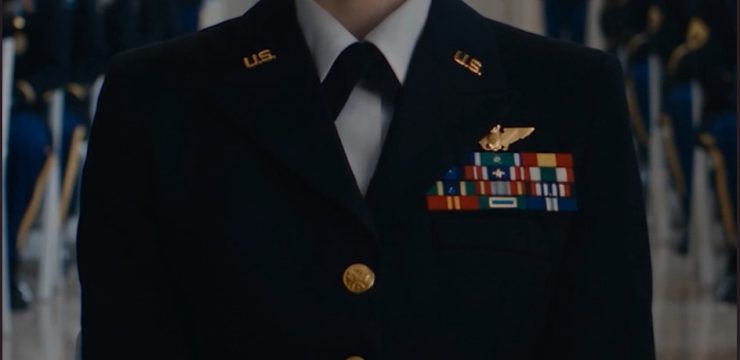
She was wearing a spotless special forces uniform. Her rank — major — was clearly displayed. Medals decorated her chest, earned through service he clearly knew nothing about. She was not a civilian playing pretend. She was a fellow officer. She outranked him in ways that had nothing to do with the stripes on a sleeve.
She placed her military identification card in front of him. Not aggressively. Not triumphantly. Quietly, the way people who have nothing to prove tend to do things.
She told him it was admirable that he cared so deeply about protecting the integrity of the uniform. But she found it curious, she said, that he had chosen to express that concern by raising his voice at a fellow officer in a public place, in front of civilians.
The silence that followed was the kind that has weight. The kind that presses down on a room. Every passenger felt it. The lieutenant colonel, whose face had drained of its earlier certainty, struggled visibly to find something to say.
She gave him a choice, offered plainly and without malice. She could mention this encounter to command, who would no doubt find his behavior worth discussing — or he could simply apologize.
He apologized. Quietly. With none of the authority he had entered the conversation carrying. He admitted, honestly, that he hadn’t known who she was.
She didn’t gloat. She didn’t smile with satisfaction. She simply offered him one last thought, the kind of wisdom that doesn’t need volume to land: it is usually better to find out who someone is before deciding how to speak to them.
At the next station, she stood, gathered herself, and stepped off the train. The doors closed behind her.
The lieutenant colonel sat in his seat, surrounded by strangers who had witnessed every second of it, and exhaled — long, slow, and heavy — the breath of a man who had just learned something important the hard way.
Some lessons cost nothing. Others cost you your dignity in front of a subway full of people.
And some people — the quietly remarkable ones — will never announce who they are. They’ll simply show you, when you leave them no other choice.