Daniel had always been the quiet type. The kind of man who held his emotions close, who showed love through small gestures rather than grand declarations. But on that afternoon, standing inside the crematorium’s mourning hall, surrounded by the hushed grief of family and friends, something inside him snapped — and the sound of his voice shook every single person in that room to their core.
Nobody was prepared for what came next.
Emilia was twenty-eight years old. She was radiant, full of life, and deeply in love with her husband. She was also eight months pregnant with their first child — a baby the couple had already named, already dreamed about, already made space for in their home and in their hearts. The nursery had been painted. The tiny clothes had been folded and placed neatly in the dresser. The future felt close enough to touch.
Then, one evening, everything changed.
Emilia suddenly felt unwell. It came on without warning — one moment she was fine, and the next she was not. Daniel rushed her to the hospital, his hands gripping the steering wheel, telling himself it would be okay. It had to be okay.
But it wasn’t.
The doctors delivered the news with the kind of careful, measured tone that somehow makes devastation even harder to absorb. Emilia had suffered a severe vascular catastrophe — a sudden, catastrophic medical event that her body simply could not survive. Despite every effort made by the medical team, she could not be saved. The baby, too, was lost.
The grief that swept through the family in the hours and days that followed was the kind that doesn’t have words. It settles into the chest like stone. It makes ordinary things — a coffee cup on the counter, a pair of shoes by the door — feel unbearable to look at.
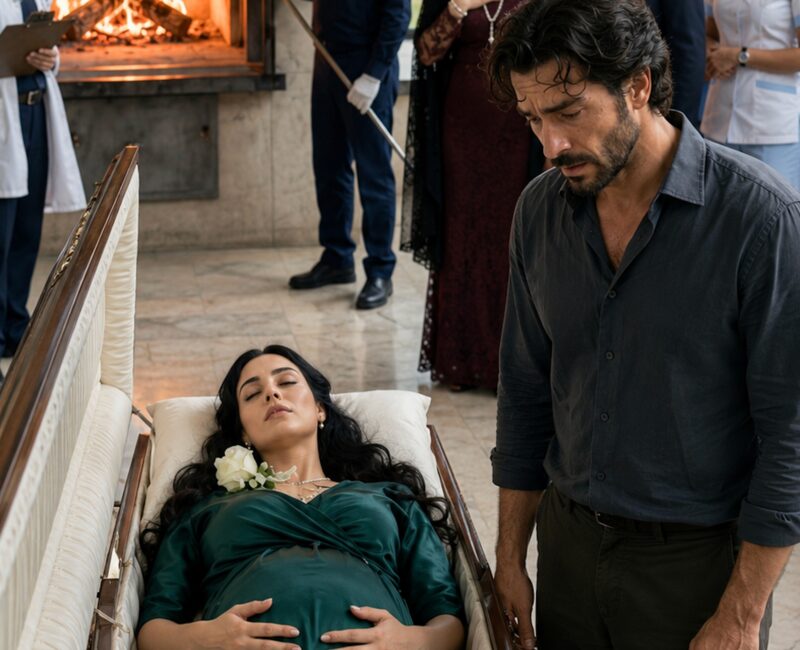
A few days later, the family gathered to say their final goodbyes. Emilia was carefully and lovingly prepared for the farewell. She was dressed in a beautiful gown, her face gently made up, and placed in an open coffin in the crematorium’s mourning hall. Only the closest relatives and a small handful of dear friends were present. The room was wrapped in a silence so heavy it almost had a physical weight to it.
People wept quietly. Others simply stood and looked at her, unable to fully accept that this young, vibrant woman — who had been laughing and planning and living just days before — was truly gone.
One by one, those present approached the coffin, whispered their goodbyes, and stepped aside. It was a slow, solemn procession of broken hearts.
Daniel was the last to approach.
He stood beside Emilia for a long moment, his head bowed. Then he leaned down close to her, and in a voice barely above a whisper, he asked her forgiveness for every mistake he had ever made, for every moment he hadn’t been as good as she deserved. It was the kind of raw, private grief that most of us keep locked away — the things we only say when it’s too late.
Then he lifted his head.
And something stopped him cold.
“Stop everything right now!”
His voice rang through the hall like a thunderclap. People flinched. A few gasped. Those who had been quietly weeping looked up in alarm. His relatives immediately moved toward him, their faces full of worry and tender concern.
“Daniel, please… we understand how hard this is.”
“It’s the shock. It’s too much for him.”
“There’s nothing that can be changed now, sweetheart.”
A crematorium staff member approached as well, speaking in a calm, practiced tone, explaining that the ceremony had already begun and gently encouraging him not to interfere with the process. The room braced itself for the grief of a man unraveling.
But Daniel wasn’t unraveling. He was staring at his wife’s face with an intensity that silenced everyone around him.
“No… wait. Just wait one moment. I saw something.”
People exchanged uncertain glances. Several of them moved closer, ready to guide him gently away. But then Daniel raised his hand and pointed directly at Emilia’s face.
“Look. There is blood coming from her nose.”
The room went utterly still.
Every pair of eyes turned toward the coffin.
And there it was — a thin, dark trickle, slowly emerging just beneath her nostril, making its way quietly down toward her lips.
No one spoke. No one moved. The silence in that hall was unlike anything those present had ever experienced.
The crematorium staff acted immediately. Protocol required that any unusual change — any anomaly whatsoever — must be investigated before proceeding, regardless of circumstance. The ceremony was halted. Medical professionals were called.
Within minutes, a medical team arrived. The doctor on call began a careful examination of Emilia’s body. What he found in those first few minutes made him pause. Then made him act with urgency.
There were signs present — subtle but undeniable — that did not align with the condition of someone who had passed away. The blood was not a random occurrence. Her body, it appeared, had not been where everyone believed it to be.
Emilia was transported back to the hospital immediately.
Once there, connected to monitoring equipment and subjected to a thorough re-examination, the medical team made a discovery that would shake every person involved to their foundation. An extraordinarily rare and devastating medical error had occurred. Due to the severity of her initial condition and the near-total absence of detectable vital signs, her death had been incorrectly declared. Emilia had not passed away. She had been in a state of profoundly deep coma — a condition so extreme that even experienced, skilled physicians can, in rare and tragic cases, misread the signs.
She was alive.
Emilia spent several more weeks in intensive care. The road was long and uncertain, filled with moments of fear and cautious hope. Tragically, the baby could not be saved — a loss the family would carry forever. But Emilia herself, slowly and against every odd, began to come back.
She regained consciousness. She healed. And eventually, she came home.
When the doctors spoke to the family after her discharge, their words carried the full weight of what had almost happened. If Daniel had not cried out when he did — if he had not looked at his wife’s face one final time, if he had not trusted what his eyes were telling him in that impossible moment — the outcome would have been permanent and irreversible.
Daniel, for his part, has never been able to fully explain what made him look. He has no logical answer. He only knows that something — call it instinct, call it love, call it grace — made him pause.
And that pause gave Emilia her life back.
Everyone who stood in that mourning hall on that afternoon carries the memory of it still. Not as a story of death, but as one of the most profound and humbling miracles any of them had ever witnessed — unfolding in the final seconds before a door that could never be reopened was about to close forever.