She left in the middle of the night with nothing but her documents, a small amount of cash, and the desperate need to survive. No suitcase. No phone call to a friend. No goodbye. She didn’t even pull the front door shut behind her, because every second she stayed increased the chance he would wake up — and she couldn’t afford to let that happen.
By the time the sun came up, she was already in a city where no one knew her name. That anonymity was both a relief and a terror. She had no friends there, no family, no couch to crash on. She had only the hollow kind of freedom that comes from running away from something rather than running toward it. The fear of being found was like a second heartbeat — always present, always pounding.
Her money was nearly gone. She walked into one rental office after another, only to be turned away. Even the cheapest shared housing required a security deposit she simply didn’t have. She walked until her feet ached and the sun started to sink low in the sky, painting the unfamiliar streets in shades of orange and shadow.
Exhausted, she ducked into a small café and ordered the least expensive thing on the menu — a plain cup of tea. She sat by the window and stared at nothing in particular, her mind running through the same hopeless loop. An old newspaper sat on the table beside her, and she picked it up without much intention, just something to do with her hands.
That’s when she saw it.
Houseboat for sale. $20.
She read it twice. Then a third time. Twenty dollars. The number was absurd — suspiciously, almost laughably low. But desperation has a way of silencing the voice of reason. She had no better options. She picked up her phone and dialed.
The man who answered was curt, impatient, and in no mood for questions. He explained that the boat had become a legal headache — fines from the port authority, mountains of unresolved paperwork — and he simply wanted it gone. Today. She asked if she could come see it first.
“No need,” he said flatly. “Take it or leave it. Someone else will by tomorrow.”
He rattled off a number for the bank transfer and ended the call before she could say another word. It was strange. Every instinct she had whispered that something was off. But the alternative — another night on the street — was worse. She transferred the money. A few minutes later, a message arrived with an address and four words: The key is under the doormat.
She made her way to the harbor as the last light of day faded from the sky.
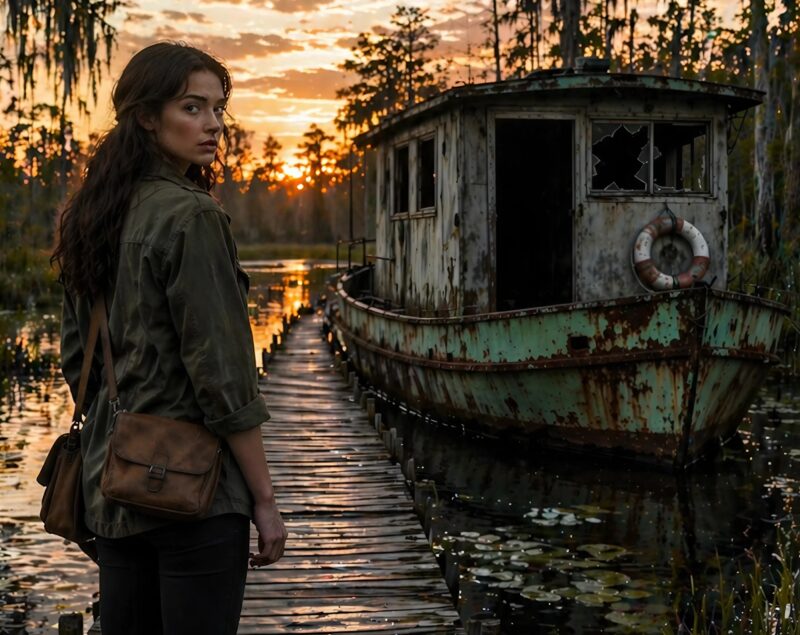
The place looked like the world had forgotten it existed. The water sat dark and perfectly still. The dock was made of old, weathered planks that groaned under the slightest weight. There were no other people — no fishermen, no passersby, nothing but scattered trees and the quiet lapping of water against rotting wood.
She spotted the boat immediately. It was smaller than she’d imagined, and far more worn. The paint was peeling in long strips. One of the windows had a crack running diagonally across it. Rust had spread along the railings like a slow disease. Still, it was shelter. She told herself that was enough.
She walked along the dock slowly, listening to the boards creak beneath her feet, the sound unnervingly loud in the silence. When she reached the door, she crouched down and found the key exactly where he said it would be. Her hand hovered over the lock for just a moment.
Then she turned the key and pushed the door open.
The hinges let out a long, low groan. Inside, it was completely dark. She felt along the wall until her fingers found a light switch and flipped it on.
She froze.
The floor. That was the first thing her eyes landed on. There were dark stains spread across the wooden planks — deep, uneven patches that couldn’t be explained away as ordinary grime or age. They were too concentrated. Too deliberate in the way they pooled and spread.
She took one careful step forward, and the smell hit her — heavy, metallic, deeply unsettling. A smell that no amount of time or sea air had managed to erase.
It was blood. There was no other explanation for it.
Her gaze traveled slowly around the room. The table had been knocked completely over. A chair lay in pieces near the wall. And along one side of the cabin, there were dark smear marks — the kind left behind when someone desperately tries to grab hold of a surface, tries to brace themselves, tries to escape.
This wasn’t simply an abandoned boat that had fallen into disrepair. This was a crime scene. And it looked recent.
Her hands began to shake uncontrollably.
In that moment, everything she had been telling herself — that the low price was just a lucky break, that the seller was simply desperate to offload a legal burden — collapsed completely. The truth settled over her like ice water.
The boat hadn’t been sold for twenty dollars because no one wanted it.
It had been sold for twenty dollars because someone needed a person to walk through that door — someone with no connections, no one to report them missing, no plan, and no way out.
Someone who was already running.
Someone exactly like her.