Henry Wallace had lived the kind of quiet life that most people overlook — and that’s exactly what made what happened at his funeral so impossible to forget.
He was sixty-seven years old, a retired hunter who kept mostly to himself after losing his wife years earlier. He lived alone in a modest house near the edge of the forest, the kind of man who fixed his neighbors’ fences without being asked, left food out for stray animals, and never once raised his voice in an argument. The only constant companion in his life was Buddy — a golden retriever who had been by his side for nine faithful years.
Buddy wasn’t just a pet. He was Henry’s shadow, his comfort, and according to nearly everyone who knew the old man, his closest friend. The dog slept beside his bed every night, waited at the front door every single morning, followed him through the woods on hunting trips, and curled beside him near the fireplace on cold evenings. Neighbors would often say that Buddy understood Henry better than most people ever could.
So when Henry passed away, Buddy seemed to stop living too.
For three days after Henry’s death, the dog barely moved. He refused to eat. He refused to drink water. He lay pressed against the bedroom door with his nose buried in his owner’s old jacket, whimpering so softly it broke everyone’s heart. When relatives tried to take him to a neighbor’s house so they could prepare for the funeral, Buddy pulled free and ran straight back, clawing desperately at the front door until Henry’s niece finally made the decision — the dog would come to the cemetery. Leaving him behind would have been cruel.
The morning of the funeral was cold and gray, the kind of sky that feels heavy with things left unsaid. Dry leaves drifted between the headstones, and the dark soil glistened from the night’s rain. Family members, old neighbors, and friends who had hunted with Henry for decades gathered quietly around the open casket. Nobody spoke much. There wasn’t much to say.
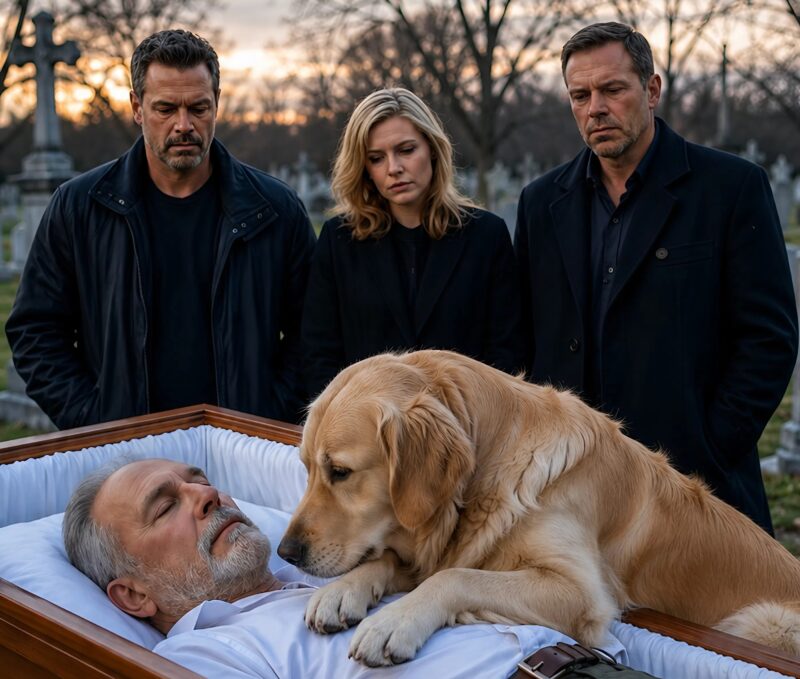
Buddy walked beside the coffin without pulling on his lead, without barking, without reacting to the crowd. He was unnervingly calm — almost dignified. When the casket was placed at the graveside, the dog stepped forward, rested his paws on the wooden edge, and looked at Henry’s face for a long, still moment. Several women began weeping harder. Even the toughest men in that group turned away to collect themselves, because the grief on that dog’s face was something no one could bear to look at directly.
Then Buddy climbed gently into the open casket and lay down beside Henry. He rested his head on the old man’s chest and whimpered once, softly. Henry’s nephew moved to pull him out, but his sister stopped him. The dog deserved these last few minutes. The cemetery fell nearly silent, interrupted only by the wind, the rustling branches, and the sound of quiet tears.
And then the priest approached the casket.
The moment the man in black stepped forward and opened his prayer book, everything changed. Buddy lifted his head. His entire body went rigid. His ears flattened, his eyes narrowed, and a low growl began to build deep in his chest — the kind that comes not from fear but from something far older and more certain. He wasn’t simply reacting to a stranger. He was reacting to someone he recognized.
The priest paused, smiled gently, and suggested the dog was simply overcome with grief. He stepped closer.
Buddy exploded.
The barking was so sudden and so violent that several people stumbled backward. The dog positioned himself directly in front of Henry’s body, refusing to let the priest come an inch closer. He growled, barked, and clawed at the white fabric lining the inside of the casket — never once breaking eye contact with the man in front of him. Henry’s nephew grabbed his collar. Buddy broke free. He lunged back toward the casket, stood guard, and locked his eyes on the priest with an intensity that silenced every person standing in that cemetery.
He wasn’t attacking anyone else. He wasn’t frightened of the crowd. Every ounce of his focus was aimed at one man.
The priest’s face had gone pale.
He tried to step around the dog. Buddy leaped from the casket and clamped his teeth onto the sleeve of the man’s long black robe. Two men rushed forward trying to pull him back. The priest yanked his arm hard — and in that moment, something small and metal fell from inside his sleeve and hit the ground with a soft clink.
Henry’s sister saw it first. She recognized it immediately and let out a sharp, broken sound that wasn’t quite a word.
It was Henry’s silver locket. The one he had worn around his neck for over thirty years. The one that held the only photograph he had left of his late wife. The one he never — not once — removed.
When Henry had been found, the locket was gone. The family had assumed it was removed by medical personnel or funeral workers. They had not questioned it. Why would they?
A terrible silence settled over the cemetery.
The priest bent down quickly to retrieve it, but Buddy growled once more and the man froze. Henry’s nephew picked up the locket instead. He opened it carefully. Behind the photograph, folded so small it was nearly invisible, was a piece of paper.
Henry’s handwriting.
The note said that if anything happened to him, the family should look closely at the man who had been visiting him under the pretense of offering spiritual care — because Henry had noticed money going missing from his home and had planned to go to the police the very next day.
One by one, every person standing at that graveside turned toward the priest.
A neighbor suddenly remembered a black car parked outside Henry’s home the night before his death. Another recalled hearing Buddy barking frantically that same night — a detail that had seemed insignificant until this exact moment.
The family called the police from the cemetery.
When investigators later examined Henry’s home more carefully, they found evidence of a struggle that had been too quickly dismissed as the ordinary disarray of an elderly man living alone. Documents were missing. A lockbox where Henry kept his savings had been emptied. The priest had been visiting for months, had gained the old man’s trust, and had counted on the fact that no one looks too hard at the death of a lonely widower.
He had been wrong about one thing.
He had forgotten about the dog.
While they waited for the police to arrive, Buddy climbed back into the casket one final time. He lay beside Henry, rested his head on the old man’s chest, and this time he did not whimper. He simply closed his eyes.
He had done what he came to do.