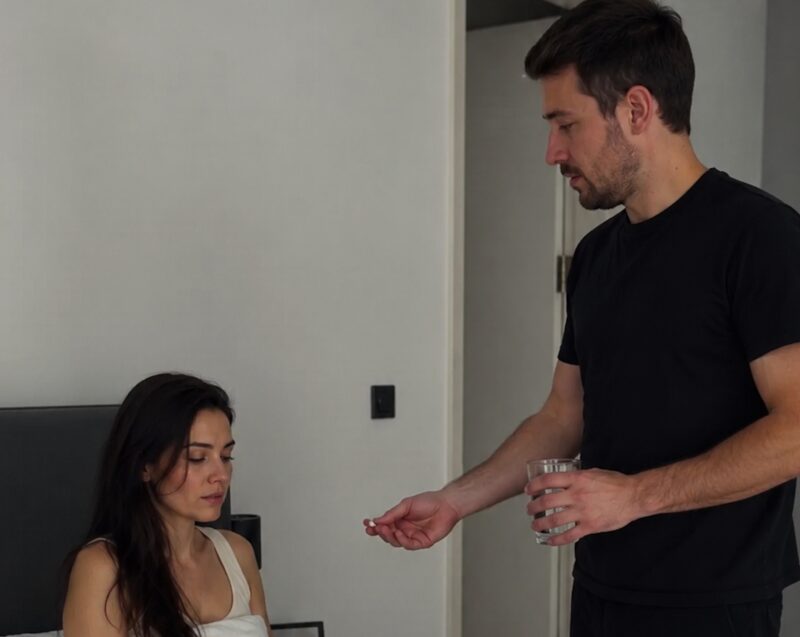
Every morning, before my husband walked out the door, he handed me a small white pill and a glass of water. Then he stood there, watching, waiting until I swallowed it. He even asked me to open my mouth and show him my tongue to prove I had actually taken it.
For weeks, I thought I was living with a controlling stranger. I had no idea that what I was about to discover would bring me to my knees — and completely change the way I understood love.
I married this man because I believed he was kind, steady, and genuinely good. Before our wedding, he never once raised his voice at me. He surprised me with small, thoughtful gestures. He told me, with every ounce of sincerity I had ever seen in a person, that he wanted to spend his entire life by my side. I believed him. I trusted him completely.
But the morning after our wedding changed everything.
He was already dressed when I woke up, holding a glass of water and a white pill. He handed them to me with a calm smile and said, simply, that I needed to take it every day. When I asked what it was, he just told me to trust him. That it was important. I wanted to push back, but something in his voice made me hesitate. So I swallowed the pill.
That became our morning routine.
Every single day, he brought me a new pill, watched me take it, then asked me to open my mouth so he could check. At first I thought it was odd. Then I thought it was controlling. Then I started to feel afraid. Because at exactly the same time every afternoon, my phone would ring. It was always him. Always the same short questions — are you home, did you go anywhere, good, I’ll be back soon — followed by a click. Less than a minute, every single day, without fail.
I started keeping a mental list of everything that felt wrong. He never explained the pills. He tracked my schedule. He watched me like he was afraid of what might happen if he looked away for too long. I told myself it was jealousy. I told myself he just liked being in control. But deep down, a colder feeling was setting in.
One morning, I made a decision.
When he handed me the pill, I pretended to swallow it. I drank the water, opened my mouth wide, and let him check. He nodded, satisfied, and left for work. The second the door closed behind him, I pulled the pill out from where I had tucked it in my cheek, wrapped it carefully in a napkin, and placed it in my bag.
Within the hour, I was standing at the counter of a private laboratory, speaking quietly to a technician. I told her I needed to know exactly what was in this medication. She told me the results would take a few days.
Those days were some of the longest of my life. I kept pretending to take the pill each morning. I kept answering his afternoon calls. But inside, every terrible possibility was running through my mind. Was he making me dependent on him? Was he trying to keep me foggy and confused? Was I being slowly, quietly harmed by the one person who was supposed to protect me?
When the laboratory finally called, I went in with my hands trembling.
The doctor looked at the results, then looked at me with an expression I couldn’t quite read.
He told me this was a serious medication — the kind prescribed for significant psychiatric conditions. The kind that cannot simply be stopped without medical supervision. He wanted to know how long I had been taking it, who had prescribed it, and whether I had a treating psychiatrist on record.
I told him I had never had any psychiatric condition in my life.
He was quiet for a moment. Then he said, very gently, that according to the documents associated with my name, treatment had been ongoing for quite some time. He gave me an address and told me I should go speak with the doctor listed in my file.
I sat in that doctor’s office feeling like the floor had dissolved beneath me.
The elderly physician opened a thick folder and told me, calmly and carefully, that he had expected I would come on my own eventually. He explained that years ago, I had experienced a severe mental health crisis following a deeply traumatic event. During my worst episodes, I had lost complete awareness of my own actions. I had no memory of those periods afterward, which is why the illness had seemed invisible to me — like it had never existed at all.
He told me my husband had voluntarily committed to ensuring I took my medication on time, every single day. The daily phone calls were not surveillance — they were a precaution recommended by the medical team. During difficult periods, I needed someone checking in. My husband had never told me any of this because the doctors had warned him that the shock of learning the full truth too suddenly could set back my recovery significantly.
He had been protecting me in the most quiet, invisible way a person can protect someone they love.
I drove home with tears streaming down my face. Not from fear. Not from anger. From the weight of understanding how completely I had misread every single thing.
When my husband walked through the door that evening and saw my face, he already knew.
He sat beside me and, for the first time, we talked about all of it. He told me he had never wanted to deceive me. That every morning, every phone call, every careful check had been his way of keeping a promise he had made — not just to the doctors, but to me, even though I hadn’t known I needed it.
That evening, for the first time, I reached across the table and picked up the pill myself.
Because love, I finally understood, doesn’t always look the way we expect it to. Sometimes it looks like a glass of water and a quiet, steady hand — offered every single morning, without asking for anything in return.