The lemon cake hit the hardwood with a sickening thud, yellow frosting spreading across the floor. Then came the words that hurt more than the fall itself: “Pick it up.” Two children sat frozen while their mother laughed, and the humiliation suddenly felt bigger than a ruined birthday cake.
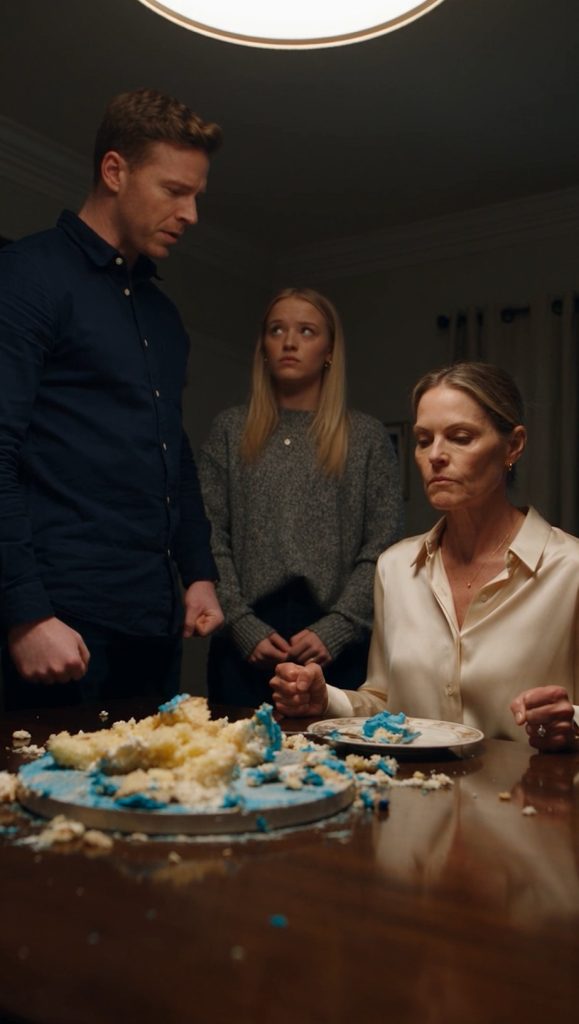
It was my sixty-eighth birthday.
My name is Thora Caldwell, and the man standing over the cake was my only son, Daniel.
For most of my life, I believed being a good mother meant making his life easier. When businesses failed, I helped. When money ran short, I covered expenses. Twelve years earlier, after his first business collapsed, I had even bought the house where he lived with his wife, Vanessa, and their children.
Whenever Daniel struggled, I stepped in before consequences could reach him. I called it love.
But the cake was different.
My husband, Harold, had been dead six years. Lemon cake had been his specialty—lemon zest, butter, sugar, vanilla, always with extra zest. I had rebuilt it from memory because I wanted one small piece of him at my birthday table.
Daniel knew what it meant.
And he let it fall.
“Mom,” he said, pointing at the mess. “You heard me.”
Vanessa gave another nervous laugh. Eleven-year-old Lily stared at me, tears gathering. Fourteen-year-old Noah looked down at his plate.
Something inside me became very still.
I could have argued, cried, or knelt down and cleaned the frosting while everyone pretended the evening could continue.
Instead, I pushed back my chair, walked into the hallway, and put on my coat.
“Where are you going?” Daniel asked.
“Thora, come on,” Vanessa called. “He was joking.”
I turned. Daniel stood beside the ruined cake with his arms folded, waiting like a man expecting an employee to fix a mistake.
“Were you?” I asked.
He didn’t answer.
I said good night to Lily and Noah and stepped into the cold October air.
“Mom, don’t be ridiculous,” Daniel called behind me.
I had heard versions of that sentence whenever I questioned his spending, refused a request, or hesitated before rescuing him. But that night, I finally understood it.
Don’t make me face the consequences of how I treat you.
I sat in my car staring at the house. Legally, it was mine. Daniel and Vanessa paid me a modest amount each month, but he had long ago started calling it “our house.”
Before I started the engine, my phone buzzed.
Are you actually doing this?
Then: Come back inside before you upset the kids.
Not once did he ask if I was hurt. Not once did he apologize. Even now, my reaction was the problem.
I drove to a twenty-four-hour diner, ordered black coffee, and opened my contacts.
Margaret Sloan.
She had been Harold’s attorney, and after his death, she became mine. Years earlier, Margaret warned me that my estate plan gave Daniel too much direct access and too much control if anything happened to me. After he misused money from an account meant for property repairs, she urged me to add stronger protections.
Daniel apologized. He cried. He told me how much pressure he was under.
I canceled the follow-up appointment.
That was the pattern. Daniel created the emergency, and somehow I ended up comforting him.
At 9:17 p.m., I typed, “I’m ready to make the changes we discussed. First appointment tomorrow, please.”
Eleven minutes later, Margaret replied: “9:00 a.m.”
I expected guilt.
Instead, I felt relief.
The next morning, I sat across from Margaret and told her everything.
When I finished, she opened a thick file with my name on it—the documents representing everything Harold and I had spent decades building.
Margaret looked at me carefully.
“What do you want now?”
I stared at the papers, knowing my answer could change my son’s future forever.
And when I finally raised my eyes, everything was about to unravel. 👇
Margaret’s fountain pen stopped above the legal pad.
I heard myself say it before fear could soften the words. “I want Daniel removed from every place where my death, my money, or my guilt gives him power over me.”
Margaret held my gaze, then nodded. She began turning pages—power of attorney, beneficiary designations, the property arrangement, the repair account Daniel had once treated like his own.
“We can protect you,” she said. “But he is going to feel the loss of access before he understands the reason.”
My phone vibrated.
Vanessa.
Did you tell Daniel the house would become ours once we finished paying you back?
The room seemed to narrow.
I handed the phone to Margaret. She read the message twice.
“Did you?”
“No.”
Before I could answer Vanessa, she called.
Her voice was thin and breathless. “Thora, Daniel says we’ve been buying the house from you for twelve years. He says the payments come out every month.”
“They do,” I said carefully. “Seven hundred dollars.”
Silence.
“Seven hundred?”
My fingers went cold.
Vanessa swallowed audibly. “Daniel has been transferring twenty-one hundred. He told me the rest was principal and taxes.”
Margaret was already reaching for another sheet of paper.
“Bring the statements,” she said. “And anything he gave you about the house.”
Vanessa arrived forty minutes later with a folder crushed against her chest. The woman who had laughed beside my ruined birthday cake could barely look at me.
“I laughed because I was afraid he’d get angry,” she whispered. “That doesn’t make it better.”
“No,” I said. “It doesn’t.”
She nodded and opened the folder.
Years of transfers. Messages describing “mortgage payments.” Screenshots of Daniel telling Vanessa not to bother me because I was “confused by legal stuff.” On the same dates, money moved from their joint account into one of Daniel’s business accounts.
Margaret arranged the papers in neat rows.
The pattern was impossible to misunderstand.
Daniel had convinced Vanessa they were buying my house while using part of the money to keep his business alive. He had counted on my silence and her trust never meeting in the same room.
Vanessa stared at the statements, hands trembling.
“I defended him to you.”
“So did I.”
That afternoon, Margaret sent Daniel notice that my estate documents were being changed, his access to my accounts was ending, and the property and repair records were being reviewed.
He called nineteen times.
I answered the twentieth.
“What are you doing?”
“Come to Margaret’s office at five.”
He arrived early.
Daniel walked into the conference room wearing the same expression he had beside the cake—irritation disguised as certainty. Then he saw Vanessa sitting next to me.
He stopped.
“What is this?”
Margaret slid the statements across the table.
The certainty vanished.
Vanessa’s voice shook. “You told me we were buying the house.”
Daniel looked at me. “This is family business.”
“No,” I said. “That sentence has protected you long enough.”
“You don’t understand those transfers.”
“Then explain them.”
His mouth opened.
Nothing came out.
The wall clock ticked. I watched my son search my face for the woman who would rescue him.
I stayed still.
Finally he said, “I was trying to keep us afloat.”
“With money you told me was paying for our home?” Vanessa asked.
“You had a home.”
“Her home.”
His face hardened. “So now you’re on her side?”
That was when I saw the pattern without excuses. Daniel had learned that if he made enough people feel guilty, frightened, or responsible for him, he never had to stand alone with what he had done.
I placed one final document on the table.
“My new estate plan gives you no direct control over my assets. Anything for Lily and Noah will be protected independently. You cannot borrow against it, manage it, redirect it, or touch it.”
Daniel went pale.
“And the house?”
“You will receive formal notice through counsel. Vanessa and the children will not be put out while they decide what comes next. But the house was never yours.”
He stared at me.
“You’re choosing them over your own son.”
My throat tightened.
“I’m choosing not to abandon myself anymore.”
Daniel stood so quickly his chair tipped backward.
He looked at Vanessa. “Get your things.”
She folded her hands in her lap.
“No.”
One word.
Quiet. Terrified. Final.
“The kids and I are going home,” she said. “You’re going somewhere else tonight.”
His power did not break with shouting. It broke in the silence after that sentence, when no one rushed to soothe him.
No one followed him out.
The weeks that followed were ugly in quieter ways. Lawyers exchanged letters. Accounts were reviewed. Faced with his own written messages and the repair-account records, Daniel agreed to repay the disputed money and formally waived any claim that he had been purchasing the house.
Vanessa filed for separation. Daniel moved into a rented apartment and, for the first time in his adult life, faced consequences no one quietly removed for him.
I did not celebrate.
Some nights I cried for the son I remembered, and for the years I had confused rescue with love.
Then, one Saturday, Lily and Noah came over with groceries.
“We want to make you something,” Lily said.
In the kitchen, she measured sugar while Noah softened butter. Neither mentioned my birthday until the smell of lemon zest filled the room.
Noah stopped.
“I’m sorry I looked down.”
I turned.
“That night,” he said. “When Dad dropped the cake. I knew it was wrong. I thought if I stayed still, it would end faster.”
I crossed the kitchen and covered his hand with mine.
“You were fourteen. It was never your job to stop your father from hurting me.”
Lily wiped her cheek with her wrist.
“I thought you were never coming back.”
I pulled them both close, and for a while we stood beside the counter with the mixer unplugged and the room smelling like lemon.
Vanessa apologized again months later, without excuses.
“I laughed when you were being humiliated,” she said. “I remember it every time I walk into that dining room.”
“I remember too.”
Forgiveness did not arrive all at once. It came in smaller things. Vanessa keeping every financial document where she could see it. Lily calling to ask if I wanted tea. Noah fixing a loose cabinet hinge with money from his first summer job and refusing reimbursement.
I gave Vanessa a proper lease while she rebuilt her finances. Margaret created protected trusts for Lily and Noah with an independent trustee Daniel could never control.
Nearly a year later, Daniel sent me a letter.
It did not ask for money.
It did not blame Vanessa.
It said only that he was sorry, and that he understood an apology did not create an obligation for me to let him back into my life.
I kept it.
I did not mistake it for change.
But from a safe distance, I hoped change might someday become possible.
On my sixty-ninth birthday, Lily and Noah insisted on baking the cake.
They banished me from the kitchen while Vanessa set the table. Sunlight lay across the hardwood where yellow frosting had once spread.
Then Noah came into the dining room holding something behind his back.
“Grandpa gave me this when I was eight.”
He placed a stained index card in my hand.
Harold’s handwriting.
Lemon zest. Butter. Sugar. Vanilla.
And beneath the ingredients, squeezed into the margin in the slanted script I had not seen in six years, were four words:
More zest. She likes it.
I laughed before I cried.
“Grandpa told me to keep it,” Noah said, “because one day I might need to make your birthday cake.”
For six years, I had believed I was keeping one small piece of Harold alive by rebuilding his recipe from memory.
I had been wrong.
He had already passed it forward.
Lily leaned against my shoulder. Vanessa covered her mouth with both hands. Noah smiled in the shy way Harold used to when he had done something kind and didn’t want praise for it.
We ate the cake at the same table where everything had broken.
No one raised their voice.
No one demanded obedience.
When the last slice was gone, Lily carried the plates to the sink, Noah slipped Harold’s recipe card into a clear sleeve, and Vanessa opened the window to let the cool October air move through the room.
I sat beneath the warm kitchen light listening to my grandchildren argue softly about who had added too much zest.
For the first time in years, the house did not feel like something I had paid for, protected, or might someday leave behind.
It felt like what Harold had always meant it to be.
Home.