The salute came without warning.
One second, the officer was correcting a quiet man for stepping over a yellow safety line. The next, she was standing rigidly in front of him, hand raised to her brow, while hundreds of people stared in stunned silence.
And the man holding the battered camera looked as though he had just seen a ghost.
The humid air above the military parade deck felt thick enough to breathe in pieces. Exhaust drifted across damp asphalt, mixing with the clean scent of pressed uniforms as hundreds of spectators crowded behind yellow safety ropes.
Beyond them, the graduating class stood in perfect formation beneath the hard afternoon sun.
Near the front of the crowd, a soft-spoken man in his late forties struggled with an old digital camera.
Brandon Mercer wore a faded work shirt, worn jeans, and boots scarred by years of use. His hands were rough, calloused—and trembling slightly as he tried to focus on the two young women standing proudly in the front rank.
His daughters.
For a moment, his face softened.
He shifted sideways, raised the camera again, and leaned a few inches past the painted yellow line, searching desperately for a clear angle.
A sharp voice cut through the noise.
“Sir. I need you behind the line.”
Brandon immediately lowered the camera.
Captain Elena Reyes stood a few feet away, immaculate in uniform, every detail of her posture controlled. She looked to be in her early thirties, the kind of officer who noticed everything and tolerated very little disorder.
Brandon stepped backward without argument.
“Yes, ma’am. My apologies.”
There was no irritation in his voice. No embarrassment. Just quiet compliance.
Beside him, a man in an expensive tailored suit gave a loud, humorless scoff.
“You just let anyone wander wherever they want?”
He adjusted his silk tie and glanced pointedly at Brandon’s dusty boots, making no effort to hide his contempt.
Brandon heard him.
He simply lowered his eyes and began straightening the worn strap of his camera.
The suited man seemed almost disappointed by the lack of reaction.
“Some people just don’t understand their place.”
Brandon’s jaw tightened for half a second.
Nothing more.
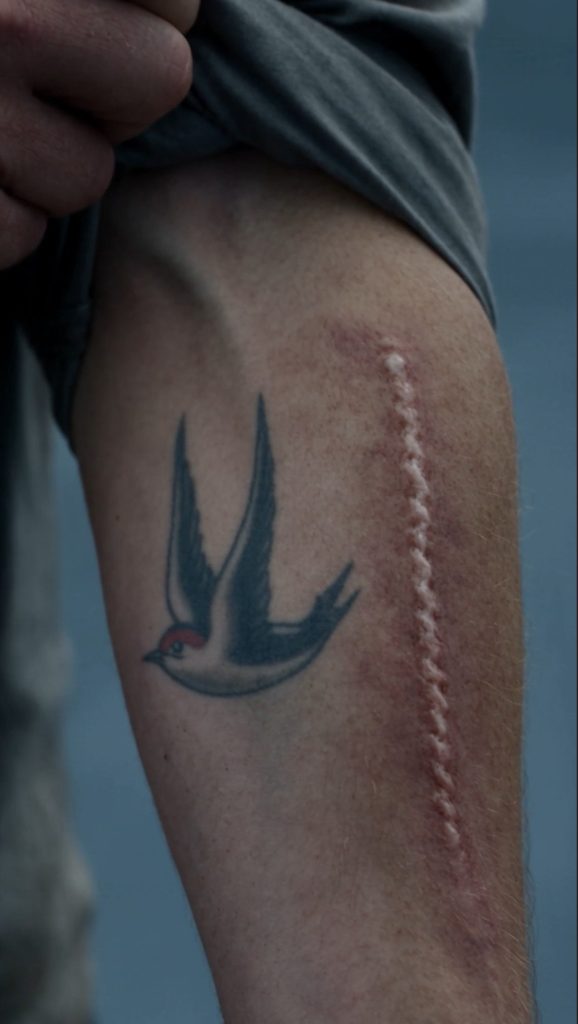
But as he adjusted the strap, the faded sleeve of his work shirt slid upward.
Captain Reyes noticed.
At first, it was only the scar tissue.
Thick. Pale. Uneven.
It wrapped around part of his forearm like the remains of an old wound that had healed badly and been carried quietly for years.
Then she saw the tattoo buried within it.
Three broken bars surrounding a compass point.
Small.
Faded.
Almost invisible unless someone knew exactly what they were looking at.
Reyes stopped breathing.
The noise of the crowd seemed to fall away from her.
Her expression changed so suddenly that one of the nearby officers glanced over, confused. The disciplined neutrality disappeared from her face, replaced by something Brandon recognized immediately.
Recognition.
And shock.
The suited man was still talking, unaware.
Captain Reyes never looked at him.
Her shoulders drew back.
Her heels came together.
Her entire body shifted into flawless military precision.
Brandon slowly raised his eyes.
For the first time, uncertainty crossed his face.
Reyes stepped directly in front of him.
Then she raised her right hand.
A crisp salute.
The nearby officers froze.
Conversation around them died almost instantly as spectators began turning toward the scene.
In the formation, Brandon’s two daughters saw it too.
Their composed expressions cracked.
One stared at the captain.
The other looked straight at her father, eyes widening as if she were seeing a part of him she had never known existed.
Brandon’s fingers tightened around the camera.
Captain Reyes held the salute.
Her voice, when it came, was controlled—but only barely.
“Staff Sergeant Brandon Mercer…”
His face went pale.
“…permission to honor a Marine who should never have been made to stand in the back.”
Brandon did not move.
His hands began trembling harder.
And as his daughters watched from across the parade deck, Captain Reyes opened her mouth to explain exactly who their father had once been.
Nobody there was prepared for what came next. 👇
The suited man’s smirk vanished first.
His fingers stopped on his silk tie, and for the first time since Brandon had stepped over the line, he looked directly at him—not at the boots or the work shirt, but at his face.
Captain Reyes saw it.
“So you do remember him,” she said.
The man’s mouth tightened. “Captain, this is neither the time nor the place.”
Brandon flinched as if the sentence had struck somewhere older than the scar on his arm.
Reyes lowered her salute slowly. “Retired Colonel Daniel Hargrove,” she said. “I think that decision stopped belonging to you a long time ago.”
A murmur moved through the spectators.
Hargrove stepped toward her. “You are supervising crowd control. Do your job.”
“Captain. Please.”
Brandon’s voice was low. Reyes turned, and the anger in her face softened.
“I came here for them,” he said, nodding toward the formation. “Not for this.”
One daughter had tears standing in her eyes. The other had gone completely still.
“I know,” Reyes said. “But they deserve the truth. So do you.”
Hargrove laughed sharply. “Truth? You were a child when it happened.”
Reyes looked at him.
“My father wasn’t.”
Something changed in Brandon’s face.
Reyes glanced at the old camera hanging from his hands. “Sergeant Luis Reyes. Third man in the Broken Compass team.”
Brandon’s knees nearly gave. The camera struck softly against his belt.
Hargrove’s expression hardened. “Enough.”
“No.”
It was the first time Brandon had raised his voice.
The word carried across the parade deck. Hargrove stopped.
Brandon stared at Reyes. “Luis was your father?”
She nodded once.
Brandon closed his eyes.
Twenty-three years earlier, four Marines on an extraction team had been ordered to abandon a collapsing position after communications failed and enemy fire cut off the road out. The official report later said Staff Sergeant Brandon Mercer panicked, broke formation, and caused three Marines to be left behind.
What the report never said was that Brandon went back.
Alone.
He crossed open ground twice, pulled wounded men from a burning transport, and refused evacuation until the last Marine he could reach was aboard.
Three members of his team still died.
One was Luis Reyes.
Hargrove had been the field commander who issued the withdrawal order. When questions began about why extraction coordinates had been changed without authorization, he wrote the report that placed the failure at Brandon’s feet.
Brandon stared at the asphalt.
“I signed the statement,” he said.
His daughters looked at him.
“Why?” one whispered.
He rubbed his thumb across the cracked edge of the camera. “Because I had two little girls at home. I’d already buried three brothers. I didn’t have anything left for another fight.”
Hargrove seized on it. “There. He admits it.”
Reyes turned on him.
“You left out the part where you threatened every surviving witness with charges if they contradicted your report.”
Hargrove’s face went gray.
“That is a lie.”
Reyes reached into her uniform and removed a folded document.
“Last month, an evidence review recovered a duplicate radio archive from my father’s personal effects. Command timestamps. Your voice. Mercer’s voice. The extraction call.”
Hargrove stared at the paper.
Then he made the mistake that ended everything.
“Those recordings were destroyed.”
Silence.
Reyes did not smile.
“No, Colonel. They weren’t.”
Two uniformed officers were already approaching from the reviewing stand with the installation commander.
Hargrove looked around as if searching for the authority he once carried. He found none.
The commander stopped beside Reyes. “Mr. Hargrove, the Inspector General’s findings were delivered this morning. Your installation privileges are revoked. Federal investigators will be contacting you regarding the falsified records and obstruction findings.”
Hargrove opened his mouth.
Nothing came out.
The officers escorted him away without force. No shouting. No struggle. Only the scrape of expensive shoes across hot asphalt while hundreds watched the power drain from a man who had spent years believing the past belonged to him.
Brandon never looked after him.
He was watching his daughters.
The ceremony commander quietly called the formation to stand at ease. Once released, both women crossed the distance to their father almost at a run.
The first stopped inches from him. “Dad.”
He tried to smile.
It broke before it formed.
The second looked down at his exposed forearm. “You told us that was an accident at work.”
“I know.”
“You told us you barely did anything in the Marines.”
“I know.”
Her chin trembled. “Why would you let us believe that?”
Brandon breathed out slowly.
“Because I wanted you to choose this life without carrying my fear into it.”
The first daughter wiped her cheek. “You thought silence was lighter?”
He had no answer.
So he shook his head.
“No.”
She stepped into him.
Brandon caught her with one arm, still holding the camera in the other. His second daughter folded around them a heartbeat later. For several seconds, the three stood in the middle of the parade deck while the crowd respectfully looked away.
Captain Reyes did too.
Until Brandon spoke her name.
“Elena.”
She turned.
He held out the camera.
For the first time, she noticed tiny scratches beneath the battery door.
L.R.
Her breath caught. “My father’s?”
Brandon nodded. “He carried it everywhere. After we brought him home, it was in the gear they handed me. I kept meaning to return it.”
“For twenty-three years?”
A fragile laugh escaped him. “I kept finding reasons not to.”
Reyes took the camera with both hands, her thumb resting over the initials.
Then she gave it back.
“No. You kept it working. That matters.”
Brandon stared at her.
“There’s something else.”
She opened an audio file on her phone.
Static filled the air.
Then came a man’s strained, distant voice.
“If this gets back… tell Elena her old man loved her.”
Reyes closed her eyes.
The recording crackled.
“And Mercer came back. Make sure they know that. He came back for us.”
Brandon stopped breathing.
For twenty-three years, he had carried one private wound above all the others: the belief that Luis died before knowing he had returned.
Now Luis’s voice crossed the distance between them and lifted that weight from his hands.
Brandon bent forward, covering his eyes.
No one touched him at first.
Then Reyes placed a hand on his shoulder.
His daughters closed in beside him.
Months later, the corrected investigation became official. Hargrove’s record was amended to reflect the findings against him, his defense contracts were terminated, and he later pleaded guilty to charges connected to falsified records and obstruction.
Brandon’s own record was corrected.
He declined the public ceremony they offered.
He accepted only a replacement copy of the commendation that should have reached his family decades earlier.
He did not hang it in the living room.
His daughters did.
Captain Reyes visited the first Sunday after it arrived. She brought no uniform, no rank, just a bakery box and a small envelope containing a restored photograph from her father’s archived files.
Four young Marines stood beside a transport, sunburned and exhausted, grinning at whoever held the camera.
Brandon was in the center.
His sleeves were rolled up.
There were no scars yet.
On the back, in Luis Reyes’s handwriting, were six words:
Mercer always gets his people home.
Brandon read them twice, then sat at the kitchen table because his legs would not hold him.
His daughters sat with him.
Elena sat too.
Nobody tried to fill the quiet.
Later, evening light turned the windows gold, and one of his daughters picked up the old digital camera.
“Come outside.”
Brandon groaned. “That thing makes everyone look terrible.”
“Dad.”
He followed them onto the porch.
Elena stood on one side of him. His daughters crowded in on the other, arguing about who was blinking and who was blocking the light.
Brandon started laughing.
Not politely. Not carefully.
He laughed until his shoulders shook.
His daughter raised the camera.
Just before the shutter clicked, Brandon reached automatically for his sleeve.
Then he stopped.
He left it rolled above the scar.
The camera flashed, catching four people in the warm evening light—no formation, no ranks, no secrets left between them.
And for the first time in twenty-three years, Brandon Mercer did not look like a man still trying to find his way home.
He was already there.