The laughter was still echoing across the prison yard when the enormous inmate bent down until his face was only inches from hers.
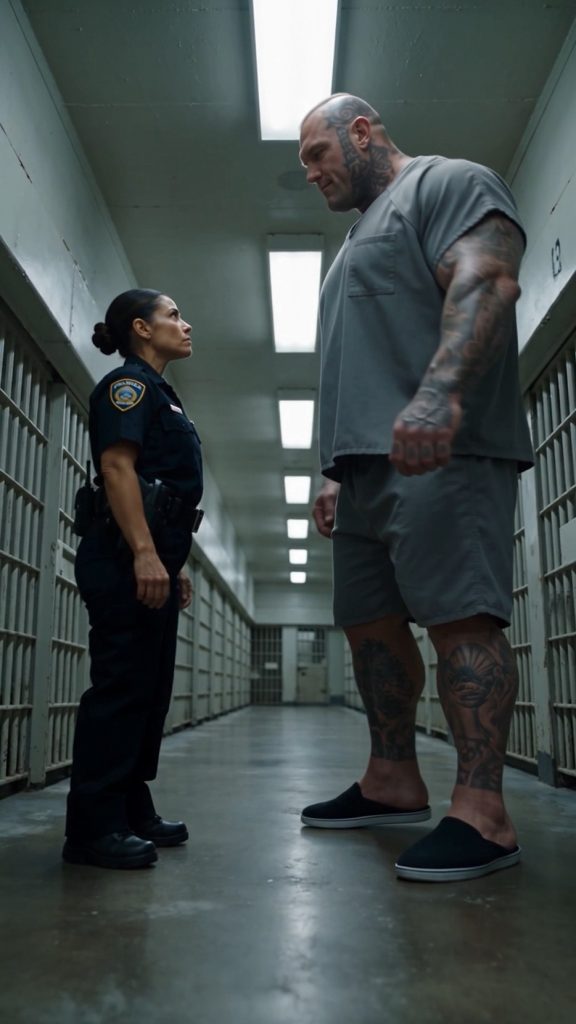
Everyone expected the new guard to back away.
She didn’t.
Long before she arrived, rumors had been moving through one of the prison’s toughest cell blocks. Administration was sending someone new, and the inmates had already invented their own version of whoever was coming.
Some claimed it would be a former soldier.
Others pictured a towering officer built like a wall—someone brought in specifically to remind the block who was in charge.
Then the heavy security door opened that morning.
And a very small woman stepped through.
She wore a black uniform, her posture straight, her expression unreadable. Because of a rare genetic condition, she stood only four feet five inches tall.
The corridor went silent.
For perhaps three seconds.
Then someone laughed.
“What is this, our new kindergarten teacher?”
Another voice came from behind the bars.
“Careful. Somebody might step on her.”
Within moments, laughter rolled through the entire block.
The woman gave them nothing.
She walked to the duty station, checked the log, studied the security monitors, then turned toward the cells.
“On your feet. Cell inspection in five minutes.”
Her voice wasn’t loud.
It didn’t need to be.
That only seemed to amuse them more.
Whenever she passed the bars, prisoners crouched dramatically until they were level with her. Some whistled. Others leaned close enough for their jokes to follow her down the corridor.
“Hey, little lady, can you even reach the top shelf?”
“I bet she has children’s furniture at home.”
“Maybe she lives in a dollhouse.”
“No. Definitely escaped from a Hobbit movie.”
The block erupted again.
Sometimes inmates stretched their arms down toward her face and waved, trying to force a reaction.
They never got one.
She inspected cells. Escorted prisoners. Filed reports. Gave instructions in the same steady voice whether someone obeyed immediately or laughed in her face.
Her silence began to mean something different to them.
They decided it was fear.
To the inmates, her refusal to respond wasn’t discipline. It was weakness. Proof that the administration had sent someone who couldn’t possibly control them.
One prisoner believed that more than anyone.
He was among the largest men in the facility—tall, tattooed, physically imposing, and surrounded by the quiet authority that comes from knowing other people are afraid of you.
Whenever she appeared, he made sure she heard him.
A joke.
A comment.
A deliberate laugh.
Then, one day, while the prisoners were being moved toward the exercise yard, he stepped out of line.
The sound around them changed immediately.
He walked slowly toward her.
The other prisoners stopped talking.
Even the officers nearby seemed to sense that something had crossed a line.
He stopped directly in front of her, forcing her to look almost straight upward.
A grin spread across his face.
“Hey, dwarf. Who gave you the right to order us around?”
A few men behind him laughed.
“Your arms are shorter than my fingers.”
She looked directly into his eyes.
“Get back in line.”
His grin widened.
“Or what?”
She said nothing.
He leaned closer.
“What, I’m supposed to regret this?”
Laughter broke out behind him.
He bent lower, bringing his face closer to hers.
“What are you going to do? Hit me? Your arms can’t even reach my face.”
The yard exploded.
Even two younger officers exchanged uneasy glances. Neither seemed certain whether stepping in would calm the situation or make it worse.
The inmate wasn’t finished.
He lowered his hands toward her.
“Come on. Try putting handcuffs on me with those tiny little fingers.”
More laughter.
Louder now.
The woman remained perfectly still.
No anger crossed her face. No embarrassment. Not even fear.
For the first time, though, something in her expression changed.
Barely.
The giant prisoner noticed it too.
His smile faltered for half a second.
Then she moved.
And nobody in that yard was prepared for what happened next. 👇
Her hand caught his wrist before anyone understood she had moved.
She turned once—not with force, but with precision—stepping outside his balance as his own momentum carried him forward. His grin vanished. One second he was towering over her; the next, his forearm was controlled against his back and one knee had hit the concrete.
The laughter died so completely that the rattle of chain-link sounded loud.
“Don’t move,” she said.
The inmate’s face burned red. He tried to rise, more from humiliation than strategy, and she shifted just enough to stop him without striking him. Then came the metallic click of one cuff, then the second.
For several seconds, nobody spoke.
The youngest officer stared at her hands. They were exactly the same hands the prisoners had mocked all week.
“Secure the line,” she said.
That snapped the officers back into motion. The inmates were ordered against the wall. The giant prisoner shouted that she had attacked him, that everyone had seen it, that he was going to have her fired.
She stood and stepped away.
“Good,” she said quietly. “Then we’ll watch the cameras.”
Something changed in his face.
Back inside, fluorescent light washed the interview room pale. The inmate sat cuffed to the table while the shift supervisor reviewed footage from the yard, then the corridor, then previous days.
The jokes were there. The crouching. The hands waved in her face. The deliberate steps out of line.
And beside the monitor sat a stack of reports.
Her reports.
The inmate looked at them, then at her.
“You’ve been writing me up this whole time?”
“I’ve been documenting behavior.”
“So this was a setup?”
“No.” She held his gaze. “You were given the same choice every day. You kept making it.”
The door opened.
The deputy warden entered with the prison’s training captain. The younger officers straightened.
The inmate leaned back as far as the restraints allowed. “Tell them what she did.”
The training captain ignored him.
“You’re all right?” he asked her.
She nodded.
Only then did he turn to the others.
“This officer is certified to teach defensive control and restraint. She has trained correctional staff in three facilities. She transferred here because this block has had repeated problems with intimidation and officers escalating situations too quickly.”
The room went still.
One young officer blinked. “She’s an instructor?”
The woman looked at him.
“An officer first.”
The inmate stared at her as if her height had somehow changed.
Then the training captain placed another folder on the table.
“And today isn’t being reviewed by itself.”
Inside were incident reports from the previous month—threats, refusals, intimidation, and repeated violations captured on camera. None had been enough alone to change his classification.
Together, they told a different story.
His smirk disappeared.
“You can’t pin all that on me.”
A voice came from the hallway.
“Yes, you can.”
One of the younger inmates stood there under escort. He was thin and usually kept his eyes down whenever the bigger man passed.
Now his hands were trembling.
“He’s been threatening us,” he said. “He told me if I ever talked about what he was doing, I’d get hurt.”
The giant prisoner surged against the cuffs.
The chair scraped hard across the floor.
The woman moved between them immediately.
Not to attack him.
To shield the younger inmate.
That was the moment his power broke.
Not when he hit the concrete.
Not when the cuffs closed.
It broke when the frightened prisoner behind her realized the biggest man in the block could no longer reach him.
The deputy warden ordered the inmate removed pending reclassification, disciplinary charges, and a full investigation into the threats against other prisoners. Two officers took him by the arms.
He shouted as they led him out.
Nobody answered.
The corridor that had once roared with laughter was silent when he passed through it. Men who had laughed at every joke watched from behind their bars.
He tried one last time.
“This isn’t over.”
She didn’t move.
“Yes,” she said. “It is.”
The security door shut behind him with a deep metallic crash.
The silence afterward wasn’t triumphant.
It was the strange emptiness that follows something everyone had expected to continue forever.
Later, the young inmate who had spoken against him sat in a holding room rubbing his palms against his trousers. The woman placed a paper cup of water within reach.
“I laughed at you too,” he whispered.
“I know.”
His eyes lifted.
“You still stepped in front of me.”
“That’s the job.”
His mouth tightened. He nodded once and looked down.
Across the hall, one of the younger officers waited for her.
“I should’ve stepped in sooner.”
She studied him.
“You were waiting for the situation to tell you what to do.”
He swallowed.
“Yeah.”
“Next time, know before it starts.”
There was no cruelty in her voice. That made the lesson land harder.
The following morning, the same steel doors opened.
Conversations faded as she entered.
Nobody crouched.
Nobody whistled.
She set the duty log on the desk.
“On your feet. Inspection in five minutes.”
Boots touched concrete.
Then someone called, “Officer?”
She turned.
It was the inmate who had made the first kindergarten joke on her first morning. He stood behind the bars, both hands visible.
For a second, it seemed another joke might come.
Instead he said, “Morning.”
She gave him a small nod.
“Morning.”
Weeks passed.
The giant prisoner was transferred to a higher-security unit after the investigation confirmed the pattern documented in reports and surveillance, along with threats against other inmates. The younger inmate who testified was moved to safer housing and entered a work program. The two young officers began attending additional defensive-control training.
The instructor was the same woman they had once watched stand silently beneath a wall of laughter.
During one session, a recruit finally asked, “Why didn’t you tell them who you were?”
She looked across the mat.
“Would it have changed what they were doing?”
“Maybe.”
“Then they would’ve been behaving for the wrong reason.”
She adjusted the cuff pouch at her belt.
“Respect that only appears when people are afraid of your reputation isn’t respect.”
Then came the last truth.
While preparing her annual evaluation, the training captain found an old handwritten request in her personnel file.
Later, he found her alone in the empty exercise yard.
“You requested this block specifically.”
She stopped.
He held up the paper.
For the first time, her composure shifted.
“My first corrections interview was here,” she said. “Years ago.”
He waited.
“One of the panel members looked at me and asked whether I honestly believed inmates would ever take orders from someone my size.”
A breeze moved through the fence.
“I went home and almost withdrew my application.”
“But you didn’t.”
“No.”
“Why come back?”
She looked across the yard where the confrontation had happened.
“Because I didn’t want the next person who looked different to have to prove they belonged before anyone even let them begin.”
The captain lowered the paper.
That evening, the younger inmate she had protected was escorted past the officers’ station on his way to the work program.
He paused and held out a folded piece of paper.
She opened it after he had gone.
The handwriting was uneven.
Thank you for standing in front of me when nobody else did.
She read the sentence twice, folded the note along its original crease, and slipped it behind her identification card.
Months later, people still remembered the day the biggest man in the yard went down.
But when new officers asked about it, she told them about the silence afterward.
About the frightened inmate who finally spoke.
About the officer who admitted he had frozen.
About how strength sometimes looked like a takedown, but more often looked like restraint, patience, and standing exactly where someone vulnerable needed you to stand.
On a quiet morning near the end of winter, she entered the block again.
The steel door opened.
No laughter followed.
An inmate stepped back from the bars to give her room. Another was already standing for inspection before she said a word.
She walked to the duty desk, placed her coffee beside the logbook, and slid her identification card into its holder.
Behind the plastic window, the edge of the folded note was still visible.
She touched it once with her thumb.
Then she looked down the long corridor of steel and concrete, no taller than she had been on her first day, no louder, no harder, and no longer required to become anything other than herself.
This time, when she walked forward, the block made room.