The laughter died so suddenly that the silence felt violent.
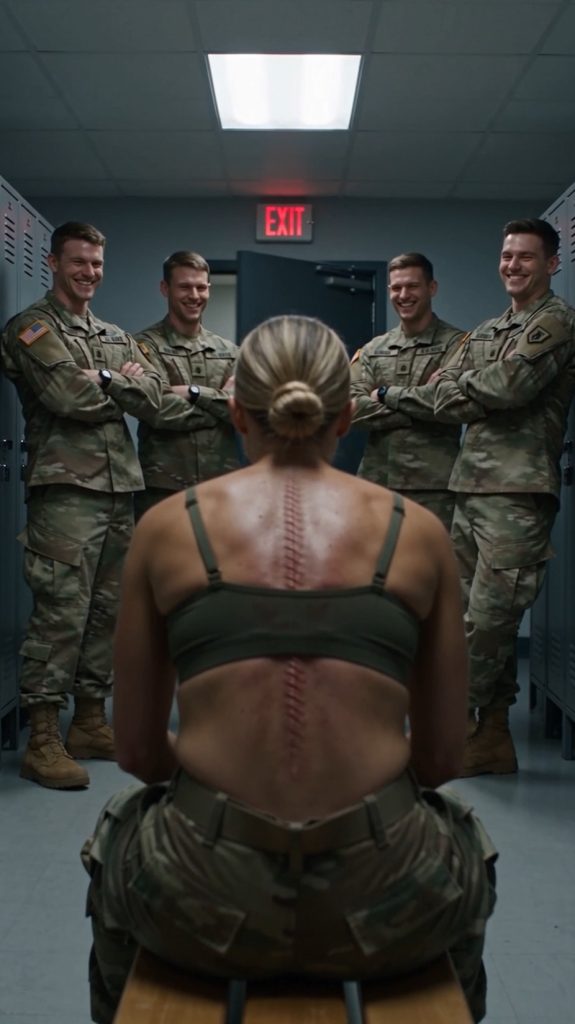
A general stood in the open doorway, staring at the young woman curled near the bench, one hand covering her face while a room full of soldiers slowly realized they had just crossed a line they could never uncross.
But only seconds earlier, they had still been laughing.
The unit had always been made up of men. So when a young woman was suddenly assigned to serve beside them, her arrival unsettled the rhythm of the place almost immediately.
At first, it was only looks.
Men glanced at one another when she walked past. Smirks appeared during training. Conversations became quieter whenever she entered the room.
Then the whispers stopped being whispers.
“Seriously?” one soldier said loudly enough for her to hear. “She’s serving with us now?”
Another looked at the rifle in her hands and laughed.
“Can she even lift that thing?”
She heard them.
Everyone knew she heard them.
But she never answered.
She trained when they trained. Followed orders. Carried her equipment without asking for help. When someone tried to provoke her, she simply tightened her jaw and continued whatever she was doing.
That silence irritated them more than anger would have.
Soon, the jokes became deliberate.
She was left out of serious missions. Men found excuses to put her in humiliating situations during training, watching closely to see whether she would finally break.
“Careful,” someone shouted as she climbed through the obstacle course. “Wouldn’t want you breaking a nail.”
Laughter followed her across the field.
Another soldier called out, “Maybe you should transfer to the infirmary. You could pour tea for everyone.”
Again, she said nothing.
Sometimes her face tightened for half a second. Sometimes her eyes dropped before she forced them forward again.
But she never complained.
Never demanded sympathy.
Never told them anything about herself.
And because they knew nothing, they invented reasons to despise her.
Then came the afternoon everything changed.
Training had been brutal. By the time they returned to the locker room, uniforms were soaked through and everyone was exhausted.
She began changing quietly at one end of the room.
One soldier happened to look in her direction.
His expression changed.
“Hey…”
The others barely reacted.
Then he frowned.
“Did you see that?”
A few men turned.
Across her back ran deep, uneven scars.
They were old, but impossible to ignore—thick, rough lines crossing her skin in a pattern that did not look like the result of an ordinary accident.
For one brief moment, nobody spoke.
The young woman seemed to feel their eyes on her.
Her body stiffened.
Then someone snorted.
“What happened to you?” he asked. “Animals tear you apart?”
A second soldier laughed.
“Looks more like she lost a fight with a chainsaw.”
That broke the silence.
Another voice joined in.
“Maybe she just fell badly.”
The room erupted.
She stood frozen for a second, her uniform clutched in her hands.
Then she slowly sat on the bench.
The laughter kept coming.
Her head lowered.
She slid farther down until she was sitting near the floor, one hand pressed over her face as if hiding it could somehow make the room disappear.
Her shoulders began to tremble.
Still, she made no sound.
One of the soldiers noticed.
“Oh, come on,” he said, the smile still on his face. “What’s wrong? Are you offended?”
He shrugged.
“We’re just joking.”
The door slammed open.
Every head turned.
The general stood there.
He did not shout immediately.
That somehow made it worse.
His eyes moved from the laughing soldiers to the woman on the floor, then to the scars still visible across her back.
Something in his expression hardened.
“Shut your mouths.”
Nobody moved.
“All of you.”
The last trace of laughter vanished.
The general stepped into the room, his gaze colder now.
He looked at each soldier in turn before pointing toward the young woman.
“Do you even know who she is?”
No one answered.
The general stared at them for another long second.
Then he began to tell them why those scars were there.
Nobody in that room was prepared for the truth that came next. 👇
The general’s jaw tightened, but his voice stayed low.
“Three years ago, outside Darvan Pass, a transport convoy was hit at 0217 hours. Two vehicles burned immediately. A third rolled into a ravine. Command ordered the survivors to pull back because enemy fire was closing in.”
The woman on the floor stopped trembling.
Slowly, she lowered her hand.
The general looked at her, and for the first time since entering the room, the hardness in his face cracked.
“She didn’t pull back.”
No one breathed loudly enough to be heard.
“She went into the first burning vehicle and dragged out two men. Then she went back for a third.”
His eyes moved across the soldiers who had been laughing only moments earlier.
“Her uniform caught fire.”
A man near the lockers swallowed.
The general continued.
“She put it out with her bare hands and went back again.”
The soldier who had joked about the chainsaw stared at the floor.
“By the time reinforcements reached them, she had carried or dragged seven wounded men away from the wreckage. Seven.”
He paused.
“Those scars are not from an accident.”
The woman pulled her shirt over her shoulders with shaking fingers.
“They are burns.”
The word landed differently than all the others.
Heavy.
Permanent.
The general stepped farther inside.
“And one of the men she dragged out was my son.”
Several heads lifted at once.
The woman closed her eyes.
“Sir,” she whispered.
“No,” the general said gently. “You stayed silent long enough.”
Something moved in her face then—not pride, not relief, but fear.
Real fear.
She looked toward the doorway.
The general noticed.
“So did he.”
Bootsteps sounded in the corridor.
Slow.
Measured.
A shadow crossed the open doorway before another officer appeared.
The woman went completely still.
The newcomer was older, broad-shouldered, his uniform immaculate. A colonel’s insignia caught the fluorescent light.
Colonel Adrian Rourke.
The general did not turn to greet him.
Rourke stopped when he saw the room.
Then he saw her.
For less than a second, his face changed.
That was enough.
“You,” the woman breathed.
Rourke recovered quickly.
“I was told there was a disciplinary disturbance.”
The general faced him.
“There is.”
Rourke looked at the soldiers.
“What happened?”
“No,” the general said. “Tell them what happened at Darvan Pass.”
The color drained subtly from Rourke’s face.
“I don’t know what you’re suggesting.”
The woman rose.
Her legs nearly failed beneath her, but she caught the edge of the bench and stood anyway.
“You left us.”
Rourke’s eyes hardened.
“Soldier, be very careful.”
“You left us there.”
The room seemed to shrink around them.
Rourke glanced toward the general.
“She was injured. She has repeated this confused version of events for years.”
The woman flinched as though the words had struck somewhere familiar.
The general saw it.
“So that’s what you told the inquiry.”
Rourke said nothing.
The general reached inside his jacket and removed a small evidence envelope.
“There was a damaged communications recorder recovered from the third vehicle six months ago.”
Rourke’s expression finally broke.
Barely.
But everyone saw it.
The general placed the recorder on the metal bench.
“Military technicians restored eleven minutes of audio.”
The woman stared at it.
Her mouth opened, but nothing came out.
Rourke took one step backward.
On the recording, beneath gunfire and screaming, his voice gave the retreat order.
Then another voice begged him to send extraction.
Rourke refused.
A soldier reported wounded men trapped in burning vehicles.
Rourke answered that they were already lost.
Then came the woman’s voice.
You can leave. I’m going back.
The room listened to the sound of flames, distant explosions, and her breathing as she ran.
Nobody looked at her scars now.
They looked at her hands.
At the hands that had pulled seven people through fire.
Then another sound emerged from the recording.
Rourke’s voice again.
This time, quieter.
“Remove her name from the field report. If she talks, she was disoriented from burns.”
Rourke lunged toward the recorder.
Two military police officers appeared in the doorway before he reached it.
He stopped.
The general looked directly at him.
“Colonel Adrian Rourke, you are relieved of command pending court-martial proceedings for falsification of operational records, dereliction of duty, obstruction of an investigation, and retaliation against a witness.”
The colonel’s face twisted.
“You think one damaged recording destroys thirty years of service?”
“No,” the woman said.
Everyone turned toward her.
She had stopped shaking.
“You did that yourself.”
Rourke stared at her.
For years, she had imagined this moment.
She had imagined screaming.
Hitting him.
Demanding that he explain how he slept after leaving wounded men inside burning vehicles and then teaching everyone else to doubt the woman who saved them.
But standing there, she discovered she wanted none of it.
She only wanted him gone.
Rourke was escorted through the doorway.
His boots faded down the corridor.
No one spoke until the sound disappeared completely.
Then came the silence.
Not the cruel silence that had followed her into rooms since arriving at the unit.
A different one.
The kind that appears when people finally understand the size of what they have done.
The soldier who had made the chainsaw joke sat down.
His face had gone gray.
“I didn’t know.”
She looked at him.
He rubbed both hands over his face.
“I know that doesn’t make it better.”
“No,” she said softly. “It doesn’t.”
The words hurt him.
She could see that.
But she did not rescue him from them.
Another soldier stepped forward.
The one who had told her to pour tea.
“I’m sorry.”
She looked away.
He swallowed.
“I kept telling myself it was just jokes because everyone laughed.”
His voice cracked.
“That sounds pathetic now.”
She pulled the bottom of her shirt straight.
“It sounded pathetic then, too.”
A few men lowered their heads.
The general almost smiled.
Almost.
Then the first soldier—the one who had noticed her scars—moved closer.
He had not spoken since the recording.
His eyes were wet.
“What were the names?”
She frowned.
“The men you saved.”
The question seemed to confuse her.
The general answered carefully.
He began listing them.
At the fourth name, the soldier made a small sound.
Not quite a gasp.
His knees seemed to weaken.
“Daniel Mercer?”
The woman looked at him.
“Yes.”
The soldier covered his mouth.
“That’s my brother.”
She froze.
He stared at her as tears gathered in his eyes.
“My brother was at Darvan Pass.”
For the first time, she looked frightened by gratitude.
“He never told us your name,” the soldier continued. “He wouldn’t talk about most of it. He only said there was someone who kept coming back.”
His voice broke.
“He called you the woman in the fire.”
She pressed her lips together.
“He’s alive?” she whispered.
The soldier nodded rapidly.
“He has two kids now.”
That did it.
She turned away.
Her hand found the bench.
For three years she had carried seven bodies in her memory as weight, blood, smoke, screams.
She had known they survived the extraction.
But after Rourke’s report buried her name and she disappeared into treatment, investigations, transfers, and silence, she had never learned what their lives became.
Two kids.
The general approached her slowly.
“My son has a daughter.”
She looked at him.
“She’s six months old.”
His eyes shone.
“He wanted to come today. I told him this part was mine.”
The woman gave a broken laugh that turned into something dangerously close to a sob.
She covered her eyes again.
But this time, nobody laughed.
Nobody looked away either.
The soldiers stood around her in absolute stillness.
Then Mercer’s younger brother did something simple.
He picked her jacket up from the floor.
He folded it carefully.
And placed it beside her.
“I’m sorry,” he said.
Not loudly.
Not for the room.
Just for her.
She lowered her hand.
“You hurt me.”
He nodded.
“I know.”
“All of you did.”
No one argued.
She looked from face to face.
“I survived that fire. I survived surgeries. I survived being called a liar.”
Her voice trembled.
“I did not think walking into this unit would be the thing that made me ashamed of my own back.”
Several men looked down.
“That belongs to you now,” she said. “Not me.”
No one asked her to forgive them.
That mattered.
Over the following weeks, apologies became actions.
The soldiers who had excluded her requested that the training assignments be reviewed. The men responsible for the harassment accepted disciplinary penalties without appeal.
Rourke’s court-martial ended months later.
The restored recording was only the beginning.
Once the truth became public inside the military justice system, other witnesses came forward.
Orders he had altered.
Reports he had buried.
Men he had pressured into silence.
The authority he had protected for decades collapsed under the weight of his own decisions.
He was dismissed from service, stripped of rank and benefits attached to honorable retirement, and convicted on multiple charges.
When she received the news, she was sitting alone outside the barracks.
She read the message once.
Then again.
Her hands did not shake.
She locked the phone and watched evening light move across the training field.
That was all.
No celebration.
No revenge.
Just one long breath she felt she had been holding for three years.
The general found her there.
“It’s over,” he said.
She stared ahead.
For a while, she could not answer.
Then she whispered, “I don’t know what to do with that.”
He sat beside her.
“Neither did my son.”
She looked at him.
“He said something after Darvan Pass that I never understood until now.”
The general reached into his pocket and handed her an old photograph.
Seven men stood together at a rehabilitation hospital.
Some leaned on crutches. One sat in a wheelchair.
In the center was Daniel Mercer.
Every man held one hand raised toward the camera.
Seven hands.
Seven lives.
On the back, in faded ink, someone had written:
For the woman who came back.
Her thumb trembled over the words.
“They took that photograph three years ago,” the general said. “They asked us not to find you until you were ready.”
She looked at him, stunned.
“They knew?”
“They knew your name.”
“Then why—”
“Because they were told you wanted no contact.”
She closed her eyes.
Rourke.
One final lie.
The general shook his head.
“But here’s the part he couldn’t bury.”
She turned the photograph over again.
“They meet every year on the date of Darvan Pass.”
Her breathing stopped.
“All seven?”
“All seven.”
He smiled.
“And this year, they asked whether they could finally meet the eighth person who survived that night.”
A month later, she stood outside a small house beneath a pale autumn sky.
She nearly turned around twice.
Then the front door opened.
Daniel Mercer stepped onto the porch.
He walked with a slight limp.
For several seconds, neither moved.
Then Daniel looked at her.
Really looked.
His eyes filled.
“There you are,” he whispered.
Behind him were six other men.
Children ran somewhere inside the house. Someone was laughing in the kitchen. A baby began to cry, and another voice softly soothed her.
Life.
So much ordinary, beautiful life.
Because she had gone back.
Daniel stepped down from the porch.
He stopped a few feet away.
“I’ve practiced what I was going to say to you for three years.”
She gave him a trembling smile.
“And?”
He shook his head.
“Forgot all of it.”
She laughed.
Then he opened his arms.
He did not move closer.
He waited.
She crossed the distance herself.
When he held her, something inside her finally gave way.
Not broken.
Released.
Behind him, seven families waited.
Children she had never known existed.
Partners she had never met.
A little girl held a drawing of a woman standing inside orange flames, carrying someone toward the light.
The scars on her back had once been proof of the worst night of her life.
Now, surrounded by the lives that had grown beyond that night, she understood they were also proof that the fire had failed to take everything.
Months later, back at the unit, the obstacle course was covered in early morning frost.
She stood at the starting line with the same men who had once mocked her.
No one made jokes.
Mercer’s younger brother glanced at her.
“Race you?”
She raised an eyebrow.
“You sure?”
He smiled.
“Absolutely not.”
For the first time, she laughed before the starting signal.
They ran.
Not behind her.
Not ahead of her.
Beside her.
And when the sun finally climbed over the barracks and warmed the scarred skin beneath her uniform, she did not pull her shoulders inward.
She lifted her head and kept running, surrounded by people who finally understood that surviving was only the first victory.
Belonging was the one that brought her home.