The diamond bracelet caught the light before I heard the insult. Six months earlier, my husband had sworn it belonged to a client; now his mistress wore it while mocking the silver-haired man across from me. My ex-husband stood beside her, silent.
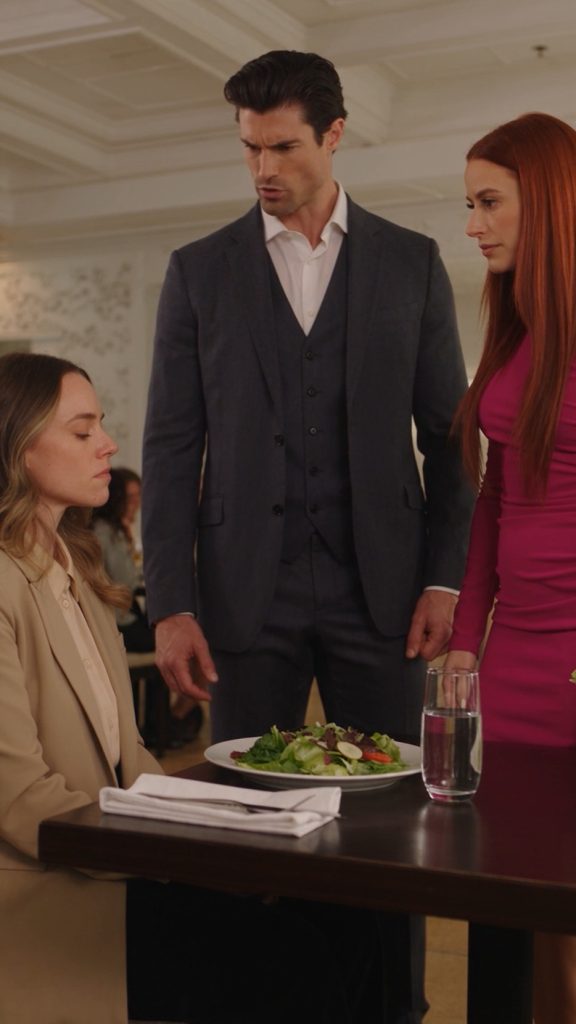
“You found a rich older man to pay your bills already?” Camila laughed, loud enough to turn heads across the restaurant on Paseo de la Reforma.
I had been divorced from Alejandro for three days. Our marriage, though, had begun unraveling months earlier, when I found photographs in a forgotten cloud account: hotel robes, champagne, his arm around Camila, dates spanning almost eleven months.
For seven of those months, I had still attended family dinners while his mother, Beatriz, corrected my manners and reminded me how fortunate I was to be a De la Vega. Alejandro never challenged her. He believed, as she did, that I came from nothing remarkable.
I had let them believe it.
Before our wedding, I asked my father to keep our connection private. No introductions. No financial favors. I wanted to know whether Alejandro could love me without knowing my family’s name.
My father warned that secrecy could cost me. I thought he meant money.
Now Camila leaned toward our table. “Careful, sir. She lived off the De la Vegas for three years. Looks like she needs a new wallet.”
I looked at Alejandro. He murmured, “Camila, enough,” then turned to me. “You don’t have to embarrass yourself like this, Valeria.”
Something inside me went still.
“You think he’s paying for me?”
“I think this looks bad.”
It was suddenly clear how little he had ever known me. I folded my napkin and stood.
“Dad, we should go.”
Camila stopped smiling. Alejandro stared. My father rose, buttoned his navy jacket, and said, “Valeria is my daughter.”
Recognition drained the color from Alejandro’s face. He had seen Arturo Mendoza in financial newspapers and presentations. My father was president and founder of Grupo Vanguardia—the investment group his family had spent two years trying to reach.
“Mr. Mendoza,” Alejandro whispered.
“Mr. de la Vega,” my father answered, without extending his hand.
Camila covered the bracelet. I noticed.
“Take care of it,” I said. “You seem to like things other women have already left behind.”
In the car, Dad told me the De la Vegas had applied for financing six months earlier. Their proposed development relied on dangerous debt and implausible projections; he had rejected a meeting on business grounds, never because of me.
My phone lit up.
WE NEED TO TALK.
I DIDN’T KNOW.
That evening Alejandro appeared at my apartment. He apologized, but his first defense was that he hadn’t known who my father was.
“That,” I told him, “is the problem.”
Before leaving, he admitted his family’s company was in serious trouble.
At 7:15 the next morning, Dad called. Alejandro and Beatriz were waiting at his mansion.
There, Beatriz suddenly spoke of family loyalty. Alejandro demanded to know why I had hidden my identity, then asked if we could stop the divorce.
“Do you love me,” I asked, “or does Desarrollos De la Vega need Grupo Vanguardia’s money?”
His silence answered enough.
I set a blue financing folder between us and asked him to open it to the authorization page. Beneath my full name was a second signature line, carrying a title he had never imagined I held.
Before he could speak, my father’s assistant rushed in with a tablet. At 2:13 that morning, someone had accessed the confidential De la Vega financing file and downloaded one particular page.
I looked at the employee name on the security log.
Camila Serrano.
My father turned the tablet toward Alejandro. And for the first time, he looked afraid of an answer he hadn’t yet heard. 👇
Alejandro reached for the tablet, but my father pulled it back.
“Before you say anything,” Dad said, “you need to understand what was taken.”
His assistant enlarged the document. It was the authorization page from the blue folder, containing my full legal name and my position as vice chair of Grupo Vanguardia. The page identified who possessed signing authority; it did not approve a single peso of financing.
“Camila had access to this?” I asked.
Alejandro swallowed. “I gave her credentials to our shared project workspace. She was helping prepare materials for potential lenders.”
My father looked at him steadily. “Then you gave someone access to confidential information without ensuring she understood its restrictions.”
The assistant swiped to another document. A financing presentation had been distributed to three prospective lenders that morning, falsely suggesting Grupo Vanguardia had given preliminary approval to the De la Vega development.
Someone had copied my signature from the downloaded page.
For several seconds, nobody spoke.
“That isn’t my authorization,” I said.
“We know,” my father answered. “One of the recipients contacted our office for confirmation.”
Beatriz gripped the arms of her chair.
“It was probably a misunderstanding,” she said quickly. “Camila has been under enormous pressure.”
I turned toward her. “Why would she be preparing a financing presentation after what happened yesterday?”
Beatriz avoided my eyes.
Then she admitted she had asked Camila to revise the proposal after learning who my father was.
“We needed to show the banks there was a real possibility of cooperation,” she said. “Nobody intended to deceive anyone.”
My father placed his palm on the table.
“Representing an unsigned arrangement as approved financing is deception, Mrs. de la Vega.”
At that moment, the assistant glanced toward the doorway.
“Mrs. de la Vega, the visitor you invited has arrived.”
Camila entered wearing a cream blouse, carrying a leather portfolio. The diamond bracelet was still on her wrist.
Her expression changed when she saw the tablet.
“What happened?” she asked.
I pushed the financing presentation toward her.
“You tell us.”
She examined the page, then looked at Alejandro.
“I only prepared what your mother asked for.”
Beatriz stiffened. “I never told you to copy Valeria’s signature.”
“No,” Camila replied, her voice sharpening. “You said we needed something convincing enough to get the lenders to listen.”
Alejandro stood.
“Camila, did you send this?”
She hesitated.
“You told me the company was going under. You said if we didn’t find money, everything would disappear.”
“That doesn’t give you the right to forge an authorization.”
Camila’s eyes filled.
“I was trying to save us.”
The word us hung between them.
I looked at Alejandro and remembered how confidently he had once told me our marriage was the safest place I could ever be.
Now he could barely look at either woman.
My father asked his assistant to preserve the access records and correspondence for the company’s attorneys.
Camila started crying.
“Please. You can’t destroy my life over one document.”
“You had a choice before you downloaded it,” Dad replied. “And another before you distributed it.”
Then Beatriz made the mistake of speaking again.
“If Valeria had simply told us who she was, none of this would have happened.”
I stared at her.
There it was. The same old accusation, dressed in different clothes.
“You knew Alejandro was cheating, didn’t you?”
Beatriz’s mouth tightened.
Alejandro whispered, “Mother.”
I didn’t look away.
“Did you know?”
Finally, she nodded.
“I knew there was another woman. I told him to end it discreetly.”
The room seemed to lose its air.
All those dinners. Every criticism. Every time she watched me clear my plate while knowing her son was betraying me.
“You knew,” I repeated, barely above a whisper, “and you kept telling me how lucky I was.”
Beatriz lowered her eyes.
Alejandro stepped toward me.
“Valeria, I wanted to tell you.”
“No,” I said. “You wanted me not to find out.”
He stopped.
Then I looked at the bracelet.
“Was that paid for with company money?”
Camila instinctively covered it.
Alejandro closed his eyes.
His silence made my stomach turn.
Eventually, he admitted that some personal expenses, including gifts and hotel charges, had been concealed within consulting expenditures on the development accounts.
My father sat back slowly.
“Then your financing problem is larger than the debt projections suggested.”
Camila began insisting Alejandro had authorized everything. Alejandro didn’t deny his involvement.
For the first time, he wasn’t searching for an excuse that would make him appear innocent.
He simply looked exhausted.
Dad turned toward me.
“Valeria, we must report the false financing representation. But before we proceed, I want you to understand the consequences.”
I looked at him.
“The lenders may withdraw. The company could enter restructuring. Employees may lose their jobs.”
I thought about construction workers who had nothing to do with hotel rooms or diamonds. People who went home with dust on their boots and children waiting for dinner.
“Can we protect their wages?” I asked.
My father nodded cautiously.
“There are ways to establish independent payroll protection during restructuring. It would require proper oversight.”
“Then do that,” I said. “But don’t give this family money to hide what they did.”
Beatriz began to speak.
I raised my hand.
“Not another word about family.”
The assistant left to contact counsel. Camila’s access was suspended, and the documents were secured for an independent investigation.
When Camila realized the evidence could not simply be recalled, she lowered herself into a chair. She removed the bracelet and set it on the table, as though surrendering it might somehow undo everything.
Alejandro stared at the diamonds.
“I ruined my marriage for this,” he said quietly.
I shook my head.
“No. You ruined our marriage long before today.”
His face crumpled, but I felt no satisfaction watching it happen.
Only a deep, unfamiliar tiredness.
Before I left, Alejandro asked whether I could ever forgive him.
“I don’t know,” I answered. “But forgiveness wouldn’t mean coming back.”
He nodded without looking up.
For once, he didn’t argue.
The investigation took months.
Financial records confirmed the misclassified expenses and the unauthorized financing presentation. Camila faced criminal proceedings over the falsified documents and was eventually held accountable through a court judgment requiring restitution. Her professional reputation collapsed under evidence she had created herself.
Alejandro resigned from his leadership position. Desarrollos De la Vega entered a supervised restructuring, sold assets, and repaid creditors where it could. Beatriz lost her place on the company’s board and, with it, much of the authority she had once treated as permanent.
None of it happened neatly.
There were employees frightened about their mortgages, vendors waiting for overdue payments, and families who had no reason to care about my divorce.
That was why I stayed involved in the independent employee-protection arrangement, while keeping Grupo Vanguardia’s decisions separate from my former husband’s requests.
Alejandro cooperated with investigators. Months later, he sent me a letter.
He didn’t ask me to return.
He wrote about the family dinners, about the way his mother had spoken to me, and how often he had chosen silence because defending me would have inconvenienced him.
One sentence stayed with me.
I thought knowing your life meant knowing what you needed from me. I never bothered asking.
I folded the letter and placed it in a drawer.
I didn’t answer. But I stopped rehearsing arguments I would never need to have.
One rainy afternoon, almost a year after the restaurant confrontation, my father asked me to visit his study.
The blue financing folder lay on his desk.
I smiled faintly.
“I thought we were finished with that.”
“We are,” he said. “There’s something else I should have shown you.”
He opened a separate file containing documents dated six months before the confrontation.
They described an employee-continuity plan for troubled development companies. After reviewing the De la Vegas’ financial projections, Dad had instructed his team to examine ways of protecting unpaid workers if the project collapsed.
He had prepared the groundwork before discovering Alejandro’s affair.
I looked up in disbelief.
“You were planning to help their employees even when you refused the company?”
“Yes.”
“Why didn’t you tell me?”
“Because you asked me to stay out of your marriage. And because this wasn’t about your marriage.”
I studied the dates again.
For months, I had believed that my father’s greatest gift was his willingness to protect me once the truth came out.
But he had already been looking beyond the powerful people asking for money, toward the people who would suffer when those promises failed.
“I thought you were warning me that hiding our relationship would cost me financially,” I said.
Dad leaned back in his chair.
“Valeria, when you asked me to keep your identity private, I worried about something else entirely.”
“What?”
“That you might spend so long trying to prove someone could love you without your name that you’d forget you never needed to earn that love in the first place.”
My throat tightened.
He reached across the desk.
“I would have been proud of you if you’d married a schoolteacher, a mechanic, or nobody at all.”
For a moment, I couldn’t speak.
Then I took his hand.
“I’m sorry I kept so much of my life away from you.”
“You didn’t keep yourself away,” he said. “You came to lunch. You called when you were upset. You still argued with me about the coffee.”
I laughed through tears.
He smiled.
“I never needed the world to know you were my daughter. I only needed you to know you could always come home.”
That evening, we ate dinner on his terrace while the city lights appeared beyond the garden.
There were no financing proposals, no business presentations, no carefully rehearsed apologies. Just warm bread, two plates of food, and my father complaining that I had stolen the last roasted potato.
I told him he could afford another.
He laughed so hard he had to put down his glass.
For the first time in years, I wasn’t measuring my words or wondering whether someone would mistake my kindness for weakness.
I thought about the woman I had been at that restaurant, sitting silently while another woman laughed at her. I wished I could reach across time and place a hand over hers.
Not to tell her about the money or the title she held.
But to tell her that losing someone who had never truly seen her was not the same as losing herself.
The night grew cool. Dad brought out an old blanket and draped it across the back of my chair without asking.
I pulled it around my shoulders.
When he reached for my plate, I pushed the last piece of bread toward him.
Outside, Mexico City continued its restless movement, headlights flowing along distant streets. Inside the garden, nothing demanded an explanation.
My father sat beside me, close enough that our shoulders touched.
And I finally understood that the safest place I had ever known was not the marriage I had fought to preserve.
It was this ordinary, quiet table, where I had never needed to be anyone other than his daughter.