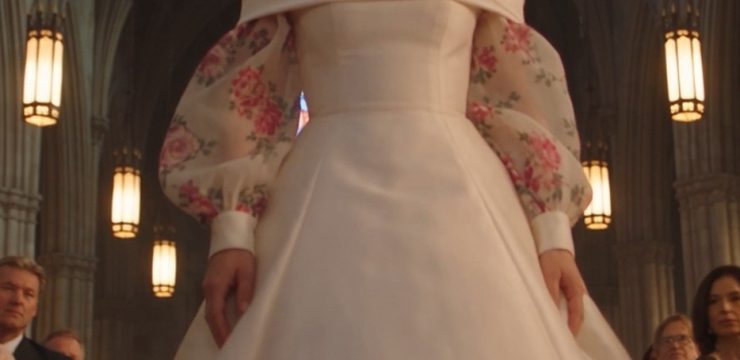
“Leave. This place is not for someone like you.”

The words cut across the penthouse terrace, silencing conversations near the infinity pool. The bride stood beneath the crystal lights, pointing toward the exit. The woman in black didn’t flinch, and somehow, that seemed to anger the bride even more.
Moments earlier, the rooftop had been alive with champagne toasts and effortless laughter. Hundreds of guests—billionaires, executives, influencers, and prominent society families—mingled above the glittering city skyline. Now they were watching Miss Rivera as though her presence required an explanation.
She wore a strapless black gown with a daring thigh-high slit, its elegant lines complemented by a diamond necklace catching the light. Her shoulders remained relaxed, her expression unreadable. She seemed completely untouched by the hostility surrounding her.
“I said go,” the bride snapped, the crystals on her wedding dress flashing as she gestured again. Her two closest friends, dressed in shimmering gold and silver, stood beside her, barely concealing their amusement.
“Was she even invited?” one asked.
“Who let her in?” the other added, loud enough for nearby guests to hear. A few people laughed. Others exchanged knowing looks and lifted their phones, eager to record someone else’s humiliation.
Miss Rivera offered no defense. She didn’t reveal her identity or demand an apology. Instead, she took one measured step forward, then another, her heels barely audible against the terrace floor.
The bride folded her arms, waiting for tears, anger, anything that might prove she had won. None came. As the silence stretched, even the spectators began shifting uneasily.
Then a piercing electronic tone rang overhead.
The music stopped instantly. The warm lights dimmed, leaving the crowd illuminated by the distant city and pale reflections from the infinity pool. Behind the stage, two enormous LED screens flickered to life.
For one breathless second, both remained black.
Then a portrait appeared.
Miss Rivera’s face filled the screens in an official photograph, elegant and unmistakably authoritative. Guests looked from the image to the woman standing among them. Phones lowered, and whispered jokes died unfinished.
The bride’s face drained of color.
“No…” she breathed, almost inaudibly.
Miss Rivera remained silent.
The gala host stepped down from the stage wearing a perfectly tailored black tuxedo, microphone in hand. The bride straightened, a brief flicker of relief crossing her face. Surely he had come to explain this embarrassing misunderstanding.
He walked toward her.
Then passed without a glance.
Her friends stopped smiling. The host crossed the terrace as hundreds of eyes followed him, then stopped directly before Miss Rivera.
And bowed.
Deeply.
“Welcome, Miss Rivera,” he said, raising his microphone. “This evening’s gala is being held in your honor.”
The bride’s lips parted, but nothing came out. The woman she had publicly humiliated wasn’t an unwanted outsider. She was the reason every influential guest on that rooftop had received an invitation.
Slowly, the bride turned toward her.
Miss Rivera finally met her gaze, but there was no smile, no visible pleasure in watching her humiliation. Her expression held something far more difficult to understand.
Then she looked toward the screens.
Her portrait vanished.
A new presentation began loading. When the first slide appeared, the bride went rigid.
Across both enormous screens stood the name and unmistakable logo of her family’s company.
Whispers spread through the crowd again, but nobody sounded amused anymore. The bride stared at the display, then at Miss Rivera, her earlier confidence giving way to unmistakable fear.
Miss Rivera calmly accepted the microphone from the host. She faced the hundreds of guests waiting for an explanation.
“Before we continue,” she said, her voice steady, “there is one reason I invited all of you here tonight.”
And for the first time that evening, the bride seemed terrified of what she might hear next. 👇
The bride tightened her grip on her champagne glass. A faint tremor traveled through her fingers as Miss Rivera turned toward the screen displaying her family’s company logo.
“Three years ago,” Miss Rivera began, “my foundation entered into a partnership with this company. Together, we promised to create an emergency assistance fund for employees facing medical bills, housing emergencies, and financial hardship.”
Several executives nodded. They remembered the announcement, the photographs, and the glowing newspaper coverage.
“What most of you don’t know,” she continued, “is that millions of dollars intended for those employees never reached them.”
The next slide appeared.
Financial records filled both screens. Dates. Bank transfers. Expense reports. A series of transactions highlighted in red.
And beneath the authorization column was the bride’s signature.
“That isn’t what it looks like,” the bride said quickly.
Miss Rivera turned toward her.
“Then please explain it.”
The bride opened her mouth, but nothing came. Her eyes moved across the figures, searching for something she could dispute.
Another slide appeared.
Luxury event expenses. Private entertainment costs. Payments to exclusive vendors. Thousands spent on decorations while employee assistance requests remained unanswered.
One invoice was for the very rooftop reception where they were standing.
A murmur passed through the guests.
Miss Rivera lowered her microphone slightly.
“The people who were supposed to receive this money weren’t asking for luxuries. Some needed rent. Others needed medicine. They trusted this company because their employers told them help was coming.”
Near the catering entrance, an older woman in a service uniform pressed a hand against her mouth.
Miss Rivera noticed her.
“Mara,” she said gently. “Would you come forward?”
The woman hesitated.
The bride’s expression changed immediately.
“No. She has nothing to do with this.”
But Mara was already walking toward the stage.
Her hands were trembling. She had spent more than twenty years working for the company, first cleaning offices, then supervising its hospitality staff.
“I kept the original payment records,” Mara said quietly. “When the numbers stopped matching, I asked questions.”
She looked directly at the bride.
“You told me to change the reports.”
“That’s a lie!”
Mara flinched at the sudden shout, but remained standing.
“You told me no one would notice because the people waiting for assistance had no influence.”
The bride stepped forward.
“Do you understand what you’re accusing me of?”
“I understand exactly,” Mara whispered.
Miss Rivera touched Mara’s arm reassuringly.
The screens changed again, revealing correspondence, verified bank records, and copies of the original authorization documents.
Independent auditors had already reviewed them. The evidence had been preserved and submitted to the appropriate authorities.
The bride stared at the screens, breathing unevenly.
Then she turned toward her father, standing among the company’s senior executives.
“Dad. Tell them there’s been a mistake.”
He didn’t move.
“Please,” she whispered.
Her father slowly removed his glasses. His face seemed to have aged years in the last few minutes.
“I saw the first complaint,” he admitted. “I should have ordered an investigation immediately.”
The bride’s eyes widened.
“Dad…”
“I told myself there had to be an innocent explanation. I trusted you instead of checking.”
He looked toward Mara.
“And people suffered because I refused to see what was happening.”
The bride shook her head.
“You’re going to believe her over your own daughter?”
His voice cracked.
“This isn’t about believing someone. The records are right there.”
For the first time, the bride looked completely alone.
Miss Rivera approached her, stopping a few feet away.
“You still have a choice,” she said. “You can acknowledge what you’ve done, cooperate with the investigation, and help return everything that was taken.”
The bride’s face twisted.
“You planned this. You came here to destroy me.”
“No,” Miss Rivera replied. “I arranged tonight to tell these people the truth. What happened when I arrived was your decision.”
The bride turned sharply toward Mara.
“You’re finished. You’ll never work for this family again.”
A chair scraped against the terrace floor.
Her father stood.
“She isn’t losing her job.”
He looked at his daughter for a long moment.
“You are.”
The words landed harder than any accusation.
He explained that the board had reviewed the evidence earlier that evening. The directors had voted to remove her from her executive position immediately and appoint independent leadership to oversee the company’s finances.
The bride stumbled backward.
“You can’t do this to me.”
Her father lowered his eyes.
“I should have acted before it reached this point.”
Beside her, the friend in gold slowly stepped away. The friend in silver stared at the floor, unable to meet anyone’s gaze.
The bride looked toward them, desperate for support.
Neither moved closer.
She glanced across the terrace, searching the faces of people who had laughed with her only minutes earlier.
Now nobody was laughing.
Miss Rivera didn’t celebrate.
She turned back toward the audience.
“An independent relief trust has already been established. Families who were denied assistance will receive emergency payments while the full recovery process continues.”
Her voice softened.
“No one should have to beg for money that was promised to them.”
Mara covered her face.
The bride stood beneath the fading lights of her lavish celebration, watching everything she had relied on slip beyond her reach.
Eventually, she walked toward the exit.
No one applauded. No one followed.
The sound of her heels disappeared behind the closing doors.
For several moments, the terrace remained silent.
Then Mara began crying.
Not loudly. Not dramatically.
She simply pressed both hands against her face, her shoulders shaking beneath her service jacket.
Miss Rivera handed the microphone back to the host and moved toward her.
“I should have spoken sooner,” Mara whispered. “I knew something was wrong, but I was afraid. I couldn’t afford to lose my job.”
Miss Rivera held her hands.
“You brought the records when you knew what it could cost you. You helped stop it.”
Mara looked toward the enormous screens.
“I kept thinking about all those families.”
“I know.”
The host approached them, his expression troubled.
“Miss Rivera, I owe you an apology. I should have intervened when she ordered you to leave.”
Miss Rivera looked at the employees standing near the service entrance.
“Then start by making sure nobody working here is ever treated that way again.”
He nodded.
And instead of restarting the music, he asked the service staff to join the guests at the tables.
Some hesitated, uncertain whether the invitation was genuine.
Mara was the first to sit.
Slowly, others joined her.
The conversations that followed were quiet and awkward at first. There were apologies, uncomfortable truths, and people finally listening to workers whose names they had never bothered to learn.
That night did not repair everything.
But something had changed.
Over the following weeks, independent administrators began distributing emergency payments. Employees received overdue assistance, and the company’s directors introduced outside oversight.
The bride’s father resigned from his leadership position and committed personal funds toward restitution. He also apologized directly to the workers whose complaints he had ignored.
Months later, his daughter pleaded guilty to charges arising from the fraudulent transactions. She was sentenced, ordered to repay the misappropriated funds, and permanently barred from holding another position involving the management of charitable funds.
Her wealth could not erase the court’s judgment.
Her father’s influence could not undo what she had signed.
And the two friends who had laughed beside her were left to confront their own behavior. One contacted Mara to apologize. The other began working with an employee assistance organization, quietly, without cameras or announcements.
Neither expected forgiveness.
Mara returned to work under the company’s new management, but something about her had changed.
She no longer lowered her eyes when important people entered a room.
Several months later, Miss Rivera organized a smaller gathering on the same rooftop.
There were no towering flower arrangements or elaborate displays of wealth.
Instead, employees and their families shared dinner beneath warm lights, with children laughing beside the infinity pool.
Mara arrived wearing a simple blue dress.
For the first time in years, she was attending an event at the building without being responsible for serving anyone.
Miss Rivera greeted her near the entrance.
Mara smiled and reached into her handbag.
“I brought something I’ve been keeping for a long time.”
She handed Miss Rivera a faded envelope.
Inside was an old college application receipt.
Miss Rivera recognized it immediately.
Her breath caught.
Years earlier, when she was a young woman struggling to continue her education, she had worked evenings at a nearby hotel. One night, unable to afford the final application fee for a scholarship program, she had sat outside the staff entrance in tears.
A woman from the cleaning department had found her there.
That woman had taken money from her own paycheck and insisted she submit the application.
Miss Rivera looked up at Mara.
“You kept this?”
Mara smiled through tears.
“I wanted to know that little girl made it somewhere.”
Miss Rivera couldn’t speak.
She had built her foundation, supported struggling families, and spent years opening opportunities for people who might otherwise be forgotten.
But she had never forgotten the woman who first helped her.
Mara squeezed her hand.
“You know what I remember most about that night?”
Miss Rivera shook her head.
“You kept telling me you didn’t belong inside because you couldn’t pay.”
Mara glanced toward the beautiful terrace.
“And I told you that needing help didn’t make you less worthy of walking through a door.”
Tears finally slipped down Miss Rivera’s cheeks.
The woman who had stood silently while a wealthy bride ordered her to leave had once been a frightened young girl, grateful that someone had invited her inside.
And the person who had opened that first door had been standing beside her all along.
That evening, Miss Rivera announced that the employee assistance trust would become permanent.
Mara had agreed to serve on its advisory council, helping decide how assistance would reach the people who needed it.
When the announcement ended, no one remained seated.
The applause continued until Mara began laughing through her tears.
Later, as the city lights shimmered beneath the evening sky, Miss Rivera and Mara sat together at a small table overlooking the pool.
Between them lay the old application receipt, carefully smoothed beneath a glass paperweight.
Mara reached for her hand.
“Your mother would have been proud of you.”
Miss Rivera looked out across the terrace, where families were still talking and children were beginning to grow sleepy in their parents’ arms.
“I hope so,” she whispered.
For a while, neither woman spoke.
They didn’t need to.
Years ago, one of them had opened a door for a frightened girl with nowhere else to turn.
Now that girl had opened it for hundreds of others.
And beneath the gentle rooftop lights, surrounded by people who finally understood what belonging meant, Miss Rivera rested her head against Mara’s shoulder.
Neither of them had to ask permission to stay.