“Sir, you need to leave. Now.”
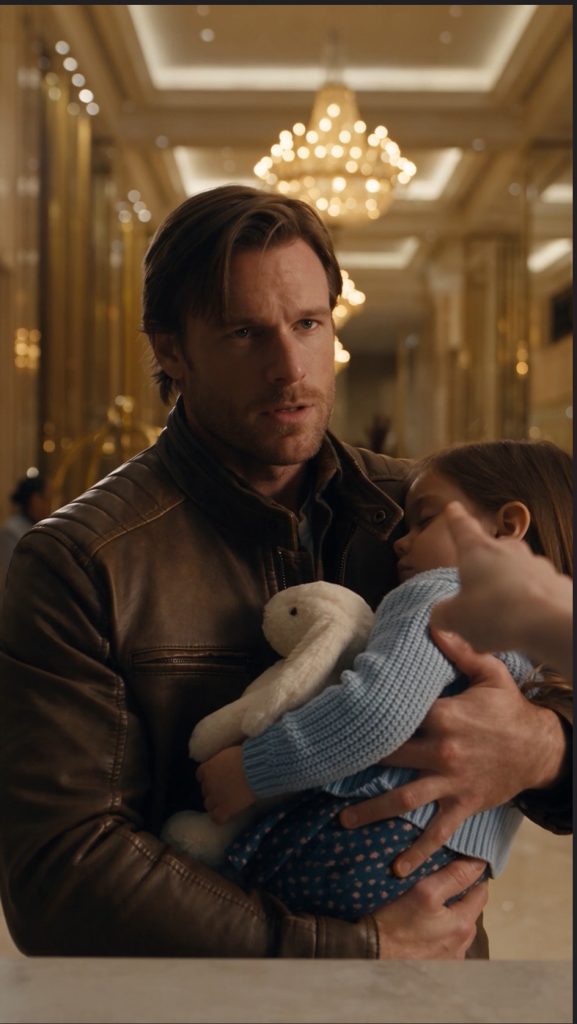
The words cut through the elegant hotel lobby just as my daughter shifted in my arms, her little fingers tightening around a stuffed rabbit. Several guests turned to stare, but the woman behind the reception desk had no idea whose hotel she was ordering us out of.
I didn’t look like someone who belonged at the Grand Regent that night. My leather jacket was worn, my backpack had faded from years of use, and exhaustion showed on my face.
My little girl had finally fallen asleep against my shoulder. Her cheek rested on the rabbit’s soft ears, and I held her closer when the receptionist raised her voice.
“Sir, I’ve already told you,” she said, her professional smile disappearing. “You cannot stay here.”
I looked past her at the chandeliers, the marble floors, the warm lights reflecting against the walls. I remembered this place before any of it existed. I remembered the empty space, the uncertain plans, and the sleepless nights wondering whether the Grand Regent would ever open its doors.
I had built this hotel from the ground up.
Yet here I stood, holding my child, being treated like someone who had wandered into a place where he didn’t belong.
For a moment, I considered telling her who I was. One sentence would have changed her expression. One name would have opened every door in the building.
But something stopped me.
I wanted to see what happened when that name meant nothing. When the person asking for kindness looked exhausted instead of wealthy, and had nothing to prove his importance.
“She’s sleeping,” I said quietly, glancing down at my daughter. “Could we please keep our voices down?”
The receptionist barely looked at her.
“This hotel is for paying guests,” she replied coldly. “You’re making people uncomfortable.”
Something tightened inside my chest.
It wasn’t my pride that hurt. It was the thought of my daughter waking up to discover that someone had decided we weren’t worthy of basic respect.
A few feet away, a housekeeper stopped what she was doing. Her name tag read Maria.
She looked at my daughter, then toward the reception desk. I recognized the hesitation in her expression, the uncertainty of someone who wanted to help but feared stepping outside her authority.
“Perhaps I can help them,” she offered gently. “The little girl looks exhausted.”
The receptionist turned sharply.
“Maria, this doesn’t concern you. Go back to your work.”
Maria lowered her eyes. Her shoulders stiffened, but she didn’t immediately walk away. She looked at my sleeping daughter again, her concern unmistakable.
I had watched this receptionist humiliate a stranger.
Now I was watching her silence an employee for showing compassion.
And suddenly, this was no longer about one rude woman behind a desk.
I wondered how many other people had been treated this way inside my hotel. How many tired travelers had been judged by their clothing? How many employees like Maria had learned to stay silent rather than risk their jobs by doing what was right?
The Grand Regent had been my life’s work. I had spent years building a place where people could feel welcomed, safe, and respected.
But beautiful walls could hide something deeply wrong.
A hotel wasn’t defined by how warmly it greeted wealthy guests. Its character showed in how it treated people who had nothing to offer except their humanity.
I adjusted my daughter’s weight against my chest.
Then I looked at Maria, standing quietly beside her cleaning supplies, and finally at the receptionist, whose impatient expression made it clear she expected us to disappear.
For the first time that evening, I knew I could no longer remain silent.
I stepped toward the counter.
“Before I leave,” I said, my voice calm, “there’s something you need to understand.”
The receptionist lifted her eyes.
And the truth I had kept hidden was finally at the edge of my tongue. 👇
Her hand moved beneath the counter, and I heard the faint click of a button. She had called for security before I could finish speaking.
“Whatever you’re about to say,” she whispered sharply, “it won’t change our policies.”
I looked at her for a long moment.
“Then perhaps it’s time we changed those policies.”
She gave a small, disbelieving laugh. Behind her, the automatic doors opened, letting in a gust of cold night air that stirred the flowers near the entrance.
A man in a dark suit hurried across the lobby, followed by a security officer. His name was Thomas, the night manager, and I recognized him immediately from our quarterly leadership meetings.
He took three steps toward us before his expression changed.
“Mr. Bennett?”
The receptionist turned.
“Thomas, thank goodness. This gentleman has been refusing to leave, and he’s disturbing our guests.”
Thomas barely seemed to hear her.
His eyes moved from my face to the sleeping child against my shoulder, then to the faded backpack hanging from my arm.
“Sir,” he said quietly, “I didn’t know you were coming tonight.”
The receptionist’s smile faltered.
“I’m sorry. You know him?”
Thomas swallowed.
“This is Daniel Bennett. He’s the founder and owner of the Grand Regent.”
For several seconds, there was no sound except the gentle hum of the ventilation system.
The receptionist stared at me. Her mouth opened, closed, and opened again.
“Mr. Bennett, I… I had absolutely no idea.”
“I know,” I said.
She began straightening papers on the desk, though nothing needed straightening.
“If someone had informed us you were visiting, we would have arranged everything. The presidential suite, a private welcome, anything you needed.”
I shook my head.
“I didn’t need a presidential suite. I needed you to treat my daughter like she mattered.”
Her eyes darted toward Thomas.
“I was only following our standards.”
Before Thomas could answer, I looked toward Maria.
She was still standing near her cleaning cart, one hand gripping the handle so tightly that her knuckles had turned pale.
“Maria,” I said gently, “would you come here, please?”
She hesitated.
The receptionist immediately spoke.
“Sir, Maria misunderstood the situation. She shouldn’t have interfered.”
“That’s enough,” I said.
My voice wasn’t loud, but the receptionist fell silent.
Maria approached slowly, glancing between the three of us.
“I didn’t mean to cause trouble,” she murmured. “I just thought the child might need somewhere quiet.”
“You didn’t cause trouble,” I told her. “You showed kindness when someone needed it.”
Her eyes filled unexpectedly.
Then she said something that made the room feel colder.
“I’m sorry, sir. We’ve been told not to do that anymore.”
I turned toward Thomas.
“Not to do what?”
Maria looked down.
“Help people before the front desk decides whether they’re important enough.”
Thomas shifted his weight.
“Daniel, perhaps we should discuss this privately.”
I studied his face.
“Why? Was it discussed privately when the rule was introduced?”
He said nothing.
The receptionist stepped forward.
“We’ve had problems with people coming in off the street. Management wanted us to protect the hotel’s image.”
“By humiliating them?”
“Nobody was supposed to be humiliated.”
Maria’s voice was barely audible.
“But people were.”
Every eye turned toward her.
She reached into her apron pocket and pulled out a folded piece of paper. Her hands trembled as she opened it.
It was a disciplinary notice.
Three weeks earlier, Maria had offered water and a chair to an elderly couple who were waiting for their delayed reservation to be confirmed.
She had been formally warned for acting outside her assigned duties.
At the bottom were two signatures.
The receptionist’s.
And Thomas’s.
I looked at the paper for a long time.
Then I looked at the people responsible.
“You punished her for giving two elderly people a place to sit?”
Thomas exhaled.
“It was an operational issue, Daniel. She bypassed the chain of command.”
“Were those guests mistreated?”
He avoided my eyes.
“I wasn’t there.”
“But you signed the warning.”
Neither of them answered.
My daughter stirred in my arms. Her rabbit slipped slightly, and I caught it before it fell.
That small movement brought me back to the only thing that mattered in that moment.
I didn’t want her first memory of my hotel to be an angry confrontation.
But I couldn’t pretend nothing had happened, either.
“Thomas,” I said, “I want both of you relieved of guest-facing duties tonight. Human Resources will review this incident and every complaint connected to these policies.”
The receptionist’s face drained of color.
“Sir, please. I have worked here for six years.”
“Then you’ve had six years to understand what hospitality means.”
She looked toward Maria.
“You see what you’ve done?”
Maria flinched.
I stepped between them.
“No. Don’t put this on her. You made your choices before you knew my name. Maria made hers before she knew it, too.”
The receptionist had no answer.
Thomas quietly asked the security officer to arrange coverage for the desk.
I watched them walk toward the staff corridor, the receptionist’s heels striking the marble with an uneven rhythm.
For the first time that evening, nobody tried to stop Maria from standing beside me.
I asked if she would help me find somewhere quiet for my daughter.
Her expression softened.
“Of course, sir.”
She led us into a small sitting room away from the lobby. The lighting was warm, and the muffled sound of a fountain drifted through the doorway.
I lowered my daughter onto a sofa and tucked my jacket around her.
Maria brought a glass of water.
When she turned to leave, I stopped her.
“Have you been afraid of losing your job?”
She stared at the glass in her hand.
“Every day,” she admitted.
I waited.
“My mother lives with me,” she continued. “She needs medication. I can’t afford to miss work, and I can’t afford to make anyone angry.”
Her voice cracked on the last word.
“I used to love coming here. I still love the guests. But lately, before every shift, I sit in the bus for a few minutes because I’m afraid of what might happen inside.”
I felt the weight of her words more deeply than any insult directed at me.
I had spent years studying financial reports, occupancy rates, and guest satisfaction scores.
Yet I hadn’t known that one of my employees was afraid to walk through the doors of the place I’d built.
“I’m sorry, Maria,” I said.
She shook her head.
“You didn’t know.”
“I should have.”
She looked at me then, really looked at me, and neither of us tried to fill the silence.
The next morning, I began reviewing the records with an independent investigator.
What emerged was worse than one unpleasant encounter.
There were guest complaints describing dismissive treatment, written warnings against employees who had helped visitors without authorization, and repeated attempts to raise concerns that had gone nowhere.
The receptionist had personally dismissed several complaints. Thomas had approved disciplinary actions and defended the policy that allowed them.
When interviewed separately, both insisted they had been protecting the hotel’s reputation.
But the documents, witnesses, and their own written explanations told a different story.
They had created a workplace where appearances mattered more than dignity, and where employees learned that compassion could cost them their livelihoods.
After a formal review, both were dismissed.
The receptionist tried one final time to justify herself.
“I treated him exactly how we treat everyone who comes in looking like that.”
The investigator asked her to clarify what she meant.
She couldn’t.
It was her own statement, more than anything, that made the problem impossible to deny.
The dismissals were only the beginning.
I personally apologized to the guests we could identify who had been mistreated. We reviewed the disciplinary warnings, corrected employee records, and established a confidential reporting process that would reach my office independently of hotel management.
Then I met with the staff.
Not from a stage.
Not behind a polished conference table.
I stood among the people who cleaned the rooms, carried luggage, prepared meals, answered phones, and made the Grand Regent function every day.
I told them what had happened to my daughter and me.
A few looked shocked.
Others simply looked tired.
That expression hurt more.
When I invited them to speak, nobody moved at first.
Then a young porter raised his hand.
“Sir, are we actually allowed to tell you the truth?”
I had to swallow before answering.
“Yes. And I’m sorry you ever had reason to ask.”
The stories came slowly.
Small humiliations. Unfair warnings. Guests turned away without explanation. Employees afraid to question decisions they knew were wrong.
We listened.
We documented everything.
And we began changing the systems that had made silence feel safer than honesty.
Maria’s disciplinary warning was removed. She received compensation for the shifts she’d unfairly lost, and I offered her a paid role helping redesign how the hotel welcomed guests.
She didn’t accept immediately.
“I’ve been a housekeeper for eleven years,” she told me. “I’m not sure I know how to do something else.”
I smiled.
“You knew how to treat people with dignity when the managers above you had forgotten. That’s exactly the experience we need.”
She covered her mouth with one hand.
Then, for the first time since I’d met her, she laughed through her tears.
Several weeks later, my daughter and I returned to the Grand Regent.
This time, the lobby felt different.
Not because the chandeliers shone brighter or the flowers were more expensive.
But because I saw a receptionist kneel to speak gently with a frightened child, and a porter offer a seat to an exhausted traveler without looking over his shoulder for permission.
Maria stood near the entrance, welcoming guests.
When she saw us, her face lit up.
My daughter ran toward her, clutching the same stuffed rabbit.
“Miss Maria!”
Maria bent down just in time to catch her.
I watched them embrace, surprised by how naturally my daughter remembered the woman who had tried to protect her that night.
Then my daughter did something unexpected.
She placed the rabbit into Maria’s hands.
“This is for the hotel.”
Maria looked confused.
“But sweetheart, isn’t this your favorite?”
My daughter nodded solemnly.
“Yes. That’s why I brought him.”
She reached into my old backpack and pulled out a folded piece of paper decorated with uneven yellow stars.
I recognized the paper.
She had spent an entire afternoon drawing on it before our first visit, refusing to let me see what she’d written.
“I wanted Daddy’s hotel to have a friend for children who get scared,” she explained. “Because Daddy says people come to hotels when they’re tired and need somewhere safe.”
Maria unfolded the paper.
In my daughter’s crooked handwriting were seven simple words.
“IF YOU FEEL ALONE, YOU CAN BORROW HIM.”
For a moment, Maria couldn’t speak.
Neither could I.
All that first night, I had believed my daughter was holding her rabbit because she needed comfort.
I hadn’t known she’d brought him because she wanted to give that comfort away.
Maria knelt beside her.
“Are you sure you don’t want to keep him?”
My daughter thought carefully.
“Maybe he can stay here, and when a little kid is scared, someone can give him a hug.”
Maria pressed the rabbit gently against her chest.
“That,” she whispered, “is a beautiful idea.”
We placed the rabbit in a small basket near the reception desk, beside my daughter’s handwritten note.
There was no ceremony.
No photographer.
No grand announcement.
Just a little stuffed animal, a piece of folded paper, and a promise that kindness would never again require anyone’s permission.
That evening, before we left, Maria walked us to the doors.
“Thank you for changing things,” she said.
I looked back at the lobby, where an employee was patiently helping an older guest find her reservation.
“Thank you for showing me what needed to change.”
My daughter slipped her hand into mine.
“Daddy?”
“Yes, sweetheart?”
“Is this the hotel you wanted to build?”
I looked down at her, then toward Maria, who was standing beneath the warm lights with tears shining in her eyes.
For years, I had thought the Grand Regent was something I had already finished building.
Now I understood that its most important part would always depend on the people inside it.
“It’s finally becoming that hotel,” I told her.
Outside, the evening air was cool. My daughter leaned against my side as we walked away, her small hand tucked securely into mine.
And through the glass doors behind us, beneath the soft golden light of the reception desk, a little rabbit waited patiently for the next person who needed somewhere to belong.