“She makes the picture look cheap.”
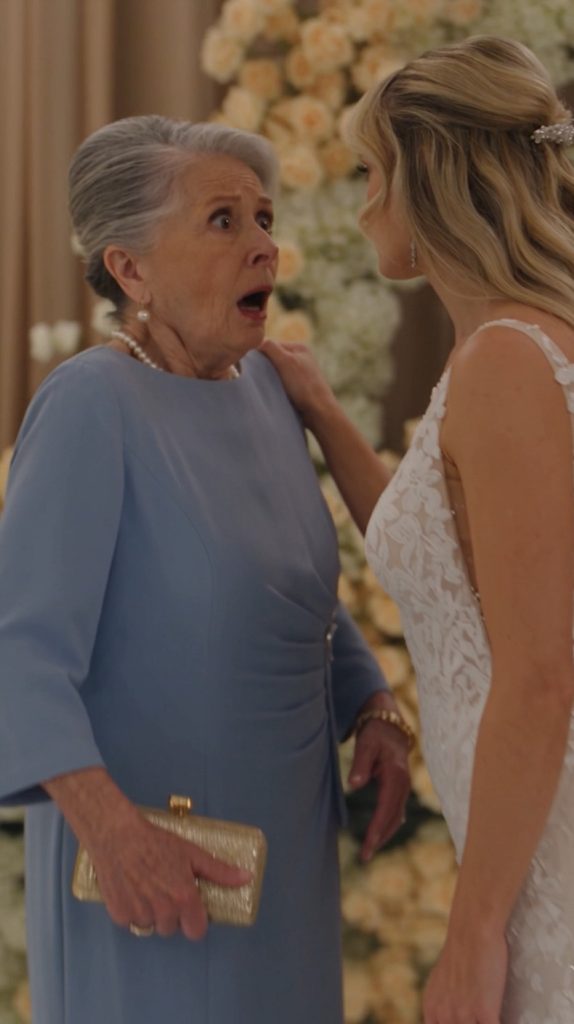
The words cut through the wedding music. Three feet away, my son stood with his hand extended toward me, unaware that his new bride was about to destroy something far more precious than a photograph.
I was seventy-seven years old.
My name is Grace Carter, and I had never felt so unwelcome at my own son’s wedding.
Noah had personally saved a place beside him for the family portraits. But when I stepped forward, Brittany blocked my path.
“We don’t need her in this one.”
“That’s my mother,” Noah said.
Brittany’s smile barely moved.
“She makes the picture look cheap.”
I glanced at my pale blue sale dress, comfortable shoes, worn handbag, and my mother’s pearl earrings.
Around us, ivory flowers towered above mirrored tables. Gold-rimmed plates, expensive linens, and hundreds of candles transformed the ballroom into Brittany’s dream.
Apparently, I was the one detail she couCreate a short, intriguing title that will pique viewers’ curiosity and encourage them to watch the next scene after seeing it.ldn’t make beautiful.
Noah’s expression hardened. I could see the conflict gathering behind his eyes, and it frightened me more than her cruelty.
I had raised him never to feel responsible for my happiness.
So I stepped away.
“It’s all right, sweetheart. Take your picture.”
“It isn’t all right, Mom.”
I shook my head gently and turned toward the platform steps.
Then Brittany grabbed my arm.
“Move completely out of the frame.”
Her fingers tightened. She pulled me sideways, and suddenly my foot slipped beyond the platform’s edge.
There was nothing to catch.
My hip struck the boards. Pain shot through my arm.
Someone screamed.
Noah was beside me almost instantly.
“Mom! Are you hurt?”
“My arm,” I whispered, attempting a smile. “Mostly my pride.”
He looked up at his bride.
“What did you do?”
“I barely touched her!”
“You pulled her.”
“She doesn’t know her place!”
The silence afterward was unbearable.
Noah helped me stand, keeping his hand beneath my trembling elbow.
“I know exactly where she belongs,” he said quietly.
“Beside me.”
Brittany’s face tightened.
Then she called for security.
“I want her removed.”
Before anyone moved, Samuel Bennett emerged from the guests.
He owned Bennett Signature Events, the prestigious company responsible for virtually every luxurious detail surrounding us.
Yet he walked straight past Brittany.
“Grace, are you all right?”
Brittany blinked.
“You know her?”
“Yes,” Samuel replied, visibly puzzled.
Years earlier, his company had nearly collapsed under debt and lost contracts. After thirty-eight years in financial administration, I recognized that his business needed breathing room, not rescuing from failure.
I had quietly invested enough to protect his payroll.
Samuel eventually repaid every dollar, with a generous return.
I wanted no publicity. Even Noah knew little about it.
But Samuel remembered.
Now the woman demanding my removal stood surrounded by the very elegance my investment had once helped make possible.
Samuel turned toward me.
“Grace, would you like us to continue?”
Noah slowly removed the white boutonniere from his tuxedo.
Brittany whispered his name.
He placed the flower on an empty chair.
“The reception is over.”
Her eyes widened.
“Three hundred guests are waiting! My parents paid for everything!”
“That doesn’t give you permission to hurt my mother.”
Brittany denied pushing me. Her mother urged Noah to speak privately because guests were recording.
“You had no problem humiliating her publicly,” he answered.
A nurse checked my wrist. Nothing appeared broken.
Then the photographer approached, pale and visibly shaken.
“Mrs. Carter, I took one photograph before everything happened.”
He glanced at Noah.
“The moment he reached for you.”
Noah stared at the camera.
And as the photographer slowly lifted its screen, I realized the picture Brittany had tried to prevent might reveal more than anyone expected… 👇
The photographer’s thumb hovered over a button.
Brittany moved first.
“Don’t show that.”
Her voice was sharper than before. Noah turned toward her, but she was already reaching for the camera.
Samuel stepped between them.
“Let him show us.”
The little screen glowed beneath the ballroom lights.
There was Noah, standing with his hand extended toward me. His expression was soft, almost boyish, the way it used to look when he waited at the school gates for me.
And there I was, taking one small step toward him.
But something else was visible.
Brittany stood behind his outstretched arm, watching me with an expression I had never seen her wear so openly.
Contempt.
Not surprise. Not irritation.
Contempt.
Noah studied the photograph without speaking.
Then the photographer swallowed.
“There are more.”
Brittany’s face drained.
“I want those deleted.”
“Why?” Noah asked.
She looked at him desperately.
“Because this is our wedding, Noah. Not some public trial.”
The photographer lowered his eyes.
“My camera takes several frames in a burst. I didn’t realize what I’d captured until I checked.”
He advanced through the images.
In the next photograph, Brittany’s hand was closing around my arm.
In the following frame, my body tilted toward the edge of the platform.
Then came the last photograph.
My face was twisted with fear.
Brittany’s fingers were still gripping my sleeve.
Nobody spoke.
I heard a candleholder being set down somewhere behind us.
Noah stared at the screen, his jaw tightening until a muscle moved near his ear.
“You told me she slipped.”
“She did.”
“You were holding her.”
“I was moving her out of the way!”
The words escaped before Brittany could stop them.
Her mother closed her eyes.
And Noah slowly stepped away from his bride.
It was only one step.
But I knew my son well enough to understand its meaning.
Brittany reached toward him.
“Please. We can fix this.”
Noah looked at her hand.
“Fix what? The photographs? What people saw? Or what you did to my mother?”
She had no answer.
Samuel quietly instructed his staff to stop the reception service and help guests collect their belongings. He made sure the photographer preserved the original files.
Brittany turned toward her parents.
“Tell him he’s being ridiculous.”
Her father, who had been silent throughout, finally spoke.
“Brittany, you need to apologize.”
She stared at him.
“Daddy?”
“You hurt an elderly woman. Your husband’s mother.”
“I didn’t mean for her to fall!”
“Then say you’re sorry.”
Her lips parted.
But instead of looking at me, she looked at the watching guests.
That was when I understood.
She was still searching for an audience that would agree with her.
I gently touched Noah’s wrist.
“Sweetheart, please take me somewhere quiet.”
He turned immediately.
“Of course, Mom.”
Brittany blocked his path.
“If you walk out with her, don’t expect me to come after you.”
Noah stopped.
For one terrible second, I thought he might turn back.
Then he looked at his bride and said, “I wasn’t asking you to.”
Outside, the evening air felt cool against my face.
Noah helped me into his car without saying a word.
Only after he closed my door did I see him grip the roof with both hands and lower his head.
His shoulders moved once.
I had not seen my grown son cry in years.
We went to the hospital because my wrist had begun to swell. The X-rays showed no fracture, but the doctor diagnosed a sprain and bruising around my hip.
While we waited for discharge papers, Noah sat beside me, holding the little plastic bag containing my pearl earrings.
One had come loose when I fell.
“I should have seen it,” he whispered.
“Seen what?”
“How she treated you.”
I watched him turn the pearls over in his palm.
“There were little things,” he continued. “The way she corrected your clothes. How she suddenly changed dinner plans when you were coming. She told me you preferred staying home.”
I looked down.
“I never told her that.”
He closed his eyes.
Then came a confession that hurt more than I expected.
“She said you made her feel judged because you didn’t have much money. I told her she’d misunderstood you.”
I let the silence settle between us.
“Noah, I never needed her to admire me.”
“I know.”
“I only wanted her to love you.”
He bent forward until his forehead rested against my uninjured hand.
“She didn’t even try to know you.”
I stroked his hair, just as I had when he was small.
For once, I did not tell him everything would be fine.
Some things should not be made smaller simply because they hurt.
The following morning, Brittany arrived at my house.
Noah was there making breakfast.
When he opened the door, she stood outside in yesterday’s expensive wedding shoes, her makeup washed away.
“I need to speak to your mother.”
I was sitting at the kitchen table.
“Come in,” I said.
She looked around my modest little home, then sat opposite me.
For several moments, nobody spoke.
Finally, Brittany whispered, “I’m sorry you fell.”
Noah put down the coffee mug.
“That’s not an apology.”
She pressed her palms together.
“I was humiliated. Everyone was looking at us.”
I studied her face.
“Brittany, I fell yesterday. You were embarrassed because people saw you do it.”
Her eyes filled.
“I didn’t know about Samuel. I didn’t know you had that kind of money.”
The room seemed to grow very still.
And there it was.
The hidden truth I had suspected but refused to believe.
I spoke carefully.
“Would you have treated me differently if you had known?”
She looked away.
Noah’s chair scraped against the floor.
“Answer her.”
Brittany began crying.
“I thought she was going to be dependent on us. I thought we’d spend our marriage taking care of her.”
I felt something inside me quietly break.
Thirty-eight years of work. Decades of careful savings. A lifetime of raising Noah without asking anyone to rescue me.
And this young woman had mistaken my simple clothes for a warning about my worth.
“I’ve never asked my son for money,” I said.
Brittany wiped her cheeks.
“I know that now.”
“No,” I answered softly. “You know I have money now. That’s different.”
She went silent.
Noah walked to the window.
When he turned around, his face was pale but composed.
“I can’t stay married to someone who thinks people deserve kindness only when they can afford it.”
Brittany stood abruptly.
“You can’t throw away our marriage over one mistake.”
“It wasn’t one mistake,” he said. “Yesterday was the first time I stopped making excuses for all the others.”
She looked toward me, waiting for me to intervene.
For most of my life, I would have.
But my son was making his own decision.
And I finally understood that protecting him did not mean choosing for him.
“I think you should go, Brittany,” I said.
She left without another word.
Within the week, Noah had contacted an attorney about ending the marriage. Samuel’s photographer provided the original images, and several guests offered their recordings.
Brittany’s family eventually accepted that there would be no celebration to salvage, no photographs to replace, and no private explanation that could erase what had happened.
Her father called me personally.
He apologized without asking me to forgive his daughter.
That mattered.
I told him I hoped she would someday understand the damage she had done.
But I would not pretend it hadn’t happened.
Noah and Brittany never began married life together. Their attorneys handled the necessary legal steps to end the marriage, while I concentrated on getting my strength back.
Some evenings, Noah still grew quiet.
He had loved her.
That truth did not disappear simply because he had learned something painful about her.
One evening, I found him sitting on my porch steps.
“Do you miss her?” I asked.
He nodded.
“Parts of her.”
I sat beside him.
“That doesn’t make your decision wrong.”
He leaned his shoulder against mine.
“I know, Mom.”
For a long while, we watched the light fade across the garden.
Then he said something I had never expected.
“I thought a wedding meant I was starting a new family. I forgot I already had one.”
I took his hand.
“You weren’t supposed to stop building a life just because you had me.”
He smiled faintly.
“I wasn’t supposed to forget who helped me build it, either.”
Several weeks later, Samuel visited with the photographer.
They brought a large, carefully wrapped parcel.
“I thought this belonged here,” Samuel said.
Inside was a framed photograph.
Not the image of Brittany grabbing my arm.
Not the fall.
It was the very first photograph.
Noah reaching for me.
Me stepping toward him.
A simple moment, surrounded by wedding flowers, before everything went wrong.
I stared at it for a long time.
Then I noticed something.
The photograph had been enlarged enough to reveal the little pearl earring glinting against my cheek.
My mother’s earrings.
I touched the glass.
“My mother wore these when she held Noah for the first time,” I whispered.
Noah looked startled.
“I didn’t know that.”
I smiled through tears.
“She was in the hospital when you were born. She insisted on wearing her good pearls because she said meeting her grandson was an occasion worth dressing for.”
My son turned toward the picture again.
For several seconds, he couldn’t speak.
Then Samuel handed me a smaller envelope.
Inside was a handwritten note from the photographer.
He explained that while reviewing the pictures, he had noticed something unusual.
In almost every photograph taken before the ceremony, I stood at the edges.
Never demanding attention.
Never moving in front of anyone.
But in the final photograph, Noah’s entire body was turned toward me.
The photographer had written:
Of all the beautiful things arranged for that wedding, this was the one moment nobody staged.
Noah began crying before I did.
He pulled me carefully into his arms, mindful of my recovering wrist.
And I held him.
Not as a groom.
Not as a man whose marriage had fallen apart before the reception ended.
Just my boy.
The same child who used to run toward me with scraped knees and important stories, certain I would always make room for him.
Months passed.
My bruises faded. Noah returned to work, began seeing a counselor, and gradually found his laughter again.
Samuel occasionally came for Sunday supper, always bringing dessert despite my protests.
The photographer received a proper thank-you from us both.
And the framed picture found its place above my living room mantel.
One Sunday afternoon, Noah arrived carrying a little white flower.
A boutonniere.
Not the one from his wedding.
A new one.
He laid it beside the photograph and smiled.
“I used to think that flower meant I was becoming somebody’s husband.”
He glanced at the picture.
“Now I think it reminds me of the day I finally learned what being a good man requires.”
I shook my head.
“You were already a good man, Noah.”
He kissed my forehead.
“Then I had a very good teacher.”
Outside, sunlight fell across the porch. Coffee warmed between our hands, and supper simmered gently in the kitchen.
My son pulled a chair close beside mine.
And above us hung the photograph of a seventy-seven-year-old mother in an inexpensive blue dress, stepping toward the hand of someone who loved her.
Brittany had wanted me removed because I didn’t belong in her perfect picture.
But that photograph became the only wedding picture my son ever wanted to keep.
And each time I looked at it, I saw what my mother had quietly taught me long before that terrible afternoon.
Love was never about how beautifully you appeared beside someone.
It was about whose hand reached for yours when the whole world was watching.
That evening, Noah reached across the table for mine.
And this time, nothing stood between us.