For Elena, the breaking point didn’t come in a hospital waiting room or during a sleepless night pacing the floor of a small apartment. It came somewhere high above the clouds, sealed inside a darkened cabin with strangers who only wanted silence — and a baby girl who simply could not stop crying.
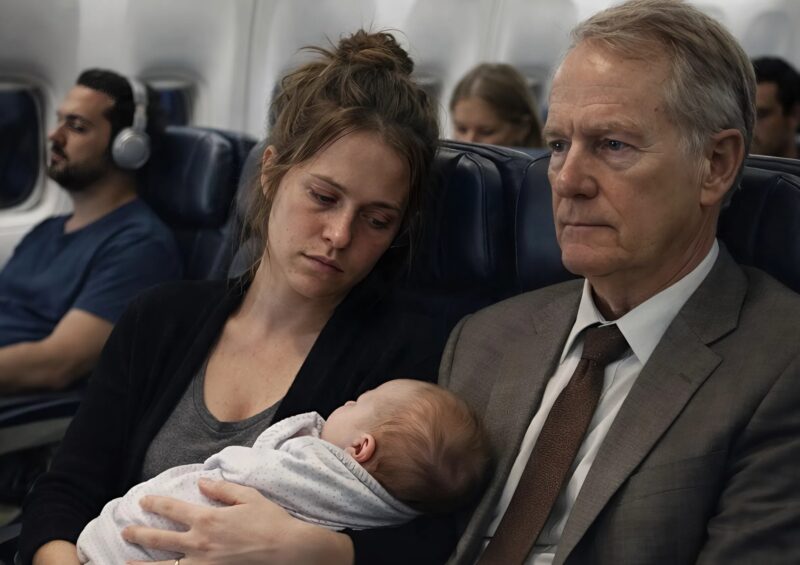
Lucia had been wailing almost from the moment the plane lifted off the runway. The sound, raw and desperate, cut right through the low hum of the engines and the white noise of the recycled cabin air. Around them, passengers shifted in their seats. Someone exhaled sharply. Someone else turned around with a look that didn’t need words to explain itself.
Elena pulled her daughter tighter against her chest, rocking her in slow, rhythmic circles the way she had done a thousand times before. She whispered into the tiny ear, pressed her lips to the warm forehead, adjusted the blanket with trembling fingers. Nothing worked. Lucia’s face was flushed deep red, her lips quivering, her little fists clutching at the fabric of her mother’s sleeve like she was holding on for dear life.
And maybe she was.
Because the truth was, Lucia wasn’t just tired or overstimulated by the noise and altitude. She was sick — genuinely, frighteningly sick — in a way that the local doctors back home had not been able to explain. There had been tests and more tests, referrals and long conversations held in hushed, worried tones. In the end, the consensus was the same: there was one man who might be able to help. A specialist, a pediatrician of considerable reputation, living in another country, hours away by air. He was not easy to reach, and he was certainly not inexpensive.
Elena had spent nearly everything she had just to buy these two seats on this flight.
She hadn’t slept in close to two days. The world had taken on that particular blur that comes only with extreme exhaustion — the kind where your thoughts feel thick and your body moves on autopilot and your emotions sit right at the surface, ready to spill over at the smallest thing.
When the man in the row ahead of her turned around with a sharp, disapproving look, that was almost the smallest thing. When a woman across the aisle shook her head slowly, deliberately, it was a little more. But when a voice somewhere behind her said, loudly enough to carry — people shouldn’t even be allowed to fly with babies — Elena felt something inside her chest collapse quietly.
Her face burned. She kept her eyes down, kept rocking, kept whispering. A flight attendant materialized beside her with a practiced smile stretched thin over visible irritation, speaking in that particular tone reserved for situations where someone is being told to fix a problem that cannot be fixed. Passengers were complaining, the attendant said softly. Was there anything Elena could do?
Elena nodded. Because she had nothing left to say.
She was running on empty — emotionally, physically, financially. Her arms still moved, still rocked, still held Lucia close, but her mind had already started to go somewhere far away. The overhead lights were dimmed. The cabin had settled into that restless, half-sleeping state that long flights produce. And Elena, without meaning to, without any warning at all, let her eyes close.
Her head came to rest against the shoulder of the man seated beside her.
She didn’t feel it happen. She was simply gone — into the first real sleep she had managed in days.
She had no idea how long she was out. But when she opened her eyes again, the first thing she registered was the silence.
Not the usual white-noise quiet of a sleeping cabin. True quiet. No crying.
Panic jolted through her before her brain had even fully woken up. She turned to her left — and stopped completely.
The man beside her, the stranger whose shoulder she had been unconsciously leaning on, was holding Lucia. Not awkwardly, not reluctantly — confidently and with a gentleness that seemed entirely natural to him. One large hand supported the baby’s back. The other rested lightly against her tiny fingers. Lucia was sleeping so peacefully that her little chest rose and fell in the slow, steady rhythm of a child completely without worry.
Elena sat upright, apologies tumbling out of her in a breathless rush.
The man turned to her with a calm that felt almost surreal in that moment.
“It’s all right,” he said quietly. “She was tired. And so were you.”
Elena looked at him properly for the first time. There was something in the way he had been holding Lucia — precise, assured, practiced — that didn’t match the image of a random business traveler doing a good deed. His eyes were steady and kind, and when he smiled, there was no condescension in it. No performance of generosity.
He asked whether she was flying to see a doctor.
The question hit her like cold water. She whispered yes — a pediatric specialist, the only one anyone had suggested who might actually be able to help her daughter.
The man was quiet for a moment.
Then he said, very simply, that she wouldn’t need to search anymore.
He told her his name — and Elena’s hands went cold. She knew that name. Every parent in three countries who had ever faced a frightening diagnosis for their child knew that name.
Tears came before she could stop them. Not the exhausted tears of the last two days — something different. Something that felt almost like grace arriving in an impossible place.
When she admitted, voice shaking, that she barely had enough to cover the cost of the flight and didn’t know how she would manage the appointment fees, he looked down at Lucia’s sleeping face for a long moment.
“You won’t have to pay anything,” he said. “I’ll treat your daughter myself. Free of charge.”
Some kindness doesn’t announce itself. It just sits down beside you in the dark, holds what you cannot hold anymore, and asks for nothing in return.