The room went silent the way a room only does when something truly wrong is happening in plain sight.
One moment there was the usual noise of a military unit going about its day — boots on concrete, muffled voices, the crackle of a radio somewhere down the hall. And then, like a switch had been flipped, every sound disappeared. Every pair of eyes locked onto the same scene. Nobody moved. Nobody spoke. Nobody dared.
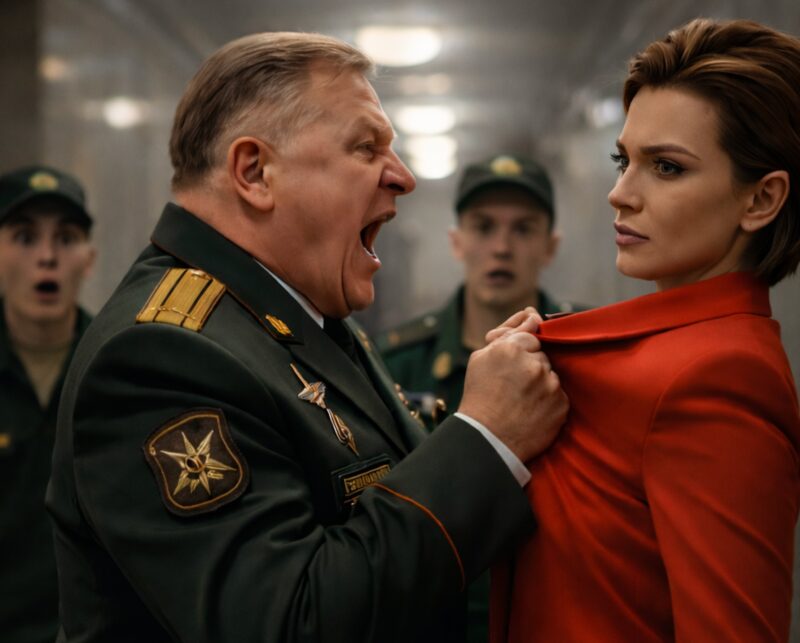
Standing in the middle of it all was a woman in a bright red suit.
She looked completely out of place among the rows of dark green uniforms, and that was exactly the point. She had just arrived at the base, her paperwork in order, her assignment legitimate. According to every official document, she was there to serve alongside the unit on equal terms. But from the moment she walked through those doors, it was painfully clear that not everyone saw it that way. And the man making his feelings most known was the colonel himself.
He didn’t hide his contempt. He didn’t even try to.
He looked at her the way some people look at something they consider beneath them — not with anger exactly, but with a kind of cold, dismissive disgust that somehow cuts even deeper than shouting. Except he was shouting too.
“Do you even understand where you’ve ended up?” he snapped, his voice carrying across the entire corridor so that every last soldier could hear. “This is no place for people like you.”
Some of the soldiers exchanged uncomfortable glances. A few stared at the floor. Nobody stepped forward. Nobody said a word in her defense. They all knew what the colonel was like — a man who had never once backed down from a confrontation, who viewed any pushback as a personal attack, who had built his reputation on being the loudest, most forceful presence in any room. Going against him wasn’t just risky. It was career-ending.
So they stayed quiet. And he kept going.
“I promise you,” he continued, raising his voice even louder, making absolutely sure there was no question about where he stood, “I will do everything in my power to make sure you walk right back out that door. Men serve here. Not — people like you.”
Those words landed hard. You could see it on the faces of the soldiers around him — not agreement, but a kind of helpless shame. The kind that comes from watching something wrong unfold and feeling like your hands are tied.
But the woman in the red suit? She didn’t flinch.
She stood perfectly still, looking at him with calm, steady eyes. No tears. No raised voice. No attempt to argue or defend herself or beg for basic human decency. She simply let him speak, as if she were waiting for something — as if she already knew exactly how this was going to end.
That stillness infuriated him more than anything else she could have done.
He closed the distance between them in two steps, grabbed her by the collar of her jacket, and shoved her back against the wall. The sound was sharp and immediate. One of the soldiers actually flinched at the impact. But again — nobody moved. Nobody intervened.
“You are nothing,” he said, his voice dropping to something low and vicious, the kind of tone that was almost worse than the screaming. “People like you have no place in this army. You don’t belong here. You never will.”
For just a moment, the air in that corridor felt unbearable. Heavy with everything that wasn’t being said, everything that wasn’t being done.
And then she reached into her pocket.
Slowly. Deliberately. No sudden movements, no drama. Just a calm, unhurried hand slipping into the pocket of her jacket.
The colonel didn’t understand at first. He stood there, grip still on her collar, watching her with narrowed eyes — and then she pulled out a small leather case and opened it directly in front of his face.
“Are we done?” she asked quietly.
He leaned in, squinting — and in that instant, his entire expression collapsed.
Inside the case was an official identification badge. Real. Authenticated. Bearing the seal and signature of a government ministry inspector.
The corridor went silent again — but this time, for an entirely different reason.
She calmly removed his hand from her collar and straightened her jacket with the unhurried ease of someone who has never once lost control of a situation.
“I’m here because of the complaints,” she said, her voice never wavering, her eyes never leaving his. “There have been a great many of them. For a long time, there wasn’t enough documented evidence to act. But now —” she glanced briefly at the soldiers watching from every direction, “— I believe there is more than enough.”
Someone in the back exhaled slowly. Another soldier took a quiet half-step backward, as if instinct was telling them to put distance between themselves and what was coming.
The colonel, who minutes before had been the loudest, most imposing presence in the room, couldn’t produce a single word.
“We’ll continue this conversation in a formal setting,” she added, her tone as steady and unhurried as it had been from the very beginning. “And it won’t only be you I’ll be speaking with.”
In the days that followed, the unit changed completely.
The colonel was stripped of his rank and removed from his command. Several of his subordinates faced disciplinary action for their long-running silence — because silence, as it turned out, had been treated as complicity. The complaints that had been filed and filed and quietly buried finally received an official response.
Justice, when it comes, doesn’t always arrive loudly.
Sometimes it walks in wearing a red suit, says almost nothing, and lets a leather badge do all the talking.
And sometimes the most powerful thing a person can do — when faced with cruelty, humiliation, and a room full of people too afraid to help — is simply stand still, stay calm, and wait for exactly the right moment.
She knew what she was walking into. She came prepared. And she never — not for a single second — lost her composure.
That, more than anything else, is what the soldiers in that corridor remembered long after everything had settled. Not the shouting. Not the badge. But the way she stood there, quietly, in that red suit — and didn’t break.