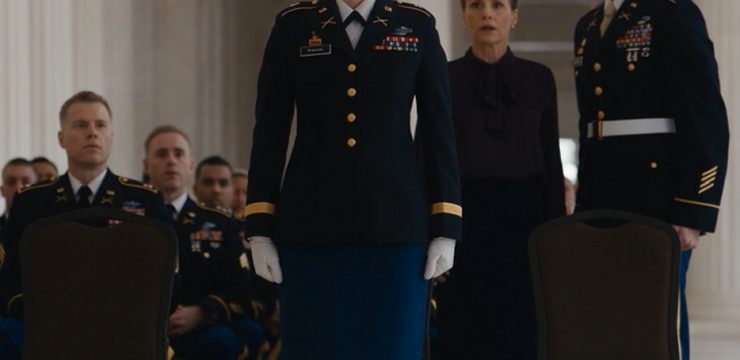
The sound of breaking glass cut through the veterans gala, but it was the silence that followed that felt unbearable. Two hundred guests watched as a mother publicly humiliated her own daughter, a Marine officer in full dress uniform.
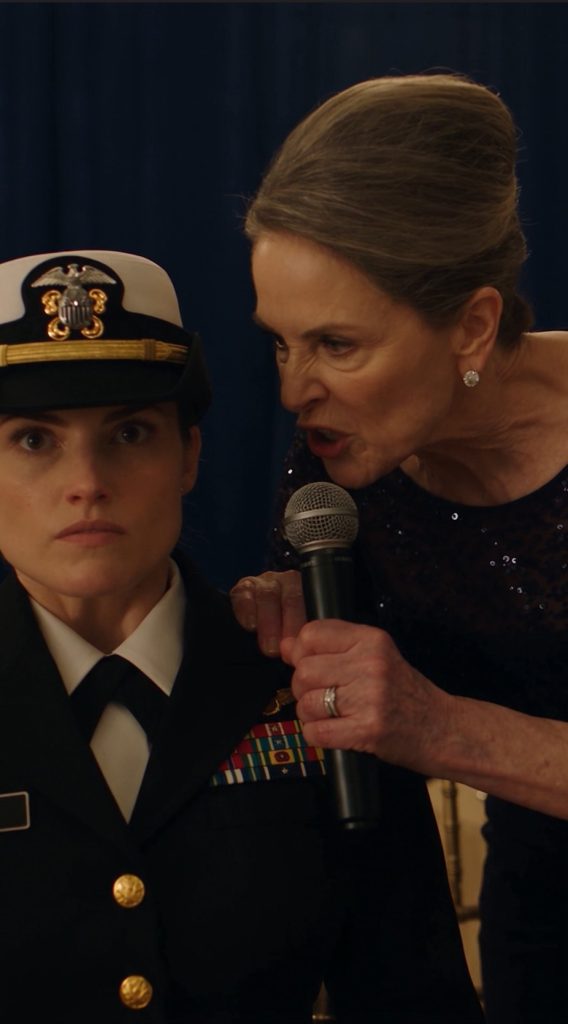
None of them knew that the man she was about to praise instead would soon recognize something on that uniform that would change everything.
Claire stumbled backward, her hip striking the edge of a banquet table. Champagne glasses trembled, and a chair crashed to the floor.
Her mother, Margaret, stood over her, breathing hard. There was no apology in her eyes. Only anger.
Moments earlier, the ballroom had been filled with conversation and laughter. Now every face was turned toward the woman who had dragged her daughter from her seat.
Margaret seized the microphone.
“You are the greatest shame of my life.”
The words landed harder than the shove.
Claire slowly straightened. She adjusted her Marine dress uniform with trembling fingers, careful not to let anyone see how deeply the words had wounded her.
She had endured her mother’s disappointment for years. But hearing it spoken before a room full of decorated veterans was something else entirely.
Still, she refused to cry.
Margaret mistook her silence for defiance.
She turned toward a decorated Navy SEAL standing near the stage, his uniform displaying the honors he had earned through years of service.
“This,” Margaret announced, pointing at him, “is the son I always wished I had.”
The officer remained motionless.
Around the ballroom, guests exchanged uncomfortable glances. Some lowered their eyes, embarrassed to witness such cruelty. Others kept watching Claire, perhaps expecting anger, tears, or some desperate attempt to defend herself.
But Claire only breathed.
Slowly. Carefully.
As though holding herself together required every ounce of strength she possessed.
That restraint seemed to infuriate Margaret more than any argument could have.
She dropped the microphone slightly and marched across the aisle.
Her eyes fixed on the insignia fastened to Claire’s chest.
“You don’t deserve to wear that.”
She reached for it.
Claire reacted instantly.
Her hand closed around Margaret’s wrist before her fingers could touch the uniform. With one controlled movement, Claire pushed her mother’s hand away and created enough distance to stop her.
“Do not touch my uniform.”
Her voice was quiet.
But something in it made Margaret hesitate.
For a heartbeat, neither woman moved.
Then, from beside the stage, the Navy SEAL took a step forward.
He was no longer watching Margaret.
His attention had settled entirely on Claire.
His eyes moved across her uniform, examining her rank, then the ribbons arranged precisely above her chest.
Finally, his gaze stopped on one small insignia.
His expression changed.
The confident composure he had maintained throughout the evening disappeared, replaced by something that looked almost like disbelief.
He stared another second, as though confirming what his eyes were telling him.
Then the color drained from his face.
Claire noticed him looking.
So did Margaret.
The officer moved closer, straightened his jacket, and brought his heels together.
With deliberate precision, he raised his hand in salute.
To Claire.
“Ma’am…” His voice sounded strained. “You’re the One-Eighty-Seven?”
A stunned silence swept through the ballroom.
Margaret’s hand loosened around the microphone.
The very man she had held up as everything her daughter could never be was standing rigidly at attention before Claire.
Then chairs began scraping against the floor.
Veterans rose from their seats, one after another, their expressions shifting from confusion to recognition.
At the head table, an elderly retired general pushed himself upright.
He looked directly at Claire.
Then he began walking toward her.
Margaret glanced between the saluting officer, the approaching general, and the daughter she had spent years belittling.
For the first time that evening, genuine fear crossed her face.
Because everyone seemed to understand something she didn’t.
And when the general finally stopped before Claire, the entire room waited to hear what One-Eighty-Seven truly meant.
What he was about to say would change the silence in that ballroom forever. 👇
The general stopped barely three feet from Claire. His weathered hand trembled as he raised it to his forehead, offering a salute so deliberate that even the sound of the air conditioning seemed to disappear.
“Colonel Claire Bennett,” he said quietly. “I never thought I’d have the privilege of meeting you.”
Claire swallowed.
“General Whitmore. Please, sir. You don’t have to do that.”
“Yes,” he replied, his eyes shining. “I believe I do.”
Margaret gave a nervous laugh.
“I’m sorry, General, but there’s obviously been some misunderstanding. My daughter has always had a talent for making herself seem more important than she is.”
Nobody laughed with her.
The Navy SEAL turned toward Margaret.
“Ma’am, with respect, you have absolutely no idea who your daughter is.”
Margaret stiffened.
“I know exactly who she is. I raised her.”
The officer looked at Claire again, almost asking permission.
Claire gave the smallest shake of her head.
But General Whitmore had already noticed the way her fingers tightened against the seam of her trousers.
“Colonel,” he said gently, “you’ve kept your service out of the public eye long enough. Would you permit me to explain?”
Claire looked toward her mother.
For years, she’d imagined what it might feel like to finally be understood. Standing there, surrounded by strangers while her mother waited to dismiss another achievement, she discovered she didn’t want victory.
She wanted the humiliation to stop.
“Only what can be shared publicly, sir,” she whispered.
Whitmore nodded.
Then he turned toward the ballroom.
“Several years ago, during a joint military operation overseas, a convoy carrying American personnel and local civilians was trapped after an attack cut off its evacuation route.”
The room remained motionless.
“Communications failed. The designated extraction point became unusable. One hundred and eighty-seven people were facing almost certain death.”
Margaret stared at him.
“An officer volunteered to remain behind with a small team while the wounded were moved to safety. She repeatedly exposed herself to enemy fire, coordinated an alternate evacuation, and refused extraction until every surviving person under her protection had been accounted for.”
The general’s voice faltered.
“She was seriously wounded. But all one hundred and eighty-seven people were brought out alive.”
A woman near the front covered her mouth.
Whitmore looked toward Claire.
“The personnel involved came to call her One-Eighty-Seven. It was never an official military designation. It was their way of remembering what she refused to leave behind.”
The Navy SEAL’s jaw tightened.
“I was one of those people.”
Claire turned toward him.
His eyes were wet.
“You probably don’t remember me, ma’am. I was on the second evacuation aircraft. You helped carry my teammate aboard.”
Claire studied his face.
Then recognition flickered.
“Petty Officer Hayes?”
He smiled despite himself.
“Commander Hayes now, ma’am.”
For the first time that evening, Claire’s expression softened.
“I’m glad you made it home.”
Hayes looked down for a moment.
“My daughter was born three months after that operation. I got to meet her because of you.”
Margaret’s face had gone pale.
She looked from Hayes to the general, then back at Claire.
“But she never told me any of this.”
Claire’s shoulders lowered slightly.
“I tried, Mom.”
Two words.
Barely audible.
Yet they seemed to carry years of conversations that had ended before they could begin.
Margaret gripped the microphone.
“You never said anything about saving people. You told me you were deployed.”
“I told you I’d been injured.”
Margaret opened her mouth.
Claire continued.
“I called you from the hospital.”
The room seemed to shrink around them.
“You told me not to exaggerate because other people’s children had real problems.”
Margaret’s lips parted, but no words came.
Claire looked down at her uniform.
“I was calling because I wasn’t sure whether I’d be walking again.”
General Whitmore lowered his eyes.
The microphone slipped from Margaret’s fingers, striking the carpet with a dull sound.
For a moment, she appeared smaller than she had at any point that evening.
Then her familiar defensiveness returned.
“Well, how was I supposed to know? You’ve always kept secrets from me.”
Claire slowly raised her head.
“I kept things private because every time I shared something important, you found a way to make it feel small.”
Margaret glanced toward the guests.
“You’re really going to embarrass me like this?”
Claire looked at the overturned chair, the broken glass, and the faces watching them.
“No, Mom. I’m finally going to stop protecting you from the truth.”
Margaret recoiled.
Before she could answer, the gala’s organizer approached from the head table.
“Mrs. Bennett,” the woman said, her expression controlled, “I need to speak with you.”
Margaret straightened immediately.
“Not now.”
“Yes. Now.”
The organizer held a folded event program against her chest.
“You serve as chair of our family recognition committee. Tonight, you publicly assaulted and degraded a decorated veteran in front of the people this organization exists to honor.”
Margaret’s eyes widened.
“This is a private family matter.”
“Not after you brought it onto our stage.”
A long silence followed.
The organizer took a breath.
“I have already spoken with the board members present. Effective immediately, you are relieved of your committee responsibilities. Your name will also be withdrawn from consideration for this year’s volunteer leadership award.”
Margaret stared at her.
For years, that committee had been the center of her social life. She had built friendships, cultivated admiration, and presented herself as a devoted supporter of military families.
Now the people whose approval she treasured were looking at her without admiration.
“You can’t do this,” she whispered.
The organizer’s expression softened, but her decision did not.
“Your daughter deserved your support tonight. At the very least, she deserved your dignity.”
Margaret searched the room for someone to defend her.
Nobody moved.
Finally, she looked toward Claire.
“Are you going to let them treat your mother this way?”
Claire’s eyes filled.
That was the hardest moment.
Not the shove. Not the public insult. Not even the years of being treated as a disappointment.
It was hearing her mother ask for protection immediately after refusing to offer any.
“I won’t hurt you,” Claire said. “But I won’t rescue you from consequences you created.”
Margaret looked away.
She left the ballroom without another word.
Nobody applauded.
Claire was grateful for that.
There was nothing about what had happened that deserved celebration.
Hayes quietly retrieved the fallen microphone while General Whitmore gestured toward an empty chair.
“Sit down, Colonel.”
Claire tried to smile.
“I’m all right, sir.”
“That’s not what I asked.”
Something about his gentle firmness finally broke through her composure.
She sat.
Her hands began shaking.
Whitmore lowered himself into the chair beside her, careful not to crowd her.
“You know,” he said, “people have spent years trying to thank you properly.”
Claire wiped beneath one eye.
“I wasn’t alone out there.”
“I know. That’s one of the reasons your people respected you.”
Hayes brought her a glass of water.
She accepted it with both hands.
Across the ballroom, conversations returned in hushed voices. The musicians remained silent, and guests gave Claire the space she hadn’t known she needed.
Then Hayes pulled a chair closer.
“There’s something else you should know.”
Claire looked up.
“After we came home, some of us started meeting every year. Just dinner, mostly. Families, stories, remembering the people who helped get us back.”
Claire listened.
“We tried inviting you. But you always declined.”
“I didn’t want a ceremony.”
Hayes shook his head.
“It was never about a ceremony.”
He reached into his jacket and withdrew a small, worn photograph.
Claire took it carefully.
The picture showed a group of smiling service members and their families gathered around a long picnic table.
Children sat on shoulders. Someone held a birthday cake. In the background, a handmade banner read, THANK YOU, 187.
Claire stared at it.
Hayes touched the edge of the photograph.
“Every person in that picture either came home because of that evacuation or loves somebody who did.”
Claire’s breathing changed.
She had spent years remembering the sounds of that operation, the faces of the wounded, and the terrible uncertainty of whether they would get everyone out.
She had rarely allowed herself to imagine the lives that followed.
Hayes pointed toward a little girl standing beside him.
“That’s my daughter, Emma.”
Claire smiled through her tears.
“She looks like you.”
“Unfortunately for her,” he said.
Claire laughed.
It was small and unsteady, but real.
Three weeks later, a letter arrived at Claire’s apartment.
The handwriting on the envelope was unmistakable.
Margaret.
Claire left it unopened on the kitchen counter until evening.
When she finally unfolded the pages, she found no excuses.
Her mother had written about the hospital call, the years of comparisons, and the cruel things she’d said whenever Claire failed to become the daughter she had imagined.
One sentence made Claire stop reading.
“I think I spent so long trying to make you feel inadequate that I never noticed how inadequate I was making myself.”
Claire pressed the letter against the table.
She didn’t call immediately.
An apology, however sincere, could not restore years of trust in a single evening.
But she kept the letter.
Over the following months, Margaret began attending counseling and stepped away from the social circles where she’d spent so much time chasing admiration.
She sent occasional notes.
Claire answered when she felt ready.
Their conversations were awkward. Sometimes they ended early. Sometimes Claire cried afterward.
But Margaret stopped demanding forgiveness.
And slowly, that mattered.
One spring afternoon, Claire accepted an invitation to the annual gathering Hayes had described.
It was held in a quiet park beneath tall oak trees.
There were folding tables, children running across the grass, and the smell of food cooking nearby.
No podium.
No microphones.
No one waiting to announce her achievements.
Hayes met her near the entrance with Emma, now old enough to ask endless questions.
“Are you Claire?” the girl asked.
Claire crouched to her height.
“I am.”
Emma considered her seriously.
“My dad says you helped him come home.”
Claire glanced toward Hayes.
He nodded.
Emma reached into her pocket and offered Claire a folded sheet of paper.
Inside was a drawing of a house beneath a bright yellow sun.
Three figures stood outside holding hands.
Across the top, in uneven letters, Emma had written:
THANK YOU FOR MY DADDY.
Claire looked at the drawing for a long time.
Then she wrapped her arms around the little girl.
For years, she had thought of One-Eighty-Seven as a number tied to the most frightening hours of her life.
Now she understood it differently.
It wasn’t only the number of people who survived.
It was birthdays, ordinary mornings, unfinished conversations, weddings, children, and quiet evenings that had all been given another chance.
Later, Margaret arrived at the park.
Claire had invited her, but neither woman knew exactly what the meeting would feel like.
Margaret stood uncertainly beside a picnic table, holding a small container of homemade cookies.
“I wasn’t sure what to bring,” she admitted.
Claire looked at the container.
“You remembered.”
Margaret’s eyes filled.
“They’re the ones you liked when you were little.”
Claire took one.
For a moment, they stood together without speaking.
Then Margaret said, “I don’t expect you to forget.”
“I can’t.”
“I know.”
Claire studied her mother’s face.
“But I’d like us to learn how to be different.”
Margaret nodded, wiping her cheeks.
“I’d like that too.”
They sat together beneath the trees.
There were no promises that everything would become easy. No sweeping declaration that erased the past.
Only two women beginning, cautiously, to build something more honest.
As the afternoon light turned golden, Emma ran toward them carrying another drawing.
This one showed a woman in uniform surrounded by dozens of smiling people.
Claire laughed when she saw the enormous medals Emma had colored across the figure’s chest.
Margaret leaned closer.
“She’s made you look like a superhero.”
Claire shook her head.
“No. Just somebody who was there when people needed help.”
Emma frowned.
“That’s what a hero is.”
For once, Margaret didn’t correct her daughter or compare her to anyone else.
She simply reached across the table and gently squeezed Claire’s hand.
And when Claire looked at the people laughing beneath the trees, at the children who would grow up knowing their parents, and at the mother who was finally learning to love her without conditions, she felt something settle inside her.
She no longer needed the whole world to know what she’d done.
She had never needed a ballroom full of strangers to stand for her.
She had only wanted a place where she could sit, take off the weight of being strong, and know she belonged.
Beneath the warm afternoon sun, with Emma’s drawing resting beside her and her mother’s hand still holding hers, Claire finally had one.