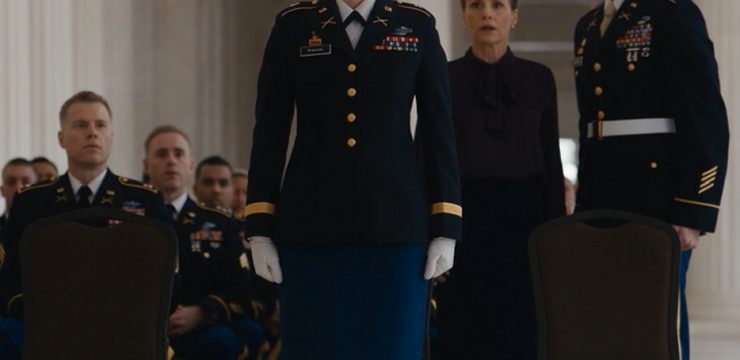
The sound of a Marine officer being shoved against a banquet table cut through the ballroom like a gunshot. Nearly 200 people turned toward the commotion, but no one moved. What they were about to witness would expose a truth her own mother had never cared to discover.
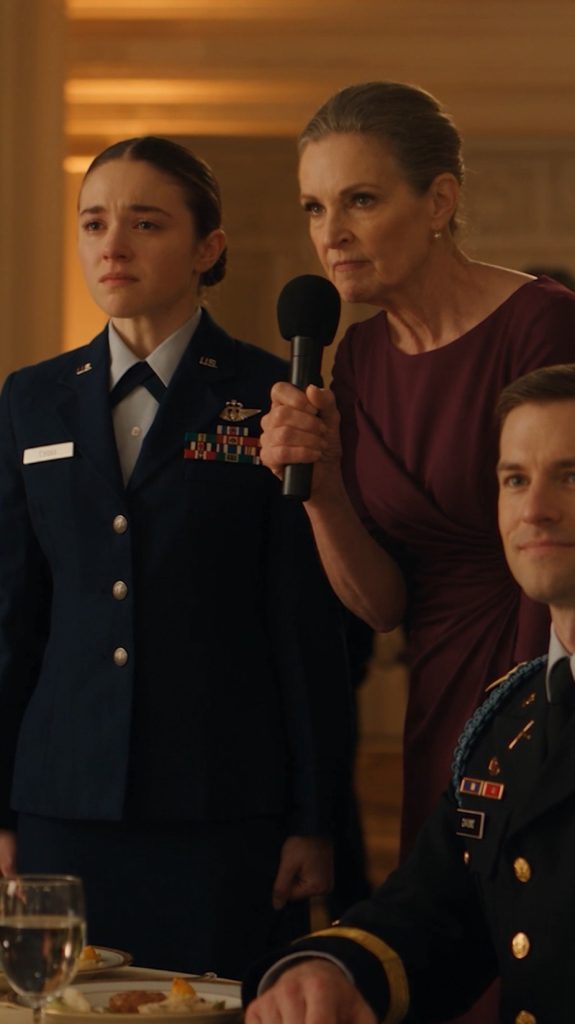
Glasses trembled. Silverware scattered across the white tablecloth.
Elena Reyes caught the table’s edge before she fell. Her dress uniform remained immaculate, though her mother’s fingers had left deep creases in the fabric near her shoulder.
Margaret Reyes snatched a microphone from the podium.
“You are the greatest shame of my life.”
Her voice carried across a room filled with veterans, active-duty personnel, military families, and decorated officers.
Elena remained silent.
She had spent years hearing her mother dismiss her service, question her choices, and treat every achievement as another disappointment. But hearing those words in front of people who understood what her uniform represented struck differently.
Margaret turned toward a distinguished officer nearby.
Commander Jack Mercer, a highly decorated Navy SEAL, sat among several retired military leaders.
“This,” Margaret announced, pointing toward him, “is the son I always wished I had.”
Jack’s expression tightened. He shifted uncomfortably in his chair, but Margaret never noticed.
She was already facing Elena again.
“You actually believe those ribbons make you someone important?”
Her finger jabbed against the decorations on Elena’s chest.
Elena’s jaw tightened. She kept her hands at her sides, refusing to give her mother the confrontation she seemed desperate to provoke.
Then Margaret reached for something higher.
A distinctive insignia.
Her fingers closed around it, and she pulled.
Elena moved instantly.
She caught her mother’s wrist, stopped the motion, and pushed her hand away with controlled firmness.
“Do not touch my uniform.”
The words were quiet.
Somehow, that made them carry further.
Margaret laughed dismissively, raising the microphone again.
But across the ballroom, Commander Mercer had stopped listening.
His eyes were fixed on Elena.
He studied her rank first, then the arrangement of her ribbons. Finally, his attention settled on the insignia Margaret had nearly torn away.
The color drained from his face.
He leaned forward, as though he needed a closer look to believe what he was seeing.
“No way,” he whispered.
A retired officer beside him followed his gaze. His expression changed too.
Jack rose slowly.
Margaret noticed him moving and straightened with visible satisfaction. She seemed convinced that the decorated officer was approaching to support her judgment.
Instead, Jack walked past her without a word.
He stopped several feet from Elena.
His shoulders squared. His heels came together. Every trace of uncertainty vanished from his posture, replaced by something the military personnel in the room recognized immediately.
Respect.
He raised his right hand.
And saluted.
Margaret’s smile collapsed.
Elena blinked, clearly caught off guard by the sudden attention.
Jack held the salute, his voice low and unsteady.
“Ma’am…”
His gaze flickered toward the insignia once more.
“Are you the One-Eighty-Seven?”
The silence that followed seemed to swallow the entire ballroom.
Elena returned his salute without smiling.
Around them, older veterans began exchanging stunned looks.
One stood.
Then another.
A whisper traveled between tables.
“One-Eighty-Seven…”
Margaret stared at the men rising from their chairs. These were seasoned officers, people whose respect could not be demanded with a microphone.
Yet they were standing for the daughter she had just publicly disgraced.
Her grip loosened around the microphone.
“What does that mean?” she demanded, her voice suddenly smaller.
Jack did not turn toward her.
His attention remained fixed on Elena, and when he finally spoke, his words carried a quiet disbelief more devastating than anger.
“You really don’t know who your daughter is?”
Margaret looked down at the insignia she had tried to rip away.
Then slowly raised her eyes toward Elena.
And the silence surrounding her was only the beginning. 👇
The microphone slipped another inch in Margaret’s trembling hand.
Jack lowered his salute, but his expression remained grave.
“Three years ago,” he said quietly, “a humanitarian evacuation collapsed in hostile territory. A convoy carrying civilians was cut off. Communications were failing. The nearest extraction team was ordered to withdraw.”
Elena’s eyes shifted toward the floor.
“Commander,” she murmured.
Jack stopped immediately.
For a moment, the two officers simply looked at each other.
Then he asked, “May I tell them what has been cleared for public release?”
Elena hesitated.
Her mother stood only a few feet away, still holding the microphone. For years, Elena had protected the parts of her life Margaret refused to understand.
Finally, she nodded.
Jack faced the room.
“There were 187 people trapped behind that evacuation line. Families. Aid workers. Children. Most of them had nowhere left to go.”
A chair creaked near the back.
“The officer responsible for coordinating their rescue refused to abandon them. She reorganized the remaining personnel, established an alternate evacuation route, and stayed until the last civilian was safe.”
He looked at Elena.
“That officer was Major Elena Reyes.”
Margaret’s mouth opened slightly.
Jack continued, his voice growing rougher.
“The operation became known among those involved as One-Eighty-Seven. Not because it was the official name of a mission. Because that was how many people came home.”
Nobody applauded.
The room was too still for that.
Margaret stared at her daughter as though searching for evidence that this was some elaborate misunderstanding.
“You never told me any of this.”
Elena raised her eyes.
“I tried.”
Two words.
Nothing more.
But Margaret remembered the telephone calls she had ended early. The ceremonies she had refused to attend. The Christmas when Elena had returned home exhausted, only to be told that serving overseas was no excuse for being an absent daughter.
“I thought you were exaggerating,” Margaret whispered.
Elena’s expression barely changed.
“You never asked.”
Jack stepped back, giving Elena space.
A silver-haired veteran approached from the nearest table. He was the retired officer who had been sitting beside Jack.
“Major Reyes,” he said, “I’m Colonel Thomas Whitaker. I reviewed the unclassified account of that evacuation.”
He swallowed.
“My daughter was one of the medical volunteers on that convoy.”
Elena looked up sharply.
“She had a broken wrist,” Elena remembered. “She wouldn’t leave until everyone in her section was accounted for.”
Thomas gave a trembling laugh.
“That sounds like her.”
His eyes glistened.
“She came home because of what your team did.”
Then he extended his hand.
Elena took it.
Margaret watched the handshake with an expression that shifted between disbelief and resentment.
“Enough,” she said suddenly.
Several heads turned.
Margaret lifted the microphone again.
“You’re all acting as though she’s some kind of saint. You don’t know what she’s like as a daughter.”
The words landed heavily.
Elena closed her eyes for one brief second.
Jack’s face hardened.
“Mrs. Reyes,” he said, “I don’t know your private relationship. But everyone here witnessed you assault your daughter.”
Margaret’s cheeks reddened.
“I was disciplining her.”
“She’s an adult Marine officer,” Thomas replied. “And she’s your daughter. Neither gives you permission to hurt her.”
Margaret turned toward Elena.
“Tell them. Tell them I didn’t mean anything by it.”
Elena looked at the familiar desperation behind her mother’s anger.
That desperate insistence that whatever Margaret did, Elena must somehow make it acceptable.
For years, she had complied.
Tonight, she could not.
“No,” Elena said.
Margaret froze.
“What?”
“I won’t tell them something that isn’t true.”
A faint hum from the ballroom’s ventilation filled the silence.
Margaret lowered the microphone.
For the first time, she seemed to understand that her daughter’s obedience had ended.
Then a woman near the rear doors stood.
She wore a simple blue dress and held a folded program against her chest.
“Excuse me,” she said.
Her voice shook.
“I was on that convoy.”
Elena turned.
The woman stepped forward slowly.
“My name is Sarah Bennett. My son was seven when the evacuation happened.”
She looked directly at Elena.
“He was the little boy who wouldn’t stop crying because he’d lost his shoes.”
Elena’s lips parted.
“Daniel?”
Sarah nodded, pressing the program against her mouth.
“You carried him through the last section of the route. He told me you kept promising there would be breakfast when he got somewhere safe.”
Elena swallowed hard.
“He was hungry.”
Sarah smiled through tears.
“He still talks about that breakfast.”
Margaret glanced around the ballroom.
Faces that had been strangers minutes earlier now held stories she had never imagined.
Sarah continued.
“My son asked me once why you didn’t come home with us. I told him that sometimes the people who help us get home still have work to finish.”
Elena looked away.
Something about that sentence had reached a place her mother’s accusations never could.
Sarah approached and gently touched her arm.
“He’s sixteen now. He wants to become a doctor.”
Elena gave a small, unsteady smile.
“I’m glad.”
Margaret tried speaking again, but her voice failed.
Across the room, one of the event organizers approached with two security officers.
“Mrs. Reyes,” the organizer said quietly, “we need you to leave.”
Margaret recoiled.
“This is a private family matter.”
“You made it public,” the organizer replied. “And several guests have provided video of what happened.”
Her eyes darted toward the people holding their phones.
The microphone was gently taken from her hand.
The organizer explained that the incident would be formally reported and Margaret would no longer be welcome at events organized by their veterans’ association.
She turned toward Elena.
“Are you seriously going to let them do this to your mother?”
Elena’s hands tightened at her sides.
She could still remember being eight years old and watching Margaret adjust the collar of her school uniform before a ceremony.
There had been tenderness once.
Or perhaps Elena had spent years searching for it in moments too small to carry the weight she placed upon them.
“I didn’t make you hurt me,” Elena said.
Margaret’s face crumpled.
“I raised you.”
“I know.”
“I sacrificed everything for you.”
Elena’s voice softened.
“And I’ve spent my whole life trying to make that enough for you.”
Margaret reached toward her.
Elena stepped back.
It was only one step.
But Margaret stopped as though a door had closed between them.
“I love you,” Margaret whispered.
Elena studied her face.
“Then someday, I hope you’ll learn what love is supposed to feel like to the person receiving it.”
Margaret had no answer.
The security officers escorted her toward the doors.
Before leaving, she looked back one final time.
Elena was surrounded by people offering her quiet words of gratitude.
Margaret stood alone beneath the ballroom lights.
Then the doors closed.
No applause followed.
Only a long, difficult silence.
Elena stood motionless until Jack approached.
“You all right, Major?”
She attempted a smile.
“No, sir.”
He nodded.
“Fair enough.”
For some reason, his ordinary response nearly broke her.
She glanced toward the doors.
“I always thought that if I accomplished enough, she’d eventually be proud.”
Jack looked at the rows of ribbons on his own uniform.
“Some people can’t recognize what they’re given because they’re too occupied with what they expected.”
Elena wiped beneath one eye before a tear could fall.
“I didn’t want tonight to happen like this.”
“I know.”
Thomas approached carrying a glass of water.
He handed it to her without ceremony.
“You don’t need to be impressive right now, Major.”
Elena accepted the glass.
“You can just be tired.”
Her shoulders dropped.
Only slightly.
But enough.
The organizer returned and asked whether Elena wanted the incident documented. She explained the available reporting options without pressuring her.
Elena listened carefully.
Then she nodded.
“Yes. I want an accurate record.”
It wasn’t revenge.
It was the first time she had chosen not to protect her mother’s behavior from consequences.
Over the following weeks, Elena gave a formal statement about the assault. Margaret was required to answer for her actions, and Elena established a firm boundary against further contact unless her mother accepted responsibility and sought help.
There were messages.
Some angry.
Some pleading.
One contained a short apology.
Elena read it twice, then set her phone facedown.
She didn’t reply.
Not because forgiveness was impossible.
Because forgiveness could not be another obligation placed upon her.
On a quiet afternoon several weeks later, Elena met Jack and Thomas at a small veterans’ community center.
Sarah was there too.
So was Daniel.
He had grown into a tall, shy teenager with his mother’s eyes.
When Elena entered, he stood so quickly his chair scraped the floor.
“Major Reyes?”
She smiled.
“Daniel?”
He grinned.
“I have shoes now.”
Elena laughed.
A genuine laugh.
The kind that arrived unexpectedly and left warmth behind.
They sat together over coffee and homemade food. Thomas told stories about his daughter. Jack spoke about the evacuation coordination he had followed over the radio, remembering an officer who had never raised her voice even when every update sounded worse than the last.
Elena listened, sometimes smiling, sometimes staring into her cup.
Then Sarah placed a small wooden box on the table.
“There is something we meant to give you at the banquet,” she said.
Elena looked confused.
Sarah opened the lid.
Inside were folded letters, photographs, children’s drawings, and handwritten notes.
One hundred and eighty-seven messages.
One from every survivor of the convoy, or from a family member writing on their behalf.
Elena covered her mouth.
“We spent nearly two years finding everyone,” Sarah explained. “Some people had moved across countries. Some didn’t speak English. We translated what we could.”
Jack leaned forward.
“That evening was supposed to include a surprise tribute to you. We hadn’t arranged for anyone to recognize you in advance.”
Elena stared at him.
“You knew I was coming?”
“We knew Major Reyes would be attending. We didn’t know you were the officer people called One-Eighty-Seven until I saw the insignia and remembered the uniform details from the report.”
Sarah reached into the box.
“There is one more thing.”
She unfolded a small piece of paper, worn along the edges.
It was a drawing.
A blue house beneath a yellow sun.
Three people stood in front of it, holding hands.
Above them, in a child’s uneven handwriting, were the words:
This Is Where We Are Going.
Elena remembered.
During the evacuation, Daniel had been terrified. She had asked him to draw the place he wanted to see when everything was over.
He had drawn a house.
She had promised to keep it safe until his mother returned.
But somewhere during the chaos, she had thought the picture was lost.
Sarah’s voice trembled.
“You gave it back to him at the evacuation center. He kept it beside his bed for years.”
Daniel took the drawing gently.
“That’s not the important part,” he said.
He turned it over.
On the back, in Elena’s own handwriting, were seven words she barely remembered writing.
You Deserve To Get Home Safe, Too.
Elena’s eyes filled.
Daniel looked at her.
“You told me to read that whenever I got scared. Mom said it wasn’t just for me.”
He placed the drawing in her hands.
“We thought maybe you needed to hear it now.”
Elena bowed her head.
For years, she had believed home was somewhere she had to earn the right to belong.
Yet here sat people who had searched across years and countries simply to tell her she already mattered.
Sarah moved closer.
Elena finally let herself cry.
Nobody asked her to stop.
Nobody told her to be stronger.
Daniel rested his hand awkwardly on her shoulder, and Jack quietly passed her a tissue.
Outside, late afternoon sunlight moved across the community center’s windows.
Eventually, Elena wiped her face and looked around the table.
“Thank you for finding me.”
Sarah squeezed her hand.
“We’ve been looking for the woman who brought us home.”
Elena looked at the box of letters, then at the people sitting around her.
For the first time in longer than she could remember, she felt no need to prove anything.
Months later, the wooden box found a permanent place on a shelf in Elena’s living room.
Some evenings, she read one letter.
Sometimes she laughed.
Sometimes she cried.
And sometimes she simply sat in the quiet, knowing that neither reaction required an explanation.
Her mother’s absence still hurt.
Healing had not erased the past.
But Elena no longer confused that pain with a reason to return to it.
One Sunday morning, Sarah, Daniel, Jack, and Thomas gathered at her home for breakfast.
The kitchen filled with conversation, the smell of coffee, and Daniel’s complaints about his upcoming examinations.
Nobody wore a uniform.
Nobody mentioned medals.
When Daniel reached for the last pancake, Sarah lightly slapped his hand away.
Elena laughed and pushed the plate toward him.
“Let him have it.”
Jack shook his head.
“You’re encouraging him.”
“Apparently,” Elena replied, “I’m very good at getting hungry people breakfast.”
Everyone laughed.
And in that little kitchen, surrounded by sunlight, familiar voices, and people who expected nothing from her except that she be herself, Elena finally understood something she had spent her whole life searching for.
Home was not the place where she had to keep proving she was worthy of love.
It was the place where love was waiting before she even walked through the door.
And when Daniel leaned against her shoulder to show her something on his phone, Elena stayed exactly where she was, smiling softly as the morning light warmed the little wooden box on the shelf.