The laughter stopped when the 78-year-old woman took the ribbon from my hand. For a few seconds, she stood motionless in front of the mirror, staring at a reflection none of us understood. And something in her expression made me realize we might have made a terrible mistake.
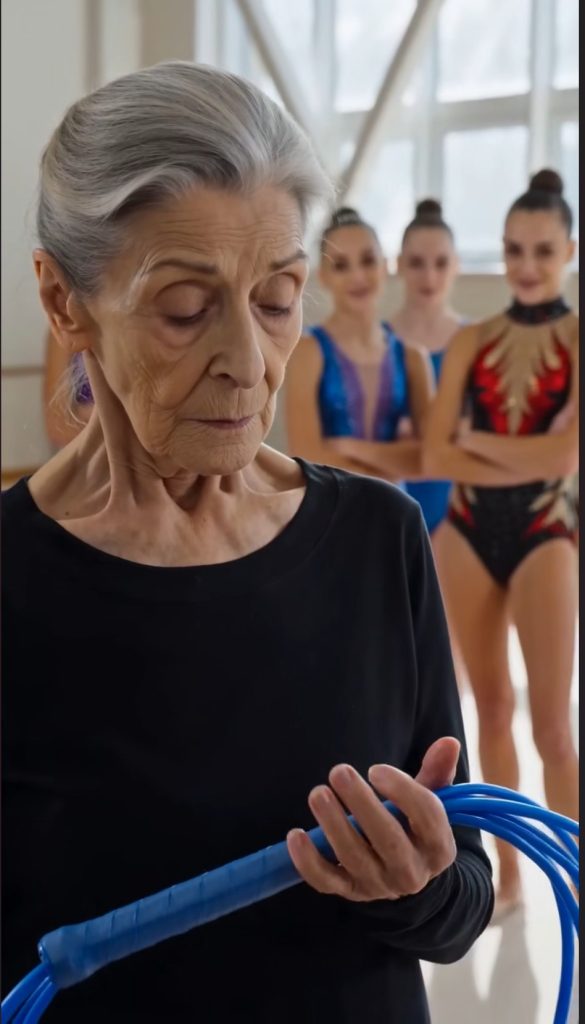
I was standing beside my students, dressed in black, when she first entered our gymnastics hall. I remember smiling at the sight of her. Now, whenever I think about that afternoon, I wish I could return to those first five minutes and change everything.
My name is Victoria. I’m 31, and I’ve spent seven years coaching rhythmic gymnastics. Our team was considered one of the finest in the city, and I had worked hard to earn that reputation.
My students were fourteen to seventeen years old, talented girls who competed regularly in glittering leotards covered with rhinestones. Their movements were precise, their routines elegant, their confidence unmistakable.
We had every reason to be proud.
But somewhere along the way, pride had turned into something uglier.
Practice had barely begun when the door opened.
An elderly woman stepped inside, slender and gray-haired, her hair tied neatly behind her head. She wore plain black training clothes and carried no gym bag.
“Good afternoon,” she said quietly. “I’ve come for a trial lesson.”
A few girls exchanged bewildered looks.
I stared at her.
“A trial lesson?”
“Yes.”
“For rhythmic gymnastics?”
She nodded without hesitation.
Behind me, someone whispered, “Is she actually serious?”
Another girl covered her mouth, trying unsuccessfully to hide her laughter.
“She probably wouldn’t survive our warm-up.”
Soft giggles spread across the room.
The woman heard every word. I noticed the slight change in her eyes, the quiet awareness that she was being ridiculed.
But she didn’t defend herself.
She simply waited.
I was the adult in that room. The coach. The person responsible for teaching those girls respect as well as discipline.
One word from me would have stopped it.
Instead, I smiled.
“Ma’am, you understand this isn’t an ordinary dance class?”
“I understand.”
“Our routines involve extremely difficult movements.”
“I know.”
Her calmness unsettled me. There was no embarrassment in her voice, no sign that she intended to leave.
“Have you ever trained before?” I asked.
She paused, as though the question had taken her somewhere far away.
“A long time ago.”
One student burst into laughter.
“How long ago? Fifty years?”
The others joined in.
And to my shame, so did I.
The woman turned her gaze toward me. She wasn’t angry. She didn’t look wounded, either.
Somehow, that quiet look felt more uncomfortable than any accusation.
I reached for a ribbon lying nearby.
“All right,” I said, walking toward the center of the floor. “Let’s start with something simple.”
The girls moved aside.
I extended the ribbon and began turning, sending its bright length curling through the air. Two quick steps carried me forward before I launched into a demanding split leap, the ribbon sweeping in a broad circle above my head.
I landed cleanly.
Applause erupted behind me.
I turned toward our visitor.
“Your turn,” I said. “Repeat that, if you can.”
Silence settled over the hall.
I expected an excuse. Perhaps she would mention her knees, acknowledge the difficulty, or politely withdraw.
Instead, she walked toward me.
Slowly. Without a word.
“She’s going to fall,” someone whispered.
I held out the ribbon stick.
Her fingers closed around it.
For a moment, she remained perfectly still.
Then she raised her eyes toward the enormous mirror.
Something shifted in her face. The quiet elderly stranger vanished behind an expression I couldn’t identify.
And as I watched her adjust her grip on the ribbon, I suddenly found myself wondering what those hands remembered.
She lifted her arm.
What happened in the next few seconds would change the way I remembered that afternoon forever. 👇
The ribbon rose in a smooth, effortless arc.
Not quickly. Not dramatically. Just a single, perfect circle, suspended in the bright afternoon light.
Then another followed.
And another.
The soft swishing of satin against air became the only sound in the gymnasium.
Her shoulders relaxed. Her spine straightened. And the woman we had dismissed as too old to belong began moving with an elegance I had spent years trying to teach.
She took three measured steps, pivoted, and sent the ribbon spiraling above her head.
There was no wasted movement.
No uncertainty.
When she lifted one leg into a controlled balance, her supporting knee trembled slightly. She adjusted, lowered her foot, and continued without pretending her body was younger than it was.
I watched, unable to speak.
She wasn’t performing my exact leap. At seventy-eight, attempting that explosive movement would have been dangerous.
Instead, she transformed my combination into something more difficult to teach than flexibility.
Control.
She released the ribbon into the air, turned beneath it, and caught the stick precisely as the final spiral descended.
The ribbon settled against the floor.
Nobody applauded.
The girls stood motionless, their earlier smiles gone.
The elderly woman breathed deeply, pressing one hand briefly against her ribs.
Then she looked at me.
“Would that be acceptable for a trial lesson?”
My throat tightened.
“Who are you?”
She lowered her eyes toward the ribbon.
“My name is Elena.”
The name meant nothing to me.
But one of my oldest students, Sophie, suddenly stepped closer.
“Elena Morozova?”
The woman turned.
Sophie swallowed.
“My grandmother has an old gymnastics book. There’s a photograph of someone with your name.”
Elena’s expression softened.
“That was a long time ago.”
Sophie looked at me.
“Coach, I think she was a national champion.”
For several seconds, I couldn’t move.
Then Elena quietly corrected her.
“Twice. But that isn’t why I came.”
The words unsettled me more than her performance.
“Then why did you come?”
She looked around the hall, at the mirrors, the polished floor, the ribbons hanging neatly beside the training equipment.
“Because I wanted to know whether there was still a place for me here.”
Something inside me sank.
Before I could answer, Sophie spoke.
“Why didn’t you tell us who you were?”
Elena smiled faintly.
“Would it have changed the way you treated me?”
Nobody answered.
She looked directly at me.
“That’s what I wanted to know.”
The silence was unbearable.
I realized then that the most humiliating moment of my career had nothing to do with being outperformed by a seventy-eight-year-old woman.
It was knowing she had walked into my classroom with dignity, and I had answered her with cruelty.
“I’m sorry,” I whispered.
Elena studied me.
“Which part?”
I blinked.
“The laughing?”
She waited.
“The challenge?”
Still nothing.
Then I understood.
“I’m sorry I made you prove you deserved to stand here.”
Her eyes glistened, but she didn’t look away.
“That’s closer.”
Behind me, a chair scraped against the floor.
Sophie was crying.
“I said you would fall,” she confessed. “I didn’t think you heard.”
“I heard.”
“I’m sorry.”
Elena reached toward her, then stopped, allowing Sophie to decide whether to come closer.
The girl crossed the distance herself.
Elena gently squeezed her hand.
“Remember how this feels,” she said. “Not because I want you to suffer. Because someday, someone else will be standing where I stood.”
I thought that would be the end of it.
It wasn’t.
At that moment, our academy director appeared in the doorway.
“Why has practice stopped?”
Nobody moved.
His eyes fell on Elena.
Then on the ribbon.
“Victoria?”
I opened my mouth, but Sophie stepped forward first.
“Coach challenged her because we were laughing at her.”
The director’s face hardened.
He looked at me.
“Is that true?”
I could have softened the story. Explained that I hadn’t meant harm, that the girls were young, that I had only been surprised.
Instead, I remembered Elena’s question.
Would it have changed the way you treated me?
“Yes,” I answered.
The director asked the students to continue their stretches and called me into his office.
Through the glass, I could see Elena sitting on a bench, carefully winding the ribbon around its stick.
The director closed the door.
“You challenged a seventy-eight-year-old visitor to perform a split leap?”
“Yes.”
“Knowing she could have been seriously injured?”
I nodded.
He sat down slowly.
“Seven years, Victoria. Seven years of building trust with these families.”
“I know.”
“No. I don’t think you do.”
His voice remained quiet.
“These girls watch you. They learn from the way you treat people when you think those people have nothing to offer you.”
I stared at the floor.
Then came the question I had dreaded.
“Can I trust you to lead them tomorrow?”
I couldn’t answer.
He folded his hands.
“Until we review what happened, you’re suspended from coaching.”
I had imagined losing competitions. Losing talented students. Losing the reputation I had spent my adult life building.
I had never imagined losing it because of something as small and deliberate as a smile.
When I returned to the hall, the girls were packing their bags.
Nobody asked why my eyes were red.
Elena stood beside the mirror.
“I’m leaving,” she said.
“Please don’t.”
She paused.
“I don’t mean you have to forgive me,” I continued. “But you came here for a lesson. You should have one.”
She looked toward the girls.
“Perhaps another day.”
Then she walked out.
I didn’t follow her.
For the first time that afternoon, I understood that I had no right to demand anything more from her.
The academy’s review took place the following week.
The girls gave their accounts. I gave mine.
There was no attempt to hide what had happened.
The decision was final: I would not return as head coach of the competitive team. The director offered me the possibility of applying for a supervised junior position in the future, but only after completing additional training.
I signed the papers without arguing.
Sophie found me outside the office afterward.
“Are you leaving because of us?”
“No,” I told her. “I’m leaving because of what I chose to do.”
She stared at her shoes.
“I laughed too.”
“I know.”
“Does that make me a bad person?”
I bent slightly so we were looking at each other.
“It means you did something unkind. What matters now is what you do when you see someone being treated that way again.”
She wiped her eyes.
“And what about you?”
That question stayed with me.
Three weeks later, I returned to the academy, not to teach, but to attend an open practice.
A familiar figure stood near the center of the floor.
Elena.
She was working with Sophie, showing her how to control the ribbon through her fingertips rather than forcing the movement through her shoulders.
The girls watched intently.
There were no jokes.
No whispers.
Just concentration.
Elena noticed me in the doorway.
After practice, she approached.
“I wondered whether you’d come back.”
“I wasn’t sure I should.”
“Why?”
I looked at the polished floor.
“Because I thought you might not want to see me.”
She considered that.
“I didn’t come here to ruin your life, Victoria.”
“I know.”
“I came because I missed gymnastics.”
Her voice softened.
“My husband died three years ago. For a long time, I stopped doing things that reminded me of who I used to be.”
I looked up.
She continued.
“He always told me I was happiest with a ribbon in my hand. Last month, I found my old equipment while clearing a cupboard.”
She smiled at the memory.
“The ribbon was ruined. But holding the stick again made me realize how much of myself I’d put away.”
I didn’t interrupt.
“I saw your academy online. Young athletes. Good facilities. Beautiful performances. I thought perhaps I could come here, try a few movements, and feel part of something again.”
Her gaze moved toward the training floor.
“I never intended to embarrass anyone.”
Tears blurred my vision.
“And I made you feel unwelcome.”
“Yes,” she said gently. “You did.”
There was no cruelty in the answer.
That made it harder to hear.
“I’m sorry, Elena.”
“I believe you.”
I covered my mouth, struggling to steady my breathing.
“But believing you doesn’t mean pretending it didn’t happen,” she added.
“I understand.”
She reached for a chair and sat down.
“Then sit with me.”
We talked for nearly an hour.
About the girls. About her years of competition. About how frightening it can be to return to something you love when your body no longer responds the way it once did.
Eventually, she asked me something unexpected.
“Do you remember why you started coaching?”
“Because I loved gymnastics.”
“No. Why did you want to teach it?”
I thought for a long moment.
“Because when I was young, someone believed in me before I believed in myself.”
Elena nodded.
“Then perhaps you haven’t lost everything. Perhaps you’ve remembered what you were supposed to protect.”
Over the following months, Elena became a regular presence at the academy.
The director invited her to lead gentle technique workshops, and she agreed on the condition that the classes would be open to beginners, including older adults.
Sophie volunteered to help.
So did two other girls who had laughed that first afternoon.
I completed my training and eventually returned, not as head coach, but as an assistant in the beginner program.
Nobody pretended that things were exactly as before.
They weren’t.
And that was good.
One afternoon, nearly six months after Elena had first walked through our doors, the director asked us to gather in the hall.
Elena stood beside a small wooden box.
Inside was an old black-and-white photograph.
A young gymnast stood in a simple leotard, holding a ribbon above her head.
Beside her stood a smiling woman in a coaching uniform.
Elena handed me the photograph.
“Look at the woman beside me.”
My hands went cold.
I knew that face.
Older in my memory, perhaps, but unmistakable.
It was my first gymnastics coach.
The woman who had taught me when I was six.
The woman who had made me believe I belonged.
“She coached you?” I whispered.
Elena nodded.
“Before she taught you, she taught me.”
I stared at the photograph.
“She used to tell me something,” Elena continued. “That the most important thing a coach can give a student isn’t a medal.”
My voice broke as I finished the sentence.
“It’s the courage to try.”
Elena smiled through her tears.
“Yes.”
For a moment, the years between us seemed to disappear.
I looked at the woman in the photograph, realizing that the kindness I had received as a child had once passed through Elena’s life too.
And somehow, I had almost broken that chain.
Elena took my hand.
“Your coach was proud of you, Victoria. She told me about the little girl who kept practicing even when she couldn’t get a movement right.”
I began to cry.
“I wish she could have seen what I did that day.”
Elena squeezed my fingers.
“Perhaps the important thing is what she would see you doing now.”
Across the hall, Sophie was helping an elderly beginner adjust her ribbon.
The woman made a mistake, tangling the satin around her wrist.
Sophie laughed softly.
Not at her.
With her.
“That’s all right,” she said, patiently untangling it. “We’ll try together.”
Elena and I watched in silence.
Outside, late-afternoon sunlight spread across the windows, filling the gymnasium with a warm golden glow.
Elena picked up a ribbon and handed me the other end.
“Shall we?”
I smiled through my tears.
Together, we walked onto the floor.
There were no judges waiting.
No medals to win.
No applause to earn.
Just an old woman, a younger coach still learning what kindness meant, and a room full of people discovering that belonging had never been something anyone should have to prove.
And when Elena lifted her ribbon, I lifted mine beside her.
This time, nobody was laughing.
We were all smiling.