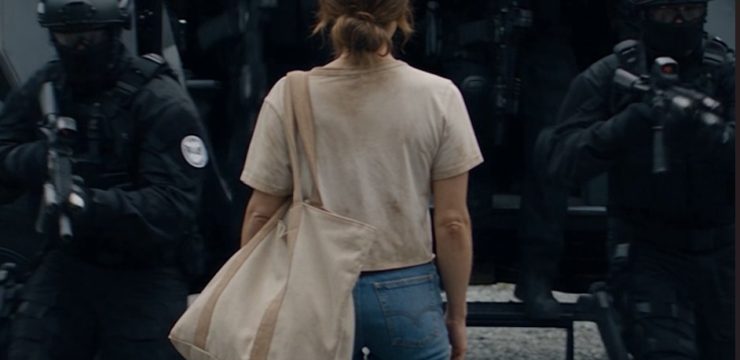
The church was picture-perfect that afternoon. White roses lined every pew. Candles glowed softly against the stained glass windows. Guests whispered with excitement, fans fluttering in gloved hands, dabbing at happy tears before the ceremony had even begun. Everything looked exactly the way a wedding should look — elegant, hopeful, and full of promise.
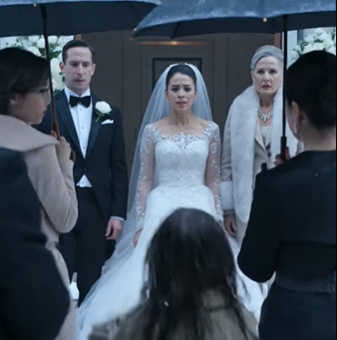
Then a little girl walked through the front doors, and the whole world stopped.
She was small, maybe seven or eight years old, with dark eyes too serious for her age and hands that trembled slightly as she moved through the crowd. She didn’t belong to any of the seated families. No one recognized her. But she walked with purpose — straight down the aisle, straight toward the altar — and she did not stop until she was standing directly in front of the bride.
The music faded to silence. Every guest turned to stare.
The little girl looked up at the bride with those old, knowing eyes and said the words that would unravel everything.
The bride’s eyes immediately cut to her future mother-in-law, who was seated in the front row in a pale blue dress, pearls at her throat, the picture of a gracious and proper woman. But the moment their eyes met, something shifted. The older woman’s expression collapsed — not into confusion, not into surprise, but into something far more damning.
It was guilt. Raw, unmistakable, long-buried guilt.
The child explained, as calmly as a child possibly could, that the woman who had raised her had worked many years ago at a private maternity clinic. A quiet place. A discreet place. The kind of place where wealthy families sometimes made arrangements that money could erase and paperwork could hide. Before that woman passed away, she had called the little girl close and whispered the truth she had carried for years.
The baby had never died.
The family — the groom’s family — had arranged for the newborn to disappear. A daughter would have divided the inheritance. A son would keep it whole. And so, rather than welcome a child into the world, they had chosen to bury the truth instead. They had paid for silence. They had paid for absence. They had paid to pretend a living, breathing little girl simply did not exist.
The bride stood at the altar and felt something inside her go completely still.
She slowly looked down at the diamond ring on her finger — the ring that had come with a proposal, with champagne, with promises of forever. She slid it off without a word.
“You knew,” she said, her voice low but carrying clearly across the silent church. She was looking directly at her future mother-in-law. “You erased a child.”
The older woman said nothing. There was nothing left to say.
The groom stood beside the altar, frozen. He was a good-looking man, successful, admired by everyone who knew him. He had grown up in a beautiful home, attended the finest schools, inherited a life that seemed built on solid ground. But standing there in his wedding suit, he began to understand that everything — every advantage, every comfort, every privilege he had ever known — had been purchased at the cost of a child who deserved to exist.
His face crumpled. Not with anger. Not with denial. With the particular devastation of a man who has just discovered that the foundation of his entire life was a crime.
The bride did not look at him for long. She turned away from the altar, lowered herself gently to one knee, and took the little girl’s freezing hands into both of hers. The child looked startled — she had not expected tenderness. She had expected to be turned away, the way she had probably been turned away before.
“No child should ever be made to disappear for money,” the bride said softly, directly to her. “No child.”
She held those small hands for a moment longer, then rose to her feet.
She turned to face the packed church — the stunned relatives, the speechless friends, the guests who had come expecting champagne and dancing and a beautiful beginning — and she spoke clearly.
“There will be no wedding today.”
She walked back down the aisle the same way she had walked up it, except this time her hands were empty and her step was lighter than anyone expected. The doors opened. The cold air rushed in. Outside, snow had begun to fall in soft, heavy sheets — the kind of snow that usually looks like a blessing, like something out of a movie, like grace made visible.
But that afternoon, the snow looked different. It looked merciless. Cold and indifferent, the way a secret feels when it has been kept too long. The way silence feels when it has been used as a weapon.
That day, no marriage began. No vows were exchanged. No rings were placed.
But something else happened — something quieter and far more significant.
A little girl who had spent her entire life being someone’s hidden mistake finally stepped into the light. She was seen. She was believed. She was held, however briefly, by someone who did not flinch from the truth of what she represented.
Some secrets, when they finally surface, do not destroy everything. Sometimes they destroy only what deserved to be destroyed — and leave behind something real.
That child deserved to be real.
And on that cold, snow-covered afternoon, for the first time in her life, she was.