She looked at the photograph for a long time before she looked up.
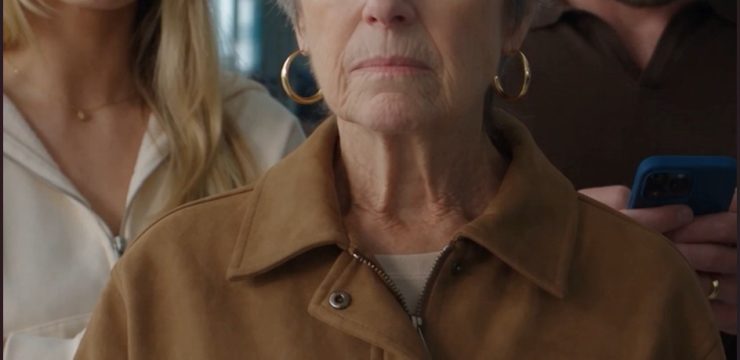
Her grandmother’s hands were trembling. Not from age — though age had certainly earned those tremors — but from something far deeper. Something that had been buried for decades and was now clawing its way to the surface at thirty thousand feet in the air.
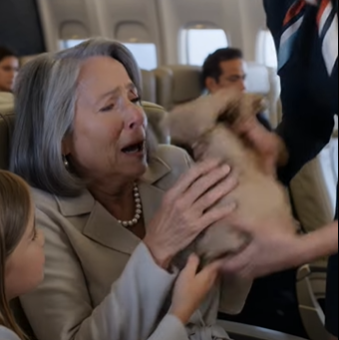
The flight attendant had tried to take the bag. Standard protocol. You can’t have loose items in the overhead compartment during turbulence. Simple rules for a simple world.
But nothing about this moment was simple.
The grandmother reached out with shaking fingers, and this time, the flight attendant quietly handed the bag back. No explanation needed. Some silences carry their own authority.
Inside the worn canvas bag were three things: a child’s bracelet with a tiny engraved name, a sealed letter written in a hand that would never write again, and a photograph of a man who had no idea he was about to have his entire life rewritten.
The bracelet said Elena.
That was the mother’s name. The woman who had packed this bag, written this letter, and then ran out of time before she could deliver it herself.
The little girl sitting in the middle seat looked up at her grandmother with wide, frightened eyes. She was old enough to understand that something was terribly wrong. She was young enough to still believe that adults could fix whatever it was.
“Open the letter,” her grandmother whispered.
The girl broke the seal with careful fingers.
One page. Her mother’s handwriting — neat and deliberate, as though she had practiced this moment a hundred times in her mind before putting pen to paper.
“If we are on that plane, it means I ran out of time. The man flying it is your grandfather. He never abandoned me. He was told I died after birth.”
The cabin suddenly felt too small to hold everything it was being asked to hold.
The flight attendant turned away and pressed her hand over her mouth.
The grandmother made a sound that had no name — the kind of sound that lives somewhere between grief and relief and fury all tangled together after years of silence.
Because the truth that letter carried was monstrous in its simplicity. For years, an entire family had lived inside a lie constructed by one cruel, calculating man — the mother’s stepfather — who had decided that a young pilot’s future income mattered more than his right to know his own child existed. He had told the pilot that the baby died. He had collected money. He had moved on, the way selfish people always do, leaving wreckage behind them that other people spend lifetimes trying to survive.
The pilot had grieved a daughter he never held.
The daughter had grown up believing her father had walked away.
And now that daughter was gone, and the only ones left to carry her final words were a heartbroken old woman and a little girl reading a letter on an airplane, somewhere high above the clouds.
The girl’s hands shook as she reached the next line.
“He does not know he has a daughter. He does not know he has a granddaughter. Please don’t let me disappear before he hears my name.”
Tears made everything blur and swim.
The grandmother stood up too quickly, steadied herself against the seat back. The flight attendant moved toward her instinctively, then stopped. Because she had worked enough flights to recognize a medical emergency, and she had worked enough years as a human being to recognize that this was something else entirely. This was a lifetime of distance collapsing into a single aisle of an airplane.
She stepped back and let the old woman breathe.
Then the intercom clicked on.
That familiar voice — calm, professional, unhurried — filled the cabin from front to back.
“Ladies and gentlemen, we’ll be beginning our descent shortly. We should be on the ground in about twenty minutes. On behalf of the entire crew, thank you for flying with us today.”
The grandmother sank back into her seat. Her shoulders shook. The little girl pressed the letter to her chest like she was trying to keep her mother’s words from escaping.
Then she looked at the flight attendant with the kind of directness that only children and the very old seem to manage, and she asked the one question that stopped the world:
“Does he still wear a silver ring with a blue stone?”
The flight attendant went completely still.
Because she had worked alongside this pilot for six years. She had seen that ring on his hand every single morning. She had wondered about it once, early on, and he had smiled the quietest, saddest smile she had ever seen on a person’s face and said only that it belonged to someone he had lost a long time ago.
She had never asked again.
And there was something else. Something she had noticed once when she stepped into the cockpit to deliver a weather update and caught a glimpse of the small faded photograph tucked just inside the instrument panel — not regulation, not protocol, but never once questioned by anyone on the crew.
A photograph of a little girl.
A little girl he had kept close to him for decades.
A little girl he had been told never lived.
The flight attendant looked at the child in seat 14B — at her dark eyes, her narrow hands, the particular way she held her chin — and felt something in her chest shift completely.
Twenty minutes to landing.
Twenty minutes to change a man’s entire understanding of his own life.
She walked slowly toward the cockpit door, knocked twice, and waited.
Some doors, once opened, cannot ever be closed again.