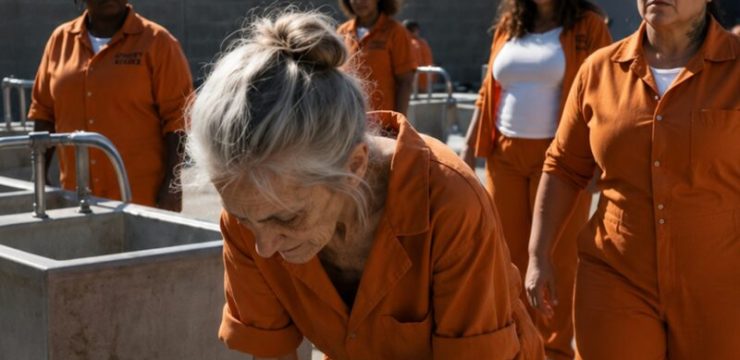
Nobody paid much attention when the bus rolled through the iron gates that gray, drizzly morning. Prison intake was routine — paperwork, photographs, a change of clothes, and then a long walk down a corridor that smelled like bleach and old regret. The female guards moved the new arrivals along efficiently, their voices flat and practiced, their eyes seeing nothing they hadn’t seen a hundred times before.

But among the women shuffling single-file into the housing block that morning, one stood apart — though not in any way that screamed danger. She was small. Slender. Her dark hair was still damp from the rain, plastered against her pale neck. Her eyes were calm in a way that felt almost unsettling, fixed somewhere just below the surface of the floor, as though she were reading something no one else could see. She didn’t introduce herself. She didn’t look around nervously like the other newcomers. She simply moved through the chaos of intake like someone who had made peace with something most people never have to face at all.
Her name was Emily. And within twenty-four hours, nobody in that prison would ever forget it.
The housing block had its own ecosystem — its own laws, its own hierarchy, and its own brutal way of establishing where each new arrival stood. The women who had been there for years had long since divided themselves into factions held together by fear, loyalty, and the quiet, grinding need for power over something when everything else had been taken away. At the top of that hierarchy stood Brenda.
Brenda was tall, broad-shouldered, and covered in ink that told stories she never bothered to explain. She had the kind of presence that made a room go quieter when she entered it, and she had cultivated that power carefully over years of calculated intimidation. When she first laid eyes on Emily — this small, silent, rain-soaked woman who barely looked up — something shifted behind her eyes. An opportunity.
The whispers started almost immediately.
Look at the quiet one. She won’t last a week. Easy target.
The words floated through the block like smoke, and the women who said them weren’t entirely wrong to say them. Prison breaks people in ways that are difficult to describe from the outside. The strong prey on the vulnerable. The vulnerable learn to become strong, or they disappear into themselves. It is a system as old as confinement itself.
Brenda sauntered over slowly, deliberately, the way a person does when they want everyone watching to know they are entirely in control. She looked Emily up and down with an expression layered in contempt and amusement.
“What’s your name?” she asked.
“Emily,” came the quiet reply.
Brenda smiled. “Forget that. Around here, you’ll be called whatever I decide.”
Laughter erupted from every corner of the room.
What followed was the kind of orchestrated cruelty that prisons — and certain corners of every human institution — tend to produce. A shove in the hallway. A shoulder deliberately thrown into Emily’s path. On the way to the showers, someone stepped on her heel. Someone else drove an elbow into her ribs. And then, on the slick tile floor, a leg appeared from nowhere. Emily went down hard, crashing into a puddle of standing water as laughter bounced off every wall.
“Well, at least she’s had a shower now!”
Brenda stood over her, expression unreadable.
“Remember one rule,” she said quietly. “Nobody helps the weak in here.”
She grabbed Emily by the collar and pushed her toward the group. Several inmates closed in from every direction, blocking every possible exit. One shoved her hard in the chest. Another drew back her fist and swung — fully expecting the frightened little newcomer to crumple.
What happened next was something none of them had any framework to process.
Emily moved.
Not frantically. Not desperately. She moved the way water moves — efficiently, without wasted effort, as though she had rehearsed this particular moment a thousand times. She slipped the punch, caught the attacker’s arm at the wrist and elbow, and in one clean, controlled motion brought her down hard onto the wet tile floor. The sound was loud. The silence that followed was louder.
Nobody moved.
Brenda’s jaw tightened. “Lucky shot,” she said. “Try again.”
But this time, Brenda came herself. And what she met was not luck. Emily read the approach, shifted her weight at the last possible second, planted a firm palm strike into Brenda’s midsection, and swept her legs cleanly out from beneath her. Two hundred pounds of feared, tattooed dominance hit the floor like a felled tree.
The room could not breathe.
“All of you — together! Now!” Brenda shouted from the ground, her voice cracking with something she hadn’t felt in years.
They came. And Emily handled them the way a master handles chaos — not by meeting it with equal force, but by understanding it completely. She blocked, redirected, stepped aside. One woman’s arm was controlled and turned against her momentum. Another slipped reaching for Emily’s back. A third simply found herself on the floor without fully understanding the sequence of events that had placed her there.
When it was over, Emily stood alone in the center of the room. She was not breathing hard. She was not smiling. She simply looked at Brenda, who was pulling herself slowly off the ground, cradling her ribs with an expression that — for perhaps the first time in years — held not a single trace of mockery.
“Who are you?” Brenda asked. Her voice was different now. Careful.
Emily met her eyes without flinching.
“Someone who never starts a fight,” she said quietly. “But always finishes it.”
No one came near her again. By evening, her name had traveled to every corner of that prison — whispered with something between fear and reluctant awe. Nobody knew her story. Nobody knew what had brought her there, or what she had lived through before those gates closed behind her.
All they knew was this: on her very first day, Emily had walked into the most dangerous room in the building — and she had walked out of it alone, standing tall, and completely unbroken.
Sometimes, the quietest person in the room is the one carrying the most strength. And sometimes, the women the world underestimates most are the ones who have simply learned — through fire and loss and years of silent endurance — exactly who they are.
Emily already knew. She had known for a long time.